@lunatika_shd igual que vos compro hace 10+ anios, pero siquiera existe todavia sitios para comprar en china que no vengan por courier (osea puerta a puerta) ?. las ultimas veces que intente comprar componentes en aliexpress ya me cobraban el impuesto onda amazon / temu en modo courier.
@YOY_Arg abri la cuenta, pero no me deja depositar ni de manera directa ni por transferencia, me rechaza todas las transferencias hacia YOY. el wsp nunca me contestaron, el bot no sive, llame por telefono y me derivaron a otro telefono de atencion tecnica que nunca contesto. asi funciona?
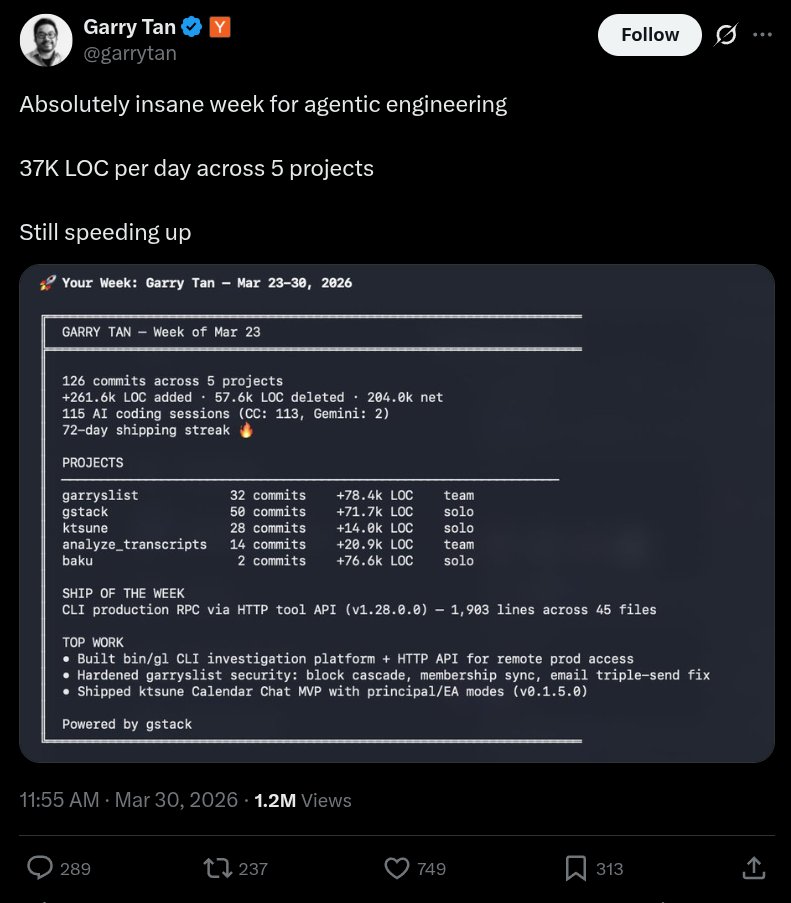
so... I audited Garry's website after he bragged about 37K LOC/day and a 72-day shipping streak.
here's what 78,400 lines of AI slop code actually looks like in production.
a single homepage load of https://t.co/TqaEZsF44N downloads 6.42 MB across 169 requests.
for a newsletter-blog-thingy.
1/9🧵
Today is the first ipsilon developments devlog, documenting the release of the github devlog plus some other news! https://t.co/QiG1W4sEbf
#maker#buildinpublic#devlog#vlog
someone connected LIVING BRAIN CELLS to an LLM
Cortical Labs grew 200,000 human neurons in a lab and kept them alive on a silicon chip, they taught the neurons to play Pong, then DOOM
now someone wired them into a LLM... real brain cells firing electrical impulses to choose every token the AI generates
you can see which channels were stimulated, the feedback from the neurons in choosing that letter or word
me pregunto la estructura de costos del que me vende el pan lactal de 600gr de salvado "crystal" (sin marca) a $1300 no se como hace (o como estos roban, 1 de 2).
The scariest number here: 3.61% of CPUs in one large-scale study were found to cause silent data corruptions. Not “a few bad chips.” Nearly 4 out of every 100 processors doing math wrong, silently, with no error log.
Google coined the term “mercurial cores” in 2021 after their production teams kept blaming software for data corruption. They’d debug for weeks, find nothing wrong with the code, swap the machine, problem gone. The actual cause: manufacturing defects at sub-7nm that pass every factory test, then degrade unpredictably months or years after deployment.
Facebook confirmed the same thing independently. Hundreds of affected CPUs across hundreds of thousands of machines. The defect doesn’t crash your system. It just gives you 5 instead of 6 when you multiply 2x3, under specific microarchitectural conditions, with zero indication anything went wrong.
Now think about what this means for AI training. A single corrupted GPU or CPU in a distributed training cluster doesn’t just produce one bad output. It feeds corrupted gradients into a synchronization step that gets averaged across every accelerator in the cluster. One bad chip can silently poison an entire training run. NVIDIA published a whitepaper on exactly this problem. Loss spikes during LLM training that nobody could explain traced back to silent hardware corruption.
The part that keeps infrastructure engineers up at night: traditional defenses don’t work. ECC memory can’t catch this because the corruption happens during computation, not storage. Checksums like CRC heavily use vector operations, which are themselves one of the most vulnerable instruction types. The tools designed to detect corruption are running on the same flawed silicon.
Google’s current detection method? Roughly half human-driven, half automated. And of the machines humans flag as suspicious, only about 50% are actually confirmed mercurial on deeper investigation. We’re debugging trillion-parameter models on hardware where we can’t reliably tell which chips are lying to us.
Moore’s Law gave us more transistors. It also gave us transistors we can’t fully verify.
After shipping hardware at Intel, Xiaomi, Lenovo, Amazon and ByteDance, I joined a robotics startup as COO. Put in a year of my life, my savings, and my family's patience.
The company died. These 6 lessons cost me a lot. Maybe they'll save you something.
Non-issues that people have brought up in regards to Anthropic's C compiler:
1. It uses GNU as and GNU ld. Irrelevant, GCC also uses GNU as and GNU ld! And respectable software like CompCert also uses GNU as and GNU ld (even worse, it calls those through GCC!).
2. It can't compile 16-bit x86 code. It's not feature complete, that's fine.
3. Code generation quality is bad. Again, that's fine.
Actual issues that people should bring up in regards to Anthropic's C compiler:
1. It doesn't do type checking. TBH, this makes it borderline fraudulent to call it a "C compiler". Now, I would be willing to brush this under "incomplete" moniker if it weren't for the next point.
2. The code is huge, fragile and resists any further modification. The article explains this. The LLMs can't add new features to it. It's the embodiment of technical debt. What exactly are you supposed to do with this artefact? It's also a disproportionately huge amount of code compared to the functionality. Code is debt.
3. I see 7 people named in the Anthropic article (plus a vague reference to "many other people"), this is not the set and forget type of thing they try to imply. People have been working full time to try to get this to work even in its current (broken) state. And they describe a feedback loop put together with spit and duct tape. Good luck scaling and maintainig this!
4. Compiling Linux is impressive but it fails to compile "Hello, World!", c'mon man. This just shows that the type of errors you get from LLMs artefact are very different then the errors people make even in the presence of specs and exhaustive tests suites. This is a hidden cost that people have no idea about its impact.
5. It uses GCC as an oracle. This won't work for a new ISA (or for a new language), but let's ignore that. The reality is that it's perfectly fine to use another compiler as an oracle and you would do it yourself if you'd write a compiler by hand. However, it is misleading because in real life, for new engineering problems you simply do not have this luxury. Not only you don't have an oracle, you don't have certified tests. Usually you don't even have a spec!
Installing the idea that all software development can be done in an unattended cycle of instructions -> code -> test -> review by a model and a set of pre-defined instructions, is the most dangerous paradigm ever, worse in the hands of decision makers with no SWE background.