”Plans are like maps. They animate people. And this is the most crucial thing they do. When people actually do things, they generate outcomes that help them discover what needs to be explained, and what should be done next. “ 2/3
The @TTChelps the only transit service on the planet that fails to understand it has one job. Get people to their destinations safely.
4 short turned cars. You owe me a refund.
I have been very lucky to have seen the magic 🪄 @jrodgers creates from StartupCampWaterloo to VeloCity to CDL to Volta to Eigenspace to Builders Club. And all the fun side quests along the way. The magic seems to be believing in people.
Very proud to be your friend.
It feels pretty special to be included on the list of these great Canadians in @BetaKit's 2nd annual Most Ambitious. https://t.co/qME4xlgOgm
I love that @tron made me a floating head... but also included probably the single best bit of feedback from a long standing member.
the pope and anthropic's co-founder just stood together at the vatican to release "magnifica humanitas," the first ever catholic teaching on AI
yes, you read that right. the full ceremony was 2 hours.
here's the most interesting things for you to know:
1. this is the biggest religious response to AI in history. popes only put out a handful of these huge official letters in their entire time as pope. the fact that one of them is about AI tells you how seriously the church is taking what's coming.
2. small detail with massive meaning: this pope picked the name "leo XIV" on purpose. the last pope named leo was leo XIII back in 1891, and his most famous act was writing the church's response to the industrial revolution. picking the same name is a deliberate signal. this pope sees AI as the new industrial revolution.
3. the catholic church does this every time a major technology reshapes humanity. they wrote "rerum novarum" in 1891 to respond to the industrial revolution. when nuclear weapons threatened the world in the 1960s, they wrote "pacem in terris." climate change and runaway tech got "laudato si" in 2015. now AI gets "magnifica humanitas." they don't issue these often.
4. the pope's main line: "AI needs to be disarmed." he literally compared AI to nuclear weapons. he said the church spent decades pushing for nuclear disarmament because the technology was too dangerous to leave in the hands of a few. he says AI is now in that same category.
5. anthropic co-founder christopher olah told the pope, on stage at the vatican, that anthropic's own research team keeps finding things inside their AI models that "mirror joy, satisfaction, fear, grief, and unease."
6. olah's reframe of what AI actually is: these things are grown. they're trained on a structure roughly modeled after the human brain and fed everything humans have ever written. in his own words: "they are made from us, from our words." he said even the people building them don't fully understand what's happening inside.
7. olah publicly admitted that every AI lab, including his own, faces pressure that can conflict with doing the right thing. commercial pressure to keep shipping, competitive pressure from other labs, plus the older pressures of pride and ambition. his solution: we desperately need outside critics with no skin in the game who will tell the labs when they're failing.
8. olah says there are 3 giant questions the AI labs cannot answer alone and the world needs religion and philosophy to step in on:
> how do we make sure poor countries actually benefit from AI?
> what does human flourishing even look like in this new world?
> and what are these things we're actually building?
9. one of the sharpest lines in the whole encyclical: "the promise of automatic general prosperity often proves illusory." translation: the idea that AI will just make everyone rich on its own is a fantasy. someone has to actually design the system so the benefits get shared.
10. the pope also pulled out a 100-year-old quote: "contemporary man has not been trained to use power well." said by a theologian back in the 1920s. the whole encyclical is basically a long argument that we need to learn how to use this kind of power before it uses us.
11. the pope kept stressing that he doesn't have the technical answers. but he says the church has thousands of years of wisdom on what it means to be human, and that wisdom is exactly what's missing from how we're building AI right now. his closing line: this technology should serve "human flourishing and human dignity, not control consciences."
“This is not due to poor domestic compensation; top graduates earn well by Canadian standards. They leave because compensation and upward mobility for their skills are simply higher elsewhere.”
I don’t know who needs to hear this at TD, but compensation is the primary factor behind brain drain.
Yes, high marginal tax rates, tax complexity, etc all matter for our economy. Yes, we need substantive tax reform and simplification. But yeesh.
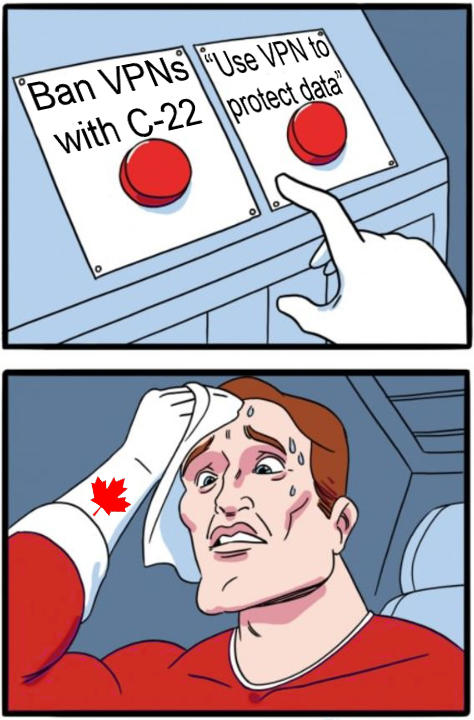
Oh this is just rich... Bill C-22 is driving VPN businesses like ours out of Canada because of the required user logging. And in the same breath you tell people to secure their data with VPNs.
I hope you bought your circus tickets folks, because the clown show is starting.
I’d expect a significant exodus of digital technology companies from Canada if C-22 passes.
This bill proposes generalized surveillance infrastructure, not law enforcement.
Incredibly concerning overreach.
It would weaken Canadian cybersecurity, lower the legal threshold for accessing Canadians’ data, and tells both Canadian and global technology companies that Canada is no longer a trusted jurisdiction for building digital infrastructure.
C-22 is looking like a huge mistake. It worries me a great deal. There is so much nonsense in there that It may well end up dealing a death blow to Canadian tech viability.
Most founders lose VC deals before the first slide. Before they even enter the room.
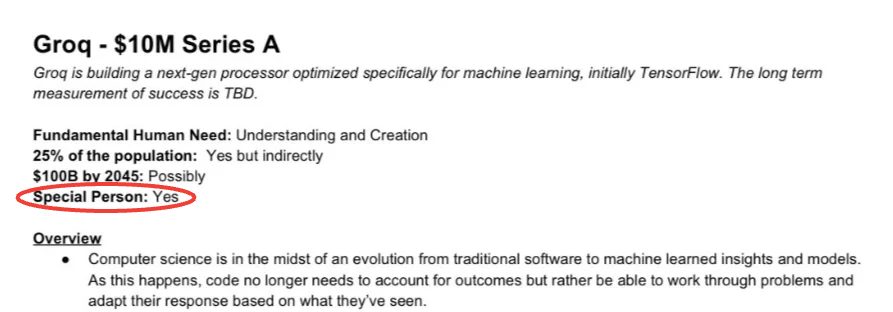
Here’s the single line from Chamath’s Groq memo that explains why.
The $10M check into Groq’s $25M valuation Series A — an investment that will return billions through the Nvidia deal.
Most people will stare at the returns.
But the most important line in the memo isn’t financial at all:
“Special Person: Yes”
I’ve been on both sides of the table.
As a founder, I pitched hundreds of VCs.
Now I’ve sat in partner-level investment committee meetings, listening to how real decisions actually get made.
And here’s something that surprised me early on:
A shocking number of IC discussions are not about product, models, or decks.
They boil down to one question:
“Is this founder special?”
I used to press investors on this.
What does special mean?
Pattern match? IQ? Grit? Vision?
No one could give a clean answer.
Not because they were hand-waving — but because “special” isn’t a checklist.
It’s a conviction.
It’s that feeling where, after seeing hundreds of founders a quarter, one person creates a pause in the room, an inevitability.
The partner leans back.
The conversation slows down.
Someone says: “I don’t know how big this gets… but this person will figure something out.”
That’s what “Special Person: Yes” really encodes.
At the earliest stages, most deals are 80–90% team.
And that judgment is formed before the spreadsheet is opened, often before the person even enters the room.
Founders should internalize this:
You don’t need to be special at everything.
But you do need to be world-class at something that matters.
Technical depth others can’t touch.
Insight from living the problem for years.
An execution engine that makes normal timelines look slow.
Or scar tissue from doing the impossible once already.
Investors see hundreds of founders a quarter.
They’re subconsciously asking:
Why you?
Why now?
Why should I bet my reputation on this person?
Sometimes the answer becomes a single quiet line in a memo.
“Special Person: Yes.”
And that one line can be worth billions.
"Yours to Discover" by internetVin
My little talk at Toronto Tech Week 2025.
This was a new format and setting for me, I was pretty nervous about it, but I thought I would just try it out and see what I would learn.
Thank you for everything so far.