The president wants our 250th to be a celebration of his monarchy. And appropriately, he’s seen pushback. But just as critical, there is also quiet resistance: Americans who keep their heads downs, ignore the noise, and just do the work of democracy. https://t.co/LhgvC8Sc9W
Nonprofits are a largely autonomous bastion of politically unrewarding, civic endeavors.
Their very existence demonstrates the limits of political power. https://t.co/ht7ht4Pusr
Asking people to look for pockets of privilege and corruption they might depend upon or participate in, or that split coalitions, makes for a much harder message. But it explains much more. 5/5
The anti-monopoly folks have ironically consolidated two distinct strands of American political thought and claimed exclusive title to them. One is hostility to artificial privileges; the other is vigilance against corruption. 1/5
Monopoly absolutely can be a source of artificial privilege and thus lead to corruption, and that is likely part of our problem today. But the American tradition recognizes many paths to these evils and does not force us to pick just one. 4/5
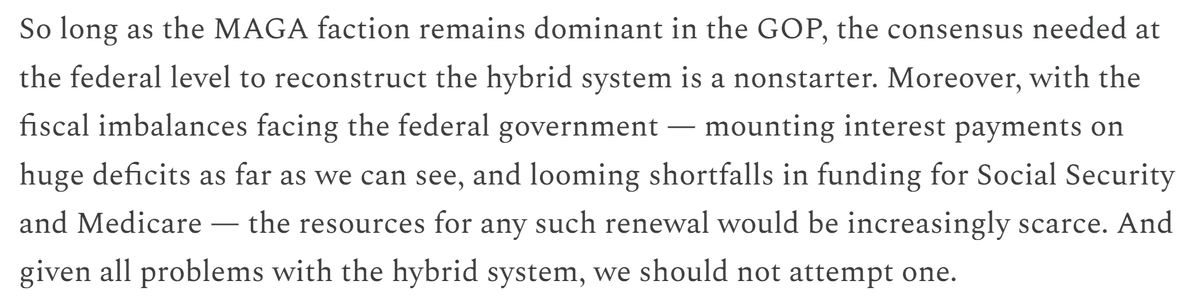
The old system of federal funding to nonprofits is not coming back from Trump’s hatchet job, says Daniel Stid of @AEI. The future, he says, looks like ... 1/2
1) a shift to state and local funding 2) whole-neighborhood solutions rather than siloed federal programs 3) effective direct service rather than activism around federal policies 4) and possibly a new legal status that clarifies what kind of animal a gov-funded nonprofit is. 2/2
While the @romanhelmetguy take on the tech CEO/public relationship has captured @pmarca's attention and set off a fun repartee with @mattyglesias, there's also a more nuanced debate going on about this :-) https://t.co/cFsUqqO8EG
New from @EbooPatel : When Alice Waters decided our food system was broken, she didn’t protest McDonald’s. She started a farm-to-table restaurant and insisted that her employees excel at the work. That launched a movement. https://t.co/6iZsNSHX3C
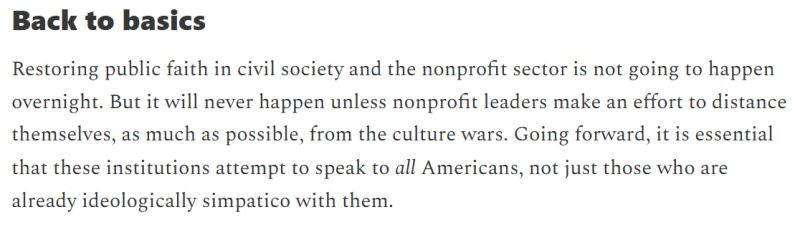
Per @Yascha_Mounk, Greg notes, "the key question for anybody who wants to preserve and protect American institutions is not 'Why do they like him?' but “Why do they hate us?'" 3/3
An unpopular president is making more power grabs like the "weaponization" fund. Civil society may feel obliged to speak out. But @GregBerman50 says nonprofits should think long and hard about the balance between their politics and their public trust. https://t.co/rpOk2i68ki 1/3
"The trap that Trump presents for nonprofit leaders is that, even as his public approval rating declines, direct opposition to the president is likely to hurt the nonprofit sector more than it hurts him." 2/3
Great to see @NiskanenCenter devoting some attention to the nonprofit sector, which is an oft-overlooked element of state capacity. In many places, government depends on NGOs to deliver essential services.
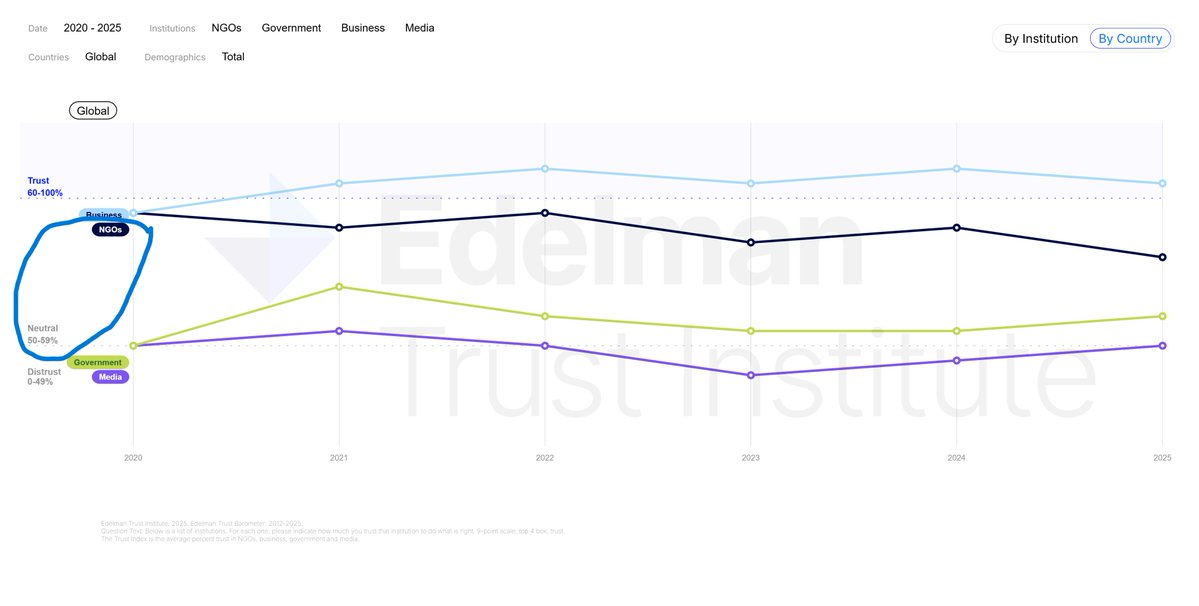
Much of the nonprofit sector is reeling from indiscriminate disruptions to the federal funds that support so many of its organizations. But the deeper problem may be here. Nonprofits at large are less trusted than business, according to @EdelmanPR.
@GregBerman50@OxUniPress@EbooPatel@AEI@seachange One survey of the cross-institutional trust decline speculated it might be broken into thirds: 1) General societal changes. 2) Specific political or cultural divides. 3) Actual experiences with the institutions in question.