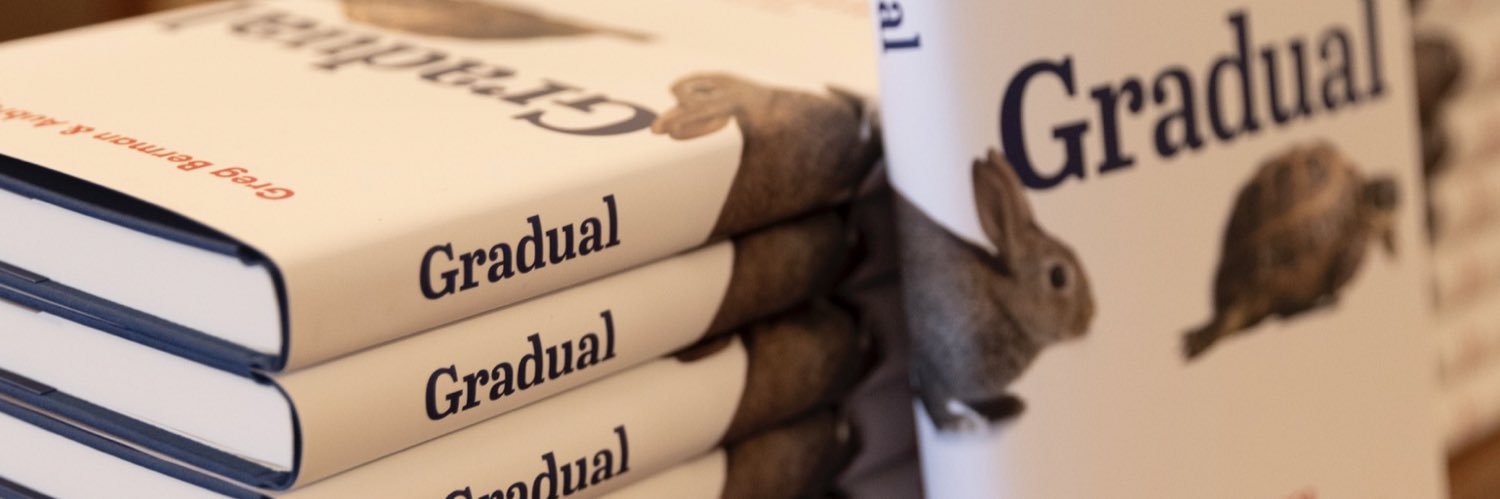
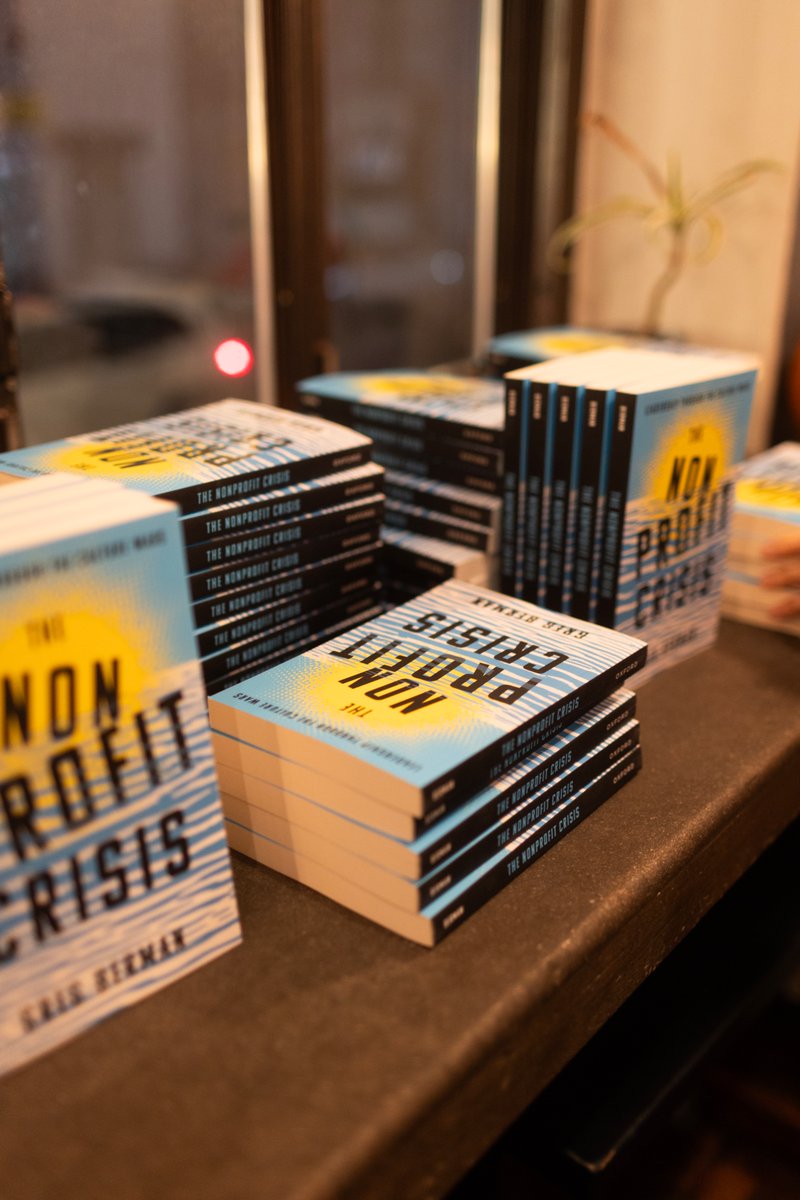
My new book from @OUPAcademic, The Nonprofit Crisis, takes a look at the vital role that nonprofits play in American society and the disturbing erosion of public trust that they have experienced in recent years. Available here: https://t.co/j8Hz68sftb
My latest piece, reflecting on the rise of wokeness and the work of @Musa_alGharbi, is currently featured on the excellent Eminent Americans Substack. Thanks to @dan_oppenheimer who also hosts one of my favorite podcasts.
https://t.co/VuR1Uv9zo5
https://t.co/AiWiEkYm2Y
@GregBerman50 begins his Thinkers Who Matter series by highlighting work of @Musa_alGharbi …
“Al-Gharbi believes that the institutions where symbolic professionals predominate—universities, nonprofits, law firms, media corporations, etc.—have changed in some important ways in recent years,” Berman writes. “Specifically, a complicated and previously obscure set of beliefs about social justice, marked by an intense focus on issues of identity, diversity, and privilege, has become part of the lingua franca in these spaces. Many have referred to this phenomenon as the ‘Great Awokening.’ …
“[T]here is little doubt that we are living through precarious times,” Berman concludes. “Politics seems to have become unmoored from the traditional work of politics—campaigns, lobbying, legislative horse-trading. By the logic of “the personal is political,” almost everything can take on a political dimension—the media we consume, the stores we frequent, the food we eat, etc.
“Nothing is immune from this line of thinking. This creates a real dilemma for institutions — the evidence suggests that politicized institutions tend to be distrusted institutions. Al-Gharbi’s ultimate message is a cautionary one: ‘When symbolic capitalists, our institutions and our outputs grow especially political, the main thing we actually achieve is backlash against ‘our’ causes, organizations and institutions.’”
My new series Thinkers Who Matter looks at writers who have particularly insightful things to say about the state of contemporary America. First up: Musa al-Gharbi, author of We Have Never Been Woke.
The Foibles of the Educated Elite https://t.co/XBwhZrZ7c6
Not mentioned here: in addition to being horrible on the court, the Nets have been bad off the court as well. My journey away from being a Nets fan: https://t.co/M8wh0BhFeE
The Brooklyn Nets have been one of the worst franchises in the league since they moved.
14 seasons in Brooklyn, two playoff series wins, and never once made it past the second round.
They went for it twice and both superteams were some of the most overrated of all time.
Pierce and Garnett cost them the picks that built the Tatum and Brown championship team. Then KD, Kyrie and Harden, one of the greatest offensive super teams on paper, won one playoff series together before everyone asked out.
And the poetic part?
The Knicks got a ring first. No shortcuts. No buying a superteam. Just a team that was built the right way.
It’s out! Anthony Braga of @UniversityofP and @DavidKennedyNYC of @Jjcommencement win the 2027 Stockholm Prize in Criminology, for the work in designing, implementing and evaluating strategies of “focused deterrence” to prevent lethal violence in criminal networks.🇺🇸🇸🇪
For @HFGuggenheim I interviewed 18 experts on polarization and political violence. I emerged more optimistic than when I started.
https://t.co/D960q5t5Ex
I’m launching a new series on my Substack looking at writers who have important things to say about the current state of American politics and intellectual discourse. https://t.co/KxDgsXxmIr
Before we vote, the Harry Frank Guggenheim Foundation revisits 18 interviews by their foundation fellow @GregBerman50's interviews with 18 thinkers engaging in civic discourse and how social trust can be restored, including an interview with FAIR Exec Dir @Monica_Y_Harris
I’m launching a new series on my Substack looking at writers who have important things to say about the current state of American politics and intellectual discourse. https://t.co/KxDgsXxmIr
https://t.co/Ys83E7uVta
“One of the traditional sources of American resilience is the strength of our civil society, with a vast network of nonprofits, foundations, book groups, religious institutions, recovery meetings, rec leagues, and other local organizations that serve as the backbone of American life,” @GregBerman50 writes in essay for @HFGuggenheim’s Polarization Project. “Civic groups play a particularly large role in the United States, owing to a weaker government-provided social safety net and (no coincidence) a stronger libertarian tradition than many other wealthy nations.
“As Alexis de Tocqueville first observed, Americans traditionally learned how to be democratic citizens by tackling problems together in association with one another,” Berman continues. “Unfortunately, the evidence suggests that participation in American civic groups has diminished over time, a phenomenon that Harvard professor Robert Putnam famously detailed in Bowling Alone: The Collapse and Revival of American Community.
“Additionally, American nonprofits have become more explicitly politicized in recent years. Funders and junior staffers have pressed nonprofits to take positions on a range of contentious issues. Many adopted language designed to signal their side in the culture wars. This slide towards politicization is understandable, but it also erodes these organizations’ ability to bridge divides; it is difficult to reduce polarization when you are an active contributor to it.”
New! This essay is my effort to summarize two years of research into American polarization. I went into the project extremely concerned that things were on the brink of falling apart. I came out feeling somewhat reassured that political violence remains a marginal phenomenon.
Ahead of next week's midterm elections, many are wondering: how polarized are Americans in 2026?
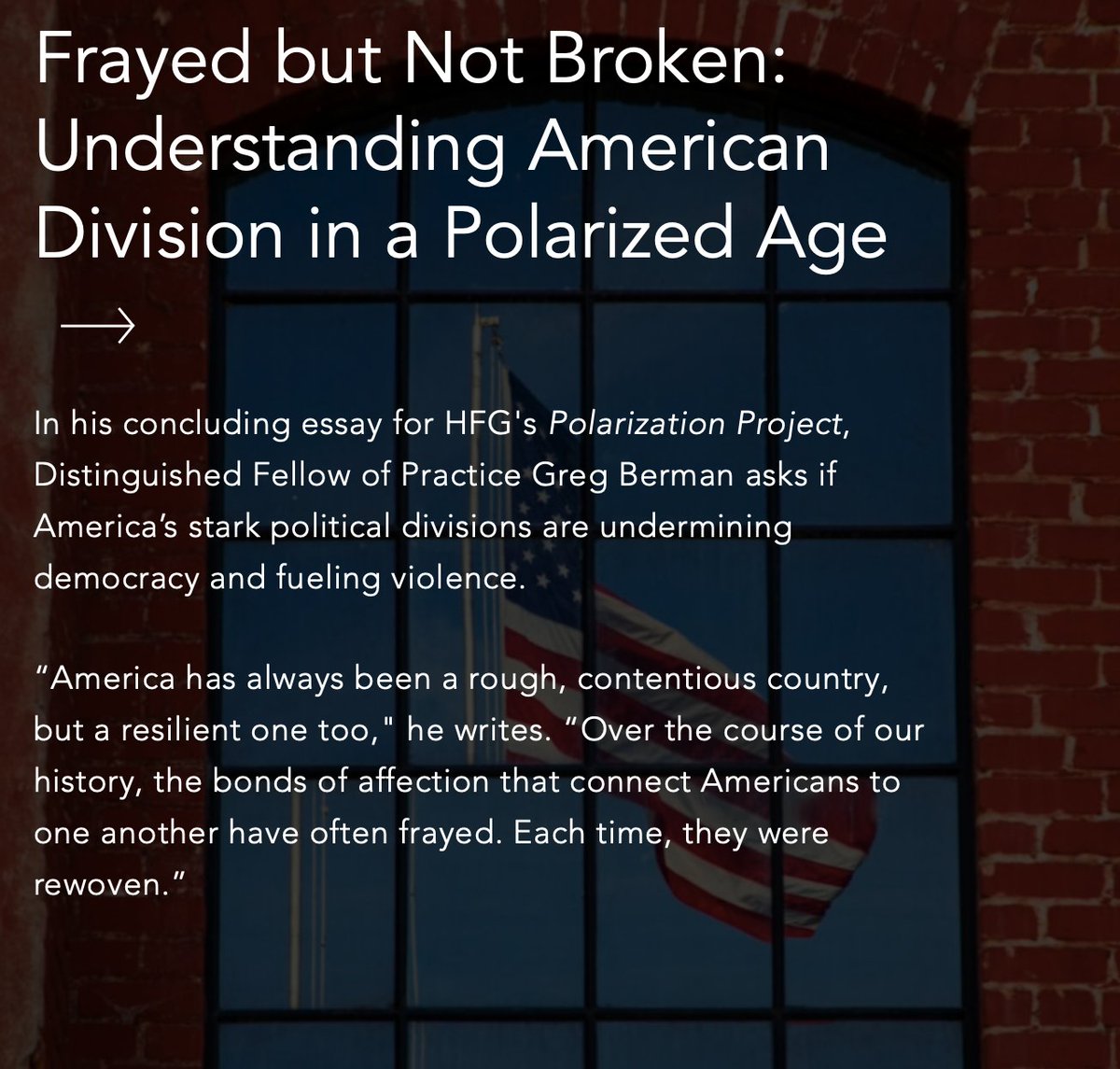
HFG Distinguished Fellow of Practice @GregBerman50 explores this question in "Frayed but Not Broken: Understanding American Division in a Polarized Age."
This new essay concludes HFG's Polarization Project, which examined the relationship between polarization and political violence in the United States. Read it today:
https://t.co/5qhYTlut5v
#HFG #HFGuggenheim #USmidterms #UnitedStates #polarization
1/ What can the “American experience” teach us about learning & talking to one another in this fractured moment?
In a new @hdxacademy (Free the Inquiry) article, @juliasonnevend & @nataliapetrzela share why they founded CAE at @TheNewSchool. https://t.co/pTQRYgNaPQ
https://t.co/OLXHiTHB9G
“I’ve begun to think of good vibes as a sort of collective good that the sector often disregards, but that have positive externalities extending widely across the sector,” @urbaninstitute’s @BenSoskis concludes in new @HistPhil piece. “This doesn’t mean we should sheathe any of our critical impulses or refrain from pointing out the limits and even dangers of philanthropy. But it does mean that we need to think as well about a compensatory set of beliefs about the good philanthropy can achieve and why it’s still necessary for our wealthiest citizens to pursue it—for the benefit of us all.”
@skaushik100@PeterMoskos@bluecitypodcast It was a good era for movies, including my pick for the most underrated NYC film of all time: Quick Change. I make the case here: https://t.co/EASntXojbG
AEI’s Daniel Stid joined The Giving Done Right Podcast with Phil Buchanan to discuss his argument that large-scale philanthropic investment in national policy advocacy has, over time, deepened American polarization rather than healed it.
https://t.co/Q7uYFv6hvz