Germany's electricity mix, 2000 vs 2025:
Renewables: 6% → 62%
Fossil fuels: 62% → 36%
Nuclear: 30% → 0%
Nuclear's exit was filled by renewables, not coal or gas.
Want more of this content + more detail and links to sources? Subscribe to my Substack: https://t.co/nBMZPS4HTp
For the first time since the early 1970s, coal power generation has fallen in both China and India.
This undercuts the claim that decarbonisation is pointless while they expand coal. Renewables are no longer just adding capacity — they’re displacing coal.
https://t.co/XonK1uHZ5h
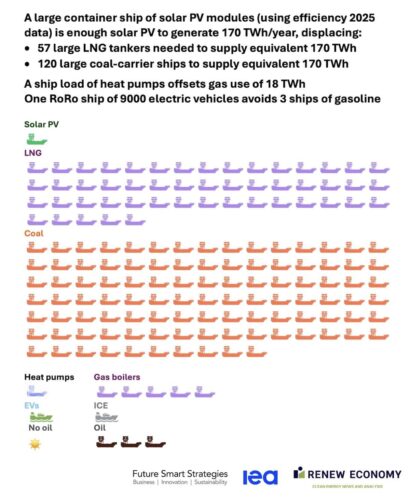
Just 1 ship packed with solar panels delivers the means to produce as much electricity as 57 LNG tankers or 120 coal ships
A world with little fossil fuels has an enormously lighter footprint - starting with zero need for 40% of global shipping
https://t.co/XS2KFgUErn
NEW RESEARCH: Europe won’t regain competitiveness by chasing cheap energy alone.
It needs to use energy better.
Our new @PLOSClimate paper shows energy efficiency is a core driver of competitiveness—boosting productivity, security & decarbonisation.
https://t.co/XUmDnzBF7C
Griechenland: #Kohleausstieg noch in 2026!
#Griechenland, das noch in den 90er-Jahren rund 80% seines Stroms aus Braunkohle erzeugte, wird im Laufe dieses Jahres die letzten verbliebenen Kohlekraftwerke vom Netz nehmen.
Griechenland hat in den...
1/4
https://t.co/i633aawcG0
SOON | Solar overtook coal for the FIRST time in the EU in 2024, bringing renewables to nearly HALF the electricity mix ☀️
What milestones did the 🇪🇺 renewables revolution hit in 2025? Answers in our upcoming European Electricity Review.
Register: https://t.co/DGIkZ4XOEw
AI may live in the cloud, but its infrastructure is more grounded. Massive data centers demand gigawatts of power and millions of gallons of water. AI’s footprint is real. Read more in our December F&D Magazine.
https://t.co/50s2CcIRu3
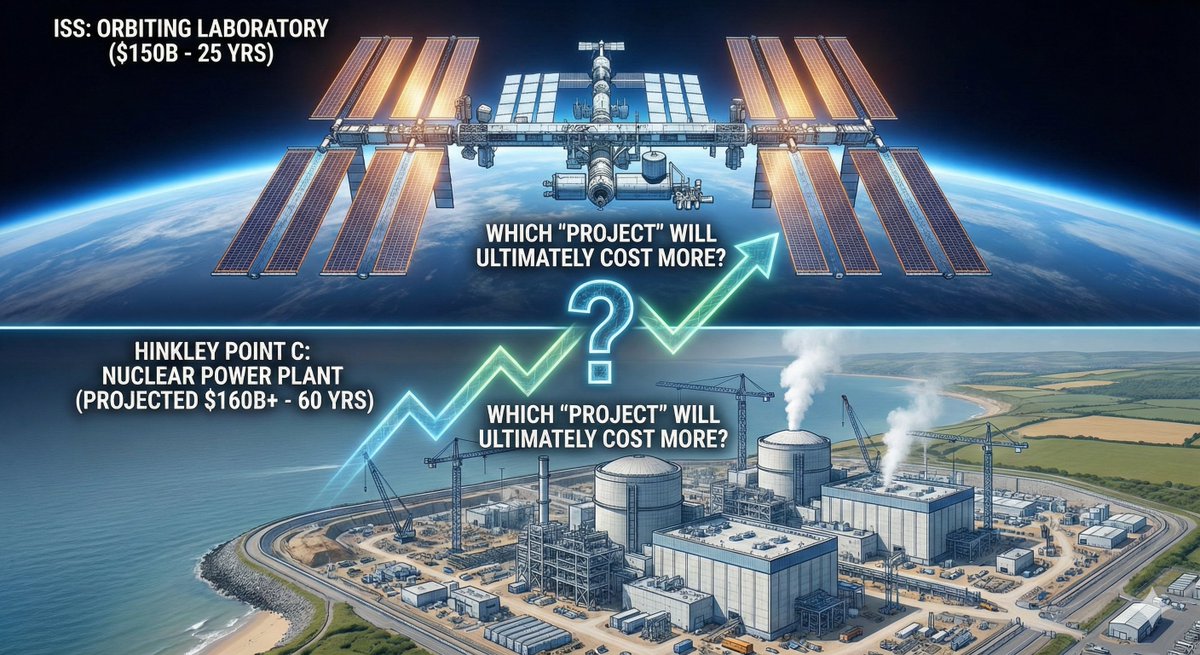
Is a UK power plant about to become more expensive than the International Space Station?
Fun fact: The ISS is often called the most expensive object ever built, costing roughly $150b to design, launch, and operate for over 20 years. But the UK’s Hinkley Point C nuclear plant is catching up fast
>Price Tag: In the case of ISS, $150b covers everything from the 1990s to today (design, dozens of rocket launches, and 25 years of life support in a vacuum)
>Construction: Hinkley Point C’s construction costs are already spiraling toward $50b or $60b (including financing costs) and that’s before it generates a single watt of power
>Long Game: With commissioning pushed to 2031 or later, costs are still rising. Over its 60-year lifespan, maintenance and fuel will likely add another $100b+ to the bill
>Decommissioning a nuclear site is a massive unknown, with estimates starting at $10b and no real ceiling
Keeping the lights on in Somerset is on track to cost more than keeping humanity in orbit
Lower electricity prices are KEY to boosting heat pump deployment in the EU.
A few ways to cut electricity prices to be more competitive with gas:
➡️ Shifting policy costs from electricity to general taxes or gas
📉 Reducing network costs
❌ Cutting VAT
https://t.co/mzkktdWtPJ
China is debunking the idea that entrepreneurship and innovation can only thrive in a free-market-oriented economy.
There is a flourishing private sector in China that plays a key role in driving the country's innovation and entrepreneurship.
Yet, the state — not capital — ultimately controls the direction of investment in China.
The state — not capital — has formulated strategic industrial policies to make China a global powerhouse in clean energy tech, electronics, and rare earths processing.
The state — not capital — is in control of the financial sector and the commanding heights of the economy.
It is not an overstatement to say that China now stands as *the* prime example of an economy in which entrepreneurship and innovation can thrive, while investment is simultaneously guided in line with long-term national objectives.
The Trump regime wants to dismantle a world leading climate research center. Why? Because the US has become a petrostate where the government has been captured by fossil fuel interests. They’re calling climate science “green new scam research”, in full on denial of reality. 🤯
Die Auswirkungen des Klimawandels sind dramatisch, das niedersächsische Wattenmeer stirbt still. Über 97 % der Seegraswiesen sind bereits verschwunden. Jetzt startet #Niedersachsen die größte Rettungsaktion in der Geschichte des Weltnaturerbes:
https://t.co/7ib2gimQx5
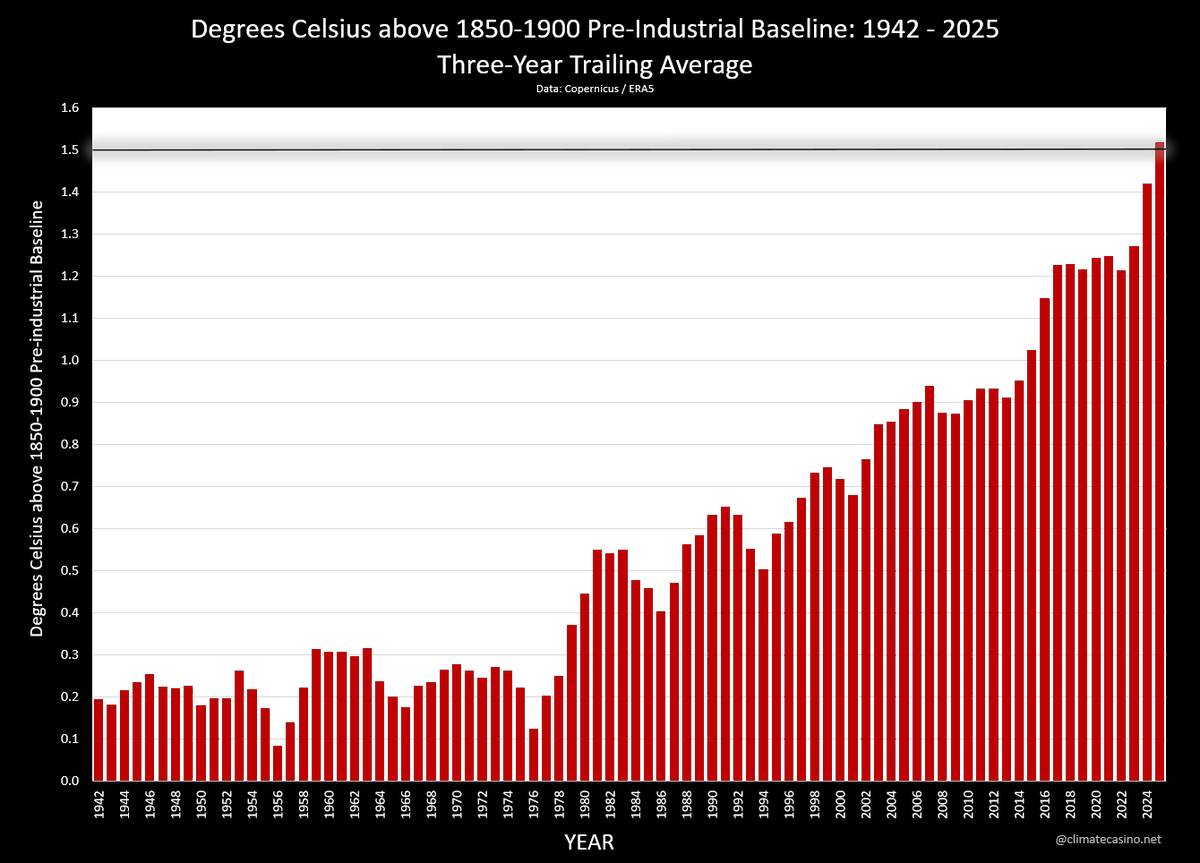
It looks like 2025 will end up at about 1.47°C above the 1850-1900 pre-industrial baseline, making it likely the third hottest year in the last 120,000+ years.
Meanwhile, the 3-year running average is going to end the year above 1.50°C for the first time.
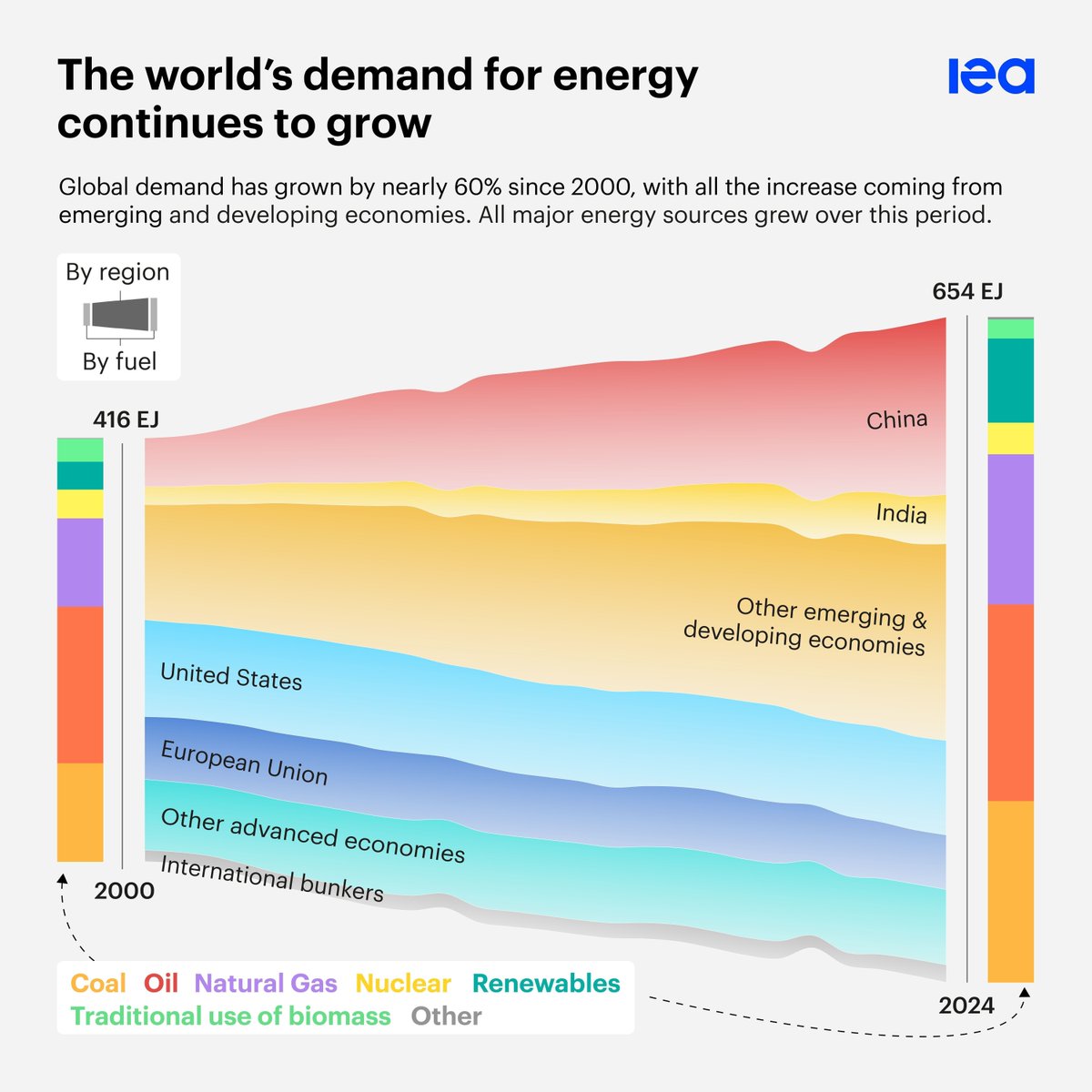
Global energy demand has risen nearly 60% since 2000, with more than half of the increase taking place in China
In the coming years, other emerging economies, led by India & Southeast Asia, are set to become increasingly influential in growth trends 👉 https://t.co/2Y5Zm6J3aq
NEW – Guest post: Why cities need more than just air conditioning for extreme heat | William Lewis, Sean Goodwin and Marta Olazabal
Read here: https://t.co/9y8uo8l2Co