Welsh writer, of ‘Kicking’, ‘St Cuthbert’s Corpse’ and now ‘Black Rood': “Excellent... pure detective work" @HistoryScotland; “Totally compelling" @UndisScot.
@GretelleMaitre Of course! There was a second edition with a new cover and title to tie in with the film. It also had a new preface (plus the Carol Ann Duffy poem) but otherwise it was unchanged from the first edition. Given she has been presented as a fantasist, her story is very consistent.
What I find so fascinating about the Richard III discovery is how, despite it being in the purview of a university, you cannot follow what happened unless you go deep into the sources. Eg I had to go through all three editions of Baldwin's book to understand his contribution.
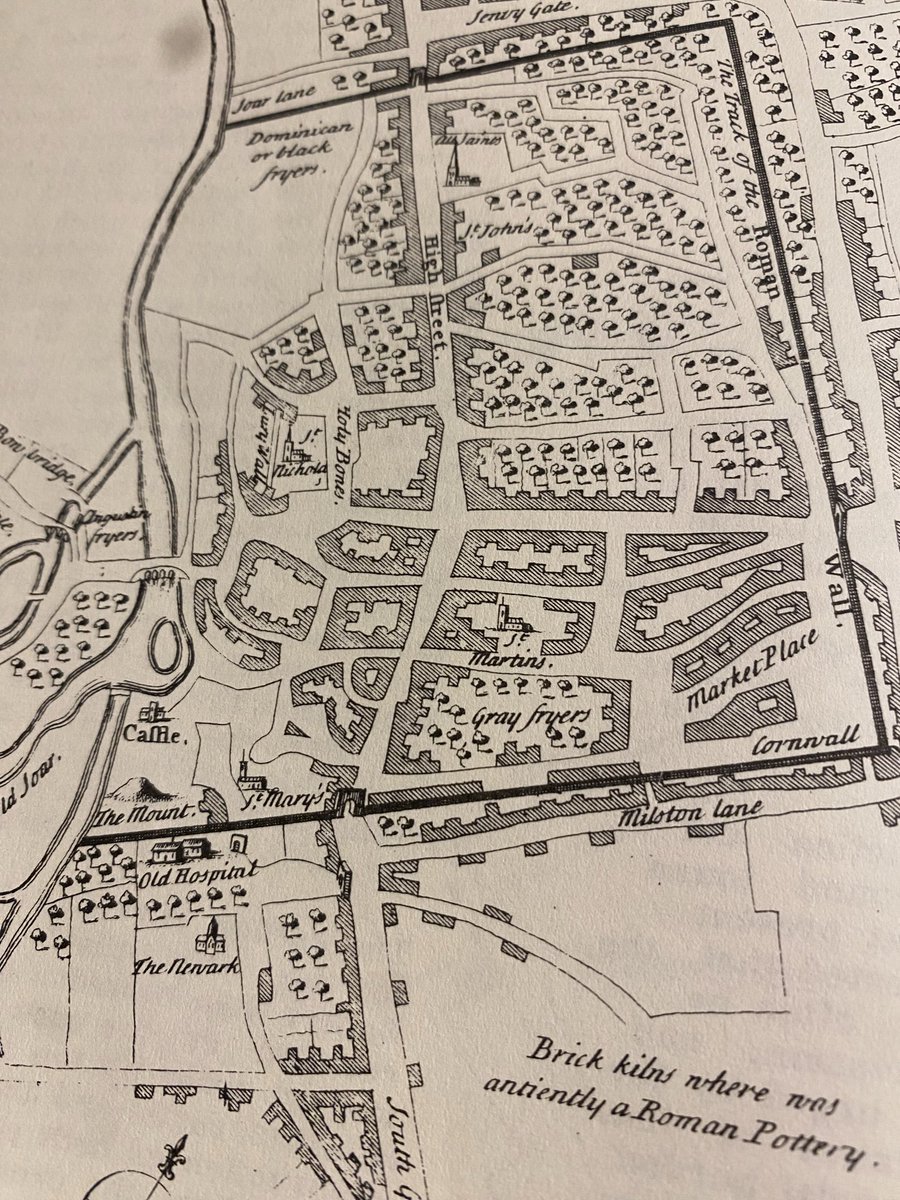
I can't find any source but the Roberts map for the narrowest version of the Greyfriars, while the 2011 ULAS report on the tiny NatWest dig a few yards to the east says this was "possibly within the precinct". So the N&S boundaries seem solid but E&W seem much more speculative.
Finally got somewhere. The limited footprint of the Greyfriars Leicester is traced from this map (Roberts 1741), which has the larger area subdivided. But if this was really the footprint, why isn't it the same on other C18 maps Stukeley (1722), Prior (1777) and Throsby (1791)?
@davidyelland Love the show, but Uni PR has nothing like the respect, resources or influence of corporate. It’s only used after fan hitters to make chaotic decision-making look purposeful.
Finally got somewhere. The limited footprint of the Greyfriars Leicester is traced from this map (Roberts 1741), which has the larger area subdivided. But if this was really the footprint, why isn't it the same on other C18 maps Stukeley (1722), Prior (1777) and Throsby (1791)?
I think this is the origin of the map that turns up occasionally showing the Greyfriars with a limited footprint (it’s from a 1987 tape-bound publication by Leicestershire Museums). l am not doubting the authors’ good faith. They know far more about Leicester than l ever will.
The limited footprint also doesn't fit with the apparently impeccable textual evidence of Henry VIII's commissioner John Leland: "The Gray-Freres of Leicester stode at the end of the Hospital of Mr. Wigeston [top left of Roberts map]… and there was byried King Richard 3.”
I think this is the origin of the map that turns up occasionally showing the Greyfriars with a limited footprint (it’s from a 1987 tape-bound publication by Leicestershire Museums). l am not doubting the authors’ good faith. They know far more about Leicester than l ever will.
It’s intriguing because it echoes lead archaeologist Richard Buckley’s view that the church of the Leicester Greyfriars (and so #Richardlll) could be in the north or south of its precinct. But is DO’S echoing him or was he echoing her from an earlier draft/discussion?
The cloister of a friary “…could be on the north or south of the [church].” Does anyone else think this is an odd way to put it? Like saying that human beings can be right or left handed, but not mentioning that there’s a bias to one side? From ‘In the Company of the Preachers’.
I once drove from Durham to @surreyarch to look at this book (in what turned out to be a brilliantly folksy library). Not only is it fascinating in its own right but it also played a discreet but key role in the discovery of Richard III.
The cloister of a friary “…could be on the north or south of the [church].” Does anyone else think this is an odd way to put it? Like saying that human beings can be right or left handed, but not mentioning that there’s a bias to one side? From ‘In the Company of the Preachers’.
It’s just l can’t understand why, given that every 18C map shows a precinct that is at least twice the size, and the book doesn’t explain the reasoning.
I think this is the origin of the map that turns up occasionally showing the Greyfriars with a limited footprint (it’s from a 1987 tape-bound publication by Leicestershire Museums). l am not doubting the authors’ good faith. They know far more about Leicester than l ever will.
Thomas I (of Bayeux), first Norman archbishop of York and founder of the Anglo-Norman cathedral, died #OTD in 1100. He once claimed to have spent a night beside the tomb of St Cuthbert, where he had received a vision and been healed of his infirmities. 📸Paul Lakin
One of the things that intrigues me and which really matters is the original size of the Greyfriars in medieval Leicester. The bigger it is, the more impressive is Looking for Richard’s acumen in nominating where its church would be. On the first useful (C18) maps, it’s big.