PulseChain agent wallets are live.
I open-sourced an MCP server that gives your preferred AI agent their own encrypted wallet on PulseChain.
Agents can:
• create a wallet
• check balances
• send/recieve PLS and other coins
• make swaps on DEXs
• review and create smart contracts
• do market research
• and what ever you ask it basically
WARNING:
fund it with only what you’re willing to lose, agents make mistakes too
Built for Grok / Cursor / Claude / Codex
Now your AI agents can actually use PulseChain.
GitHub link in the reply below, have your agent review it and then install it for you.
The RPCs and websites I run, which are free for @PulsechainCom users, had about 36 hours of downtime a few days ago because of a service provider issue. 2 years of uptime, no service has zero downtime
https://t.co/aRllXNxQfh
I apologize for the disruption; it's been resolved
Good questions.
Withdrawal address is set to your wallet and it’s immutable, that’s where the 32M and consensus rewards go. A bug in my software can’t redirect that.
Slashing is the real risk on any validator, mine or yours. It happens if the same keys sign in two places. I don’t do that. Keys only run on the ValCloud machines, slashing protection on, and if you ever want them on your own hardware you just exit first and start fresh.
Still in private testing and I'll let you know more as I get closer to public launch.
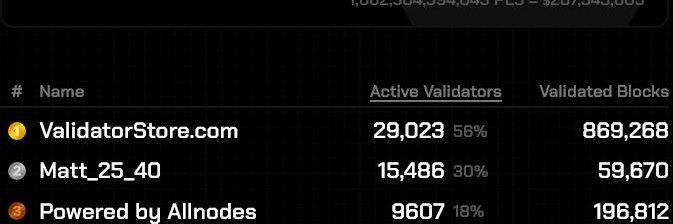
I'm working on a new product for PulseChain to democratize PLS staking.
ValCloud — self-service validator hosting without running your own node:
• Keys stay local • Only encrypted keystores are uploaded • I host the validators/hardware • You keep your stake + consensus rewards • Unstake whenever you want
No liquid staking token. No derivative wrapper. No hardware needed.
You basically get free PLS coins daily if you've got the 32 million PLS minimum.
Still in development / private testing. Public access coming soon.
#PulseChain
I'm still building ValCloud, the new way to solo stake PulseChain. Your keys. Your 32M PLS. Your consensus rewards. I just run the machines.
Public access soon. #PulseChain
I'm working on a new product for PulseChain to democratize PLS staking.
ValCloud — self-service validator hosting without running your own node:
• Keys stay local • Only encrypted keystores are uploaded • I host the validators/hardware • You keep your stake + consensus rewards • Unstake whenever you want
No liquid staking token. No derivative wrapper. No hardware needed.
You basically get free PLS coins daily if you've got the 32 million PLS minimum.
Still in development / private testing. Public access coming soon.
#PulseChain
If you like running your own stuff at home, this box is for you.
Same machine I ship for PulseChain validators also makes a solid home RPC. 64GB RAM, 4TB. Run your own node so you’re not reliant on a public endpoint. Or give Grok a real local computer for builds and MCP.
If the same machine is also running your active validators, exposing the RPC to the public internet significantly increases the attack surface. That box is holding validator keys and is critical for staying online and avoiding penalties. Making it publicly reachable opens the door to DoS attempts, potential exploits against the RPC endpoint, and generally unnecessary risk.
Best practice is:
Keep the validator machine locked down (no public RPC)
Run a separate pure RPC node (no validator keys on it) if you want to share or use a public-facing endpoint
Or only expose the RPC on your local LAN for your own wallets
I made a one-command Docker setup specifically for a clean private/home RPC node here if useful:
https://t.co/5F9MFUXEm1
When DexScreener breaks, https://t.co/mmLVOtaNCV keeps reading PulseChain/Hex/PulseX prices straight from the blockchain.
Direct on-chain pricing.
Built different.
if you’ve been having issues on PulseChain for the last 3 hours, here’s the reason so you don’t get misled by random noise 👇
one of the biggest RPC providers, @g4mm4io, is currently experiencing a bottleneck and they’re already working on a fix. many protocols, wallets, DEXs, and tools like DexScreener may also be affected if they rely on that RPC source for data processing. until it’s resolved, using alternative RPCs is the safer move.
also, useful reminder:
app / UI RPC and wallet RPC are not the same thing.
fallback, read, and write flows can work through different RPC layers. the RPC used by the UI may be different from the RPC active in your web3 wallet. example: if the UI uses the official RPC, it can still fetch data. but if g4mm4 is active in your wallet, the confirmation modal may not trigger.
on the Piteas side, there is no protocol issue. the UI automatically selects the most efficient RPC, and if an RPC is timing out, you’ll see a warning modal.
we also pushed an update in the last hour. now, if the confirm stage doesn’t get a response, the app can detect the RPC-side issue and guide your wallet to add a working RPC. so yeah, it still finds the right path :)
gg.
Blockchain devs: RPC latency is a terrible way to pick your endpoint.
Why it's a weak signal:
→ Block times are ~10s. Shaving 11ms won't get your tx included any sooner.
→ TLS handshake is one-time. With keep-alives you pay it once.
What actually matters:
→ Fresh heads — no stale data
→ Accurate GPO — reliable gas estimates
→ Reliability under real load — not just acing health checks
The fastest RPC on your probe can still serve stale heads and fail real requests.
Be kind to your users.
Every day we see real people hurt by poor technical decisions.
The trade-offs developers choose have real consequences.
Security should be the number one priority — especially in blockchain.
@RichardHeartWin was and is right.
https://t.co/rnWDffleYz
@DompedroXpls I could do something like that. What wallet would you like me to show using specifically? I can teach how to manually add more RPC nodes.
Hardware recommendations for a PulseChain full node + private RPC:
RAM: 32 GB or more recommended (16 GB minimum, but it may swap under load)
Storage: 2 TB+ NVMe SSD recommended (1.5 TB+ fast SSD minimum — leave headroom for growth)
CPU: 4+ modern cores
Network: Stable broadband, preferably unmetered (required for sync and peers)
Notes:
Use an SSD. Mechanical drives are generally unsuitable for a reliable full node.
Initial sync can take hours to days depending on hardware and bandwidth. Checkpoint sync speeds up the beacon client a lot.
This is for a full node + private RPC, not an archive node (archive needs many more terabytes).
If you want ready-to-run hardware already built and tested, I have kits at https://t.co/JLCESOKEJZ.
@SlipMech I open-sourced a simple one-command install for it:
https://t.co/EYgpJIJHUZ
Runs Go-Pulse + Prysm as a private RPC node. Takes like 10–15 mins once the hardware is ready.
Need a ready-to-go machine? I build and ship the kits from https://t.co/dW5rzeXzl6