You have noticed it. ChatGPT feels dumber than it used to. Your prompts that worked six months ago produce worse results now. The writing sounds flatter. The ideas sound safer. The internet itself feels like it is shrinking. Every article reads the same. Every email sounds the same. Every answer sounds like it was written by the same voice.
You thought it was you. It is not you.
Researchers at Oxford and Cambridge published a paper in Nature proving what is happening. They call it Model Collapse.
Here is the mechanism in one sentence. AI trained on AI-generated data gets dumber every generation until it forgets what real human data looked like.
The internet is filling with AI-generated content. Blog posts. Articles. Reviews. Comments. Social media. AI companies scrape the internet to train the next generation of models. Which means the next generation of AI is being trained on the output of the current generation.
Each cycle loses information. Not randomly. It loses the rarest, most unusual, most creative parts first. The researchers call these the "tails of the distribution." The weird ideas. The unexpected perspectives. The things that made the internet feel human. Those disappear first.
What remains is the average. The safe. The expected. The bland.
Then the next generation trains on that. And loses more. And the next generation trains on that. And loses more. The researchers proved this is not a slow decline. Major degradation happens within just a few iterations. Even when some of the original human data is preserved.
They tested it on large language models. On image generators. On statistical models. The pattern was the same every time. The output converges toward a narrow, flattened version of reality that looks nothing like the original data.
The lead researcher put it plainly. "Large language models are like fire. A useful tool. But one that pollutes the environment."
The pollution is invisible. You cannot see which sentence on the internet was written by a human and which was written by AI. Neither can the AI that is about to train on it. And once the tails are gone, they do not come back. The damage is irreversible.
This is not a prediction anymore. It is a diagnosis.
The internet you grew up on was built by humans writing things no algorithm would have written. Strange, personal, imperfect, alive. That internet is being diluted. One generation of AI at a time. And the models trained on what remains are learning a smaller and smaller version of the world.
Model Collapse is not a technical problem. It is a cultural one. The thing that made the internet worth reading is the thing that disappears first.
"La IA ya está por delante de nosotros en la mayoría de tareas cognitivas."
Geoffrey Hinton no lo dice como hipótesis. Lo dice como el hombre que construyó los sistemas que lo demuestran, y que luego dejó Google para advertirle al mundo.
Su conferencia de 47 minutos no es un análisis del futuro. Es un diagnóstico del presente.
Lo que más incomoda no es lo que dice sobre la IA. Es lo que dice sobre nosotros.
La mayoría abre Claude, escribe algo y cierra la pestaña. Creen que están usando IA. Están usando el 10%.
Hinton lleva años estudiando cómo aprenden las máquinas. Yo estudié su conferencia completa para entender cómo deberíamos usarlas nosotros.
El resultado: un sistema de 18 pasos para usar Claude de verdad, con prompts listos para copiar y pegar hoy mismo.
Lo tienes en el post de abajo.
I've just launched https://t.co/g49t3mPCFF.
As far as I know, it's the world's first dedicated marketplace for football AI tools.
Skills, MCPs, and APIs. All in one place.
15 tools live today. Open to any developer who wants to list theirs.
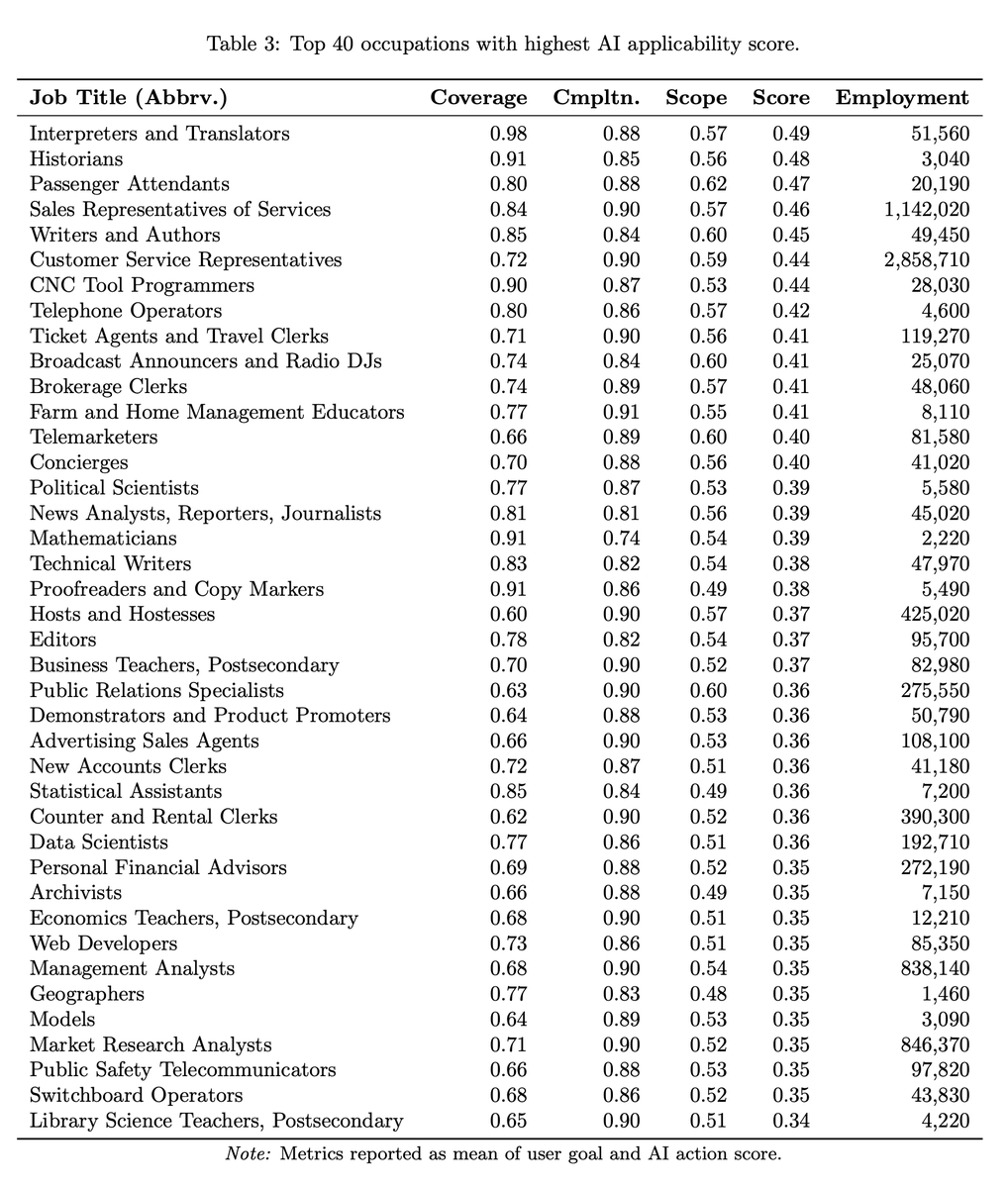
💣 Microsoft acaba de publicar un estudio donde determina los empleos más susceptibles de ser reemplazados por IA generativa (primera imagen) y los más seguros (segunda imagen)
Os recomiendo que lo leáis, especialmente los jóvenes.
¡DE AQUÍ NO SE MUEVE NI DIOS!
#TalDíaComoHoy, 25 de abril de 1993, la sección del teniente Monterde se desplazó al norte del destacamento de #Jablanica en dirección a #Sarajevo. El convoy estaba formado por 5 blindados y 35 #legionarios.
Ball Striking - Lofted Pass. A Physical Literacy approach rather than the four-corner model. In terms of tactical, individual decisions would come under “think”. 🤔 welcome.
We’re hiring a Research Engineer at @Arsenal ⚽️ to help accelerate our applied research efforts!
We’re building state-of-the-art models to understand football at scale, and a suite of ML-powered applications on top of them to drive tactical and strategic decisions.
⚽📊The Development of a Return to Performance Pathway Involving A Professional Soccer Player Returning From A Multi-Structural Knee Injury
https://t.co/sEb12rby9r