Excited about our new strategic partnership with @OpenAI. Developers and companies of all kinds are eager to run services powered by OpenAI models on AWS, and our unique collaboration will provide a stateful runtime environment for them that’s powered by OpenAI’s frontier intelligence on Amazon Bedrock.
OpenAI is also going big on our custom Trainium chips, which are 30-40% more price performant than comparable GPUs, to power their growth. Both the leading AI labs now have made significant commitments to Trainium, which is gaining a lot of momentum.
We’ll be the exclusive 3P cloud distribution provider for OpenAI Frontier (which enables organizations to build, deploy, and manage teams of AI agents).
And finally, we’re excited about our investment in OpenAI — it’s an extremely talented team with great products, IP, and vision for how they can continue to serve customers and enterprises. We think they’ll be one of the big winners in AI, we can help them grow, and we believe we’ll earn a strong return for Amazon over the long term. https://t.co/aDJ8On5iQQ
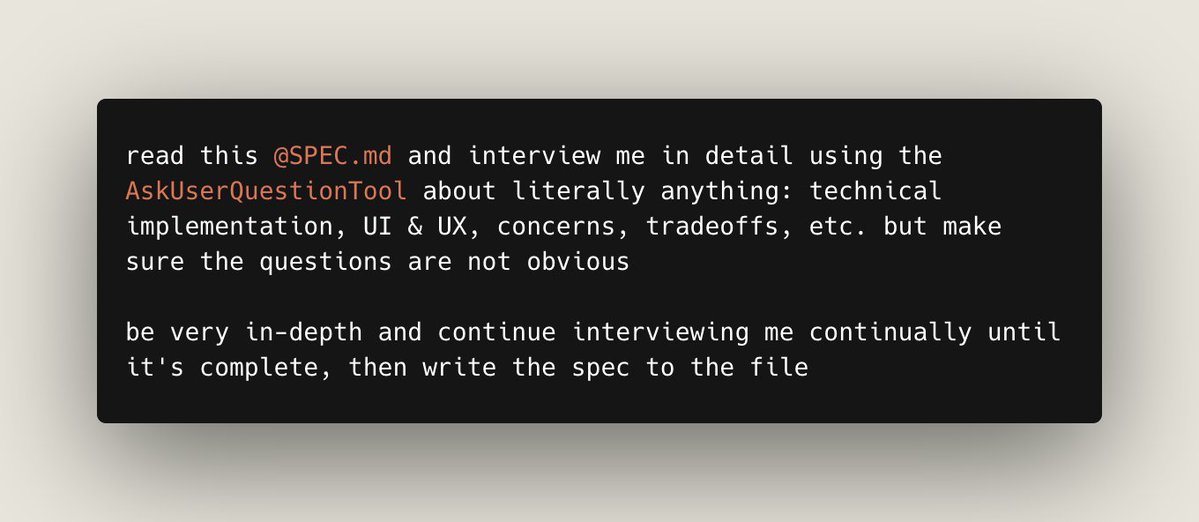
my favorite way to use Claude Code to build large features is spec based
start with a minimal spec or prompt and ask Claude to interview you using the AskUserQuestionTool
then make a new session to execute the spec
From prototype to production in minutes. 💭⏱️🚀
Now Generally Available, Amazon Bedrock AgentCore, our agentic platform lets you build, deploy & operate highly capable agents using any framework or model—no infrastructure management required. #AWS
👉 https://t.co/1Ek9s1ogjF
Here is a simple Deep Research Agent built with Strands:
- Uses Bedrock LLMs (e.g. Claude Sonnet) for reasoning
- Calls Tavily endpoints for search, extraction, and crawling
- Produces structured Markdown output with citations
🧠🤖Deep Agents
Simple tool calling loops fail on longer time horizon or more complex tasks
Deep Agents like Deep Research, Claude Code & Manus succeed by using a number of tools and tricks
We created a new Python package which makes it easy to build your own Deep Agents!
Introducing Kiro, an all-new agentic IDE that has a chance to transform how developers build software.
Let me highlight three key innovations that make Kiro special:
1 - Kiro introduces spec-driven development, helping developers express their intent clearly through natural language specifications and architecture diagrams for complex features. This comprehensive context helps Kiro’s AI agents deliver better results with fewer iterations.
2 - Kiro features intelligent agent hooks that automatically handle critical but time-consuming tasks like generating documentation, writing tests, and optimizing performance. These hooks work in the background, triggered by events like saving files or making commits. It’s like having an experienced developer constantly reviewing your work and handling the maintenance tasks that often get delayed.
3 - Kiro provides a purpose-built interface that adapts to how developers work. Whether you prefer chat interactions or working with specifications, Kiro supports your workflow while keeping you in control of the development process.
Kiro is really good at "vibe coding" but goes well beyond that. While other AI coding assistants might help you prototype quickly, Kiro helps you take those prototypes all the way to production by following a mature, structured development process out of the box. This means developers can spend less time on boilerplate code and more time where it matters most – innovating and building solutions that customers will love.
Starting today, Kiro is available for free during preview and supports most popular programming languages.
Here’s how to get started with @kirodotdev today: https://t.co/Ne5m2Nh4wC
Excited to see how developers use Kiro, and to work with the developer community to continue to shape Kiro moving forward.
🚀 Amazon Q Developer IDE plugins now support Model Context Protocol (MCP). This new experience allows developers to use external tools to support richer, contextual development workflows.
You can connect and manage MCP tools directly within Q Developer's UI, no additional code needed. Once integrated, Q Developer will orchestrate between native and MCP server-based tools to provide even more customized responses, streamlining the developer experience even further.
MCP Support is available within Q Developer IDE plugins for Visual Studio Code and JetBrains, and Q Developer CLI.
Our commitment to openness remains—try our expansive free tier today ➡️ https://t.co/Tu8sEZCswp
Really proud of the team for the power they put into today’s launch of AWS Transform ➡️ https://t.co/UwPHiKx3B3
This is the industry’s first agentic AI experience for large-scale migration and modernization of .NET, mainframe, and VMware workloads. We’re excited to make this generally available today—and we’ve put more power behind it since its preview at re:Invent last year. Customers using AWS Transform can modernize Windows .NET application to Linux up to 4X faster and see up to 40% reduction in licensing costs. For VMware, in our internal tests, we used AWS Transform to translate VMWare network configurations for 500 virtual machines to generate AWS networking configurations such as VPCs, subnets, transit gateways and internet gateways within one hour. This is 80X faster compared to the two work weeks taken with traditional, manual approaches!
What’s great about AWS Transform is that it’s accessible to both technical and non-technical employees. With natural language chat capabilities, cross-functional teams can collaborate on reviews and approvals, keeping projects on track. We are also excited to work with customers, such as Thomas Reuters, The Hartford, and Toyota Motor Company North America to deliver the power of AWS Transform and help modernize the application stack. This is a huge leap forward, and I’m excited to see how organizations will innovate even faster.
Now Available: Strands Agents, an open source agent SDK 🔓🤖⚡
Today we are open sourcing Strands Agents: now you can build agents using just a few lines of code.
Learn more about Strands & watch the demo. #AWS#opensource#generativeAI
👉 https://t.co/7oaTS54vaa
Thrilled to see @awscloud making a major contribution to the open source AI community with the launch of the Strands Agents, an open source AI agents SDK! https://t.co/PqWWjlpmlM
The core of Strands is the simple agentic loop that connects the model and tools together, like the two strands of DNA. This model-driven approach to agent building eliminates the need for complex agent orchestration by embracing the capabilities of state-of-the-art models to plan, chain thoughts, call tools, and reflect. Providing open source tools and interoperability with open source protocols is an important part of our strategy to enable an agentic future. Can't wait to see what you build with Strands!
🚀 Model Context Protocol (MCP) support in Amazon Q Developer’s CLI is here https://t.co/0VjiZWc3FJ
This update unlocks access to an expansive list of pre-built AWS integrations or any MCP servers that support stdio. Once integrated, Q Developer will orchestrate between native and MCP server-based tools to provide even more customized responses, understand data structures and, execute complex queries, streamlining the developer experience within the CLI even further. Test it out on our expansive free tier today.
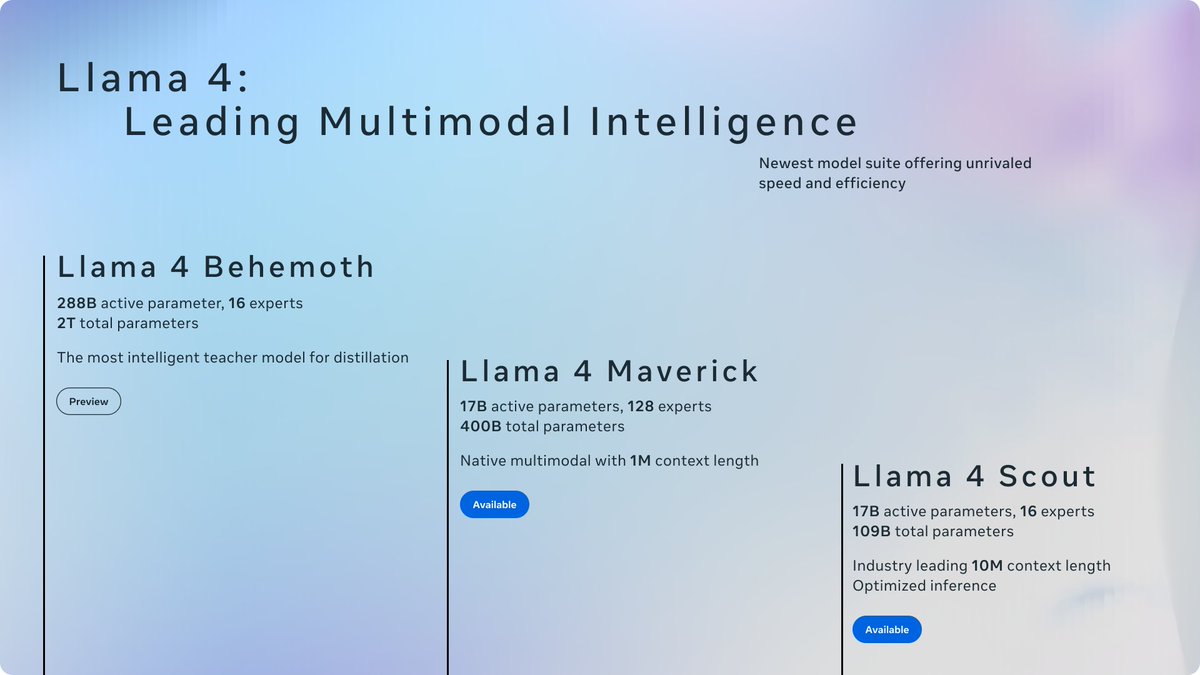
Today is the start of a new era of natively multimodal AI innovation.
Today, we’re introducing the first Llama 4 models: Llama 4 Scout and Llama 4 Maverick — our most advanced models yet and the best in their class for multimodality.
Llama 4 Scout
• 17B-active-parameter model with 16 experts.
• Industry-leading context window of 10M tokens.
• Outperforms Gemma 3, Gemini 2.0 Flash-Lite and Mistral 3.1 across a broad range of widely accepted benchmarks.
Llama 4 Maverick
• 17B-active-parameter model with 128 experts.
• Best-in-class image grounding with the ability to align user prompts with relevant visual concepts and anchor model responses to regions in the image.
• Outperforms GPT-4o and Gemini 2.0 Flash across a broad range of widely accepted benchmarks.
• Achieves comparable results to DeepSeek v3 on reasoning and coding — at half the active parameters.
• Unparalleled performance-to-cost ratio with a chat version scoring ELO of 1417 on LMArena.
These models are our best yet thanks to distillation from Llama 4 Behemoth, our most powerful model yet. Llama 4 Behemoth is still in training and is currently seeing results that outperform GPT-4.5, Claude Sonnet 3.7, and Gemini 2.0 Pro on STEM-focused benchmarks. We’re excited to share more details about it even while it’s still in flight.
Read more about the first Llama 4 models, including training and benchmarks ➡️ https://t.co/9G3QgVdCkB
Download Llama 4 ➡️ https://t.co/eVomRvEr0w
New short course: Serverless Agentic Workflows with Amazon Bedrock. Learn to build and deploy serverless agents in this course created with @awscloud and taught by @mikegchambers, a Senior Developer Advocate at AWS specializing in GenAI. (Disclosure: I serve on Amazon's board.)
Generative AI applications are becoming more complex, sophisticated, and agentic. Agentic applications have workloads that can be hard to predict in advance -- for example, what tools will it decide to call? -- and a serverless architecture helps you efficiently providing on-demand resources.
This course teaches you to build and deploy a serverless agentic application. You’ll learn to create agents with tools, code execution, and guardrails, and build responsible agents for business use cases:
- Build a customer service bot for a fictional tea mug business that can answering questions, retrieve information, and process orders.
- Connect your customer service agent to a CRM to get customer info and log support tickets in real-time.
- Explore how you invoke the agent, and see the trace to review the agent’s thought process and observation loop until it reaches its final output.
- Attach a code interpreter to your agent, giving it the ability to perform accurate calculations by writing and running its own Python code.
- Implement guardrails to prevent your agent from revealing sensitive information or using inappropriate language.
By the end, you will have built a sophisticated AI agent capable of handling real-world customer support scenarios.
Please sign up here! https://t.co/FQKGJNBPwp
One reason for machine learning’s success is that our field welcomes a wide range of work. I can’t think of even one example where someone developed what they called a machine learning algorithm and senior members of our community criticized it saying, “that’s not machine learning!” Indeed, linear regression using a least-squares cost function was used by mathematicians Legendre and Gauss in the early 1800s — long before the invention of computers — yet machine learning has embraced these algorithms, and we routinely call them “machine learning” in introductory courses!
In contrast, about 20 years ago, I saw statistics departments at a number of universities look at developments in machine learning and say, “that’s not really statistics.” This is one reason why machine learning grew much more in computer science than statistics departments. (Fortunately, since then, most statistics departments have become much more open to machine learning.)
This contrast came to mind a few months ago, as I thought about how to talk about agentic systems that use design patterns such as reflection, tool use, planning, and multi-agent collaboration to produce better results than zero-shot prompting. I had been involved in conversations about whether certain systems should count as “agents.” Rather than having to choose whether or not something is an agent in a binary way, I thought, it would be more useful to think of systems as being agent-like to different degrees. Unlike the noun “agent,” the adjective “agentic” allows us to contemplate such systems and include all of them in this growing movement.
More and more people are building systems that prompt a large language model multiple times using agent-like design patterns. But there’s a gray zone between what clearly is not an agent (prompting a model once) and what clearly is (say, an autonomous agent that, given high-level instructions, plans, uses tools, and carries out multiple, iterative steps of processing).
Rather than arguing over which work to include or exclude as being a true agent, we can acknowledge that there are different degrees to which systems can be agentic. Then we can more easily include everyone who wants to work on agentic systems. We can also encourage newcomers to start by building simple agentic workflows and iteratively make their systems more sophisticated.
In the past few weeks, I’ve noticed that, while technical people and non-technical people alike sometimes use the word “agent,” mainly only technical people use the word “agentic” (for now!). So when I see an article that talks about “agentic” workflows, I’m more likely to read it, since it’s less likely to be marketing fluff and more likely to have been written by someone who understands the technology.
Let’s keep working on agentic systems and keep welcoming anyone who wants to join our field!
[Original text: https://t.co/4izf1hsv9P ]








![AndrewYNg's tweet photo. One reason for machine learning’s success is that our field welcomes a wide range of work. I can’t think of even one example where someone developed what they called a machine learning algorithm and senior members of our community criticized it saying, “that’s not machine learning!” Indeed, linear regression using a least-squares cost function was used by mathematicians Legendre and Gauss in the early 1800s — long before the invention of computers — yet machine learning has embraced these algorithms, and we routinely call them “machine learning” in introductory courses!
In contrast, about 20 years ago, I saw statistics departments at a number of universities look at developments in machine learning and say, “that’s not really statistics.” This is one reason why machine learning grew much more in computer science than statistics departments. (Fortunately, since then, most statistics departments have become much more open to machine learning.)
This contrast came to mind a few months ago, as I thought about how to talk about agentic systems that use design patterns such as reflection, tool use, planning, and multi-agent collaboration to produce better results than zero-shot prompting. I had been involved in conversations about whether certain systems should count as “agents.” Rather than having to choose whether or not something is an agent in a binary way, I thought, it would be more useful to think of systems as being agent-like to different degrees. Unlike the noun “agent,” the adjective “agentic” allows us to contemplate such systems and include all of them in this growing movement.
More and more people are building systems that prompt a large language model multiple times using agent-like design patterns. But there’s a gray zone between what clearly is not an agent (prompting a model once) and what clearly is (say, an autonomous agent that, given high-level instructions, plans, uses tools, and carries out multiple, iterative steps of processing).
Rather than arguing over which work to include or exclude as being a true agent, we can acknowledge that there are different degrees to which systems can be agentic. Then we can more easily include everyone who wants to work on agentic systems. We can also encourage newcomers to start by building simple agentic workflows and iteratively make their systems more sophisticated.
In the past few weeks, I’ve noticed that, while technical people and non-technical people alike sometimes use the word “agent,” mainly only technical people use the word “agentic” (for now!). So when I see an article that talks about “agentic” workflows, I’m more likely to read it, since it’s less likely to be marketing fluff and more likely to have been written by someone who understands the technology.
Let’s keep working on agentic systems and keep welcoming anyone who wants to join our field!
[Original text: https://t.co/4izf1hsv9P ]](https://pbs.twimg.com/media/GP98LglbEAMeQBC.jpg)


