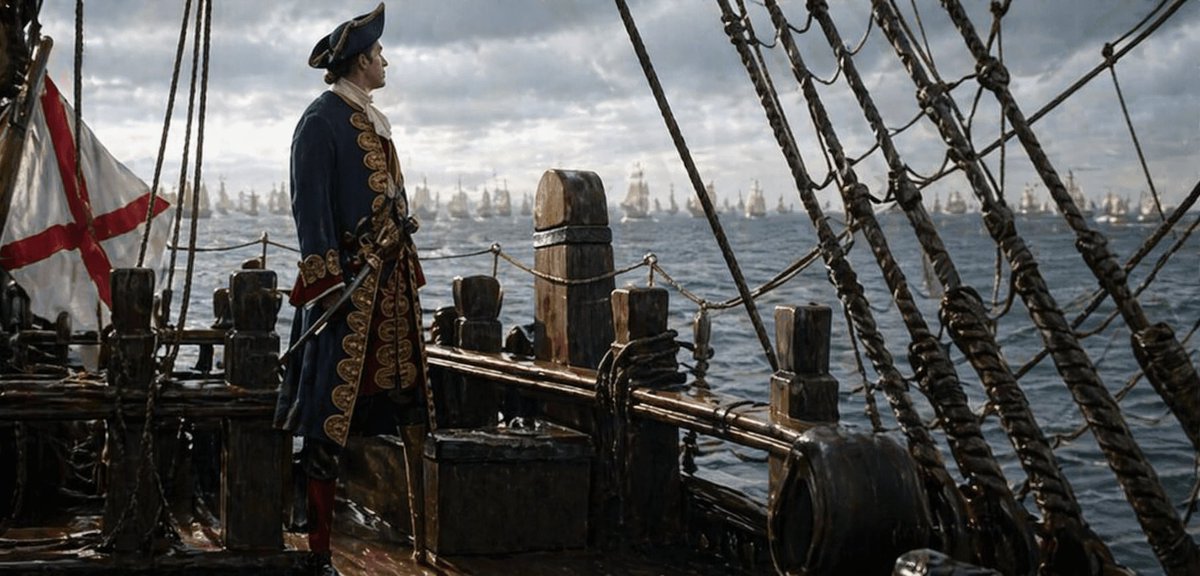
Hoy hace 285 años, 20 de mayo de 1741, terminó el asedio inglés a Cartagena de Indias. El almirante Blas de Lezo, uno de los mayores héroes de la historia de España, invicto en todas las batallas que libró, había humillado a los británicos después de tres meses de sitio. (Sigue)
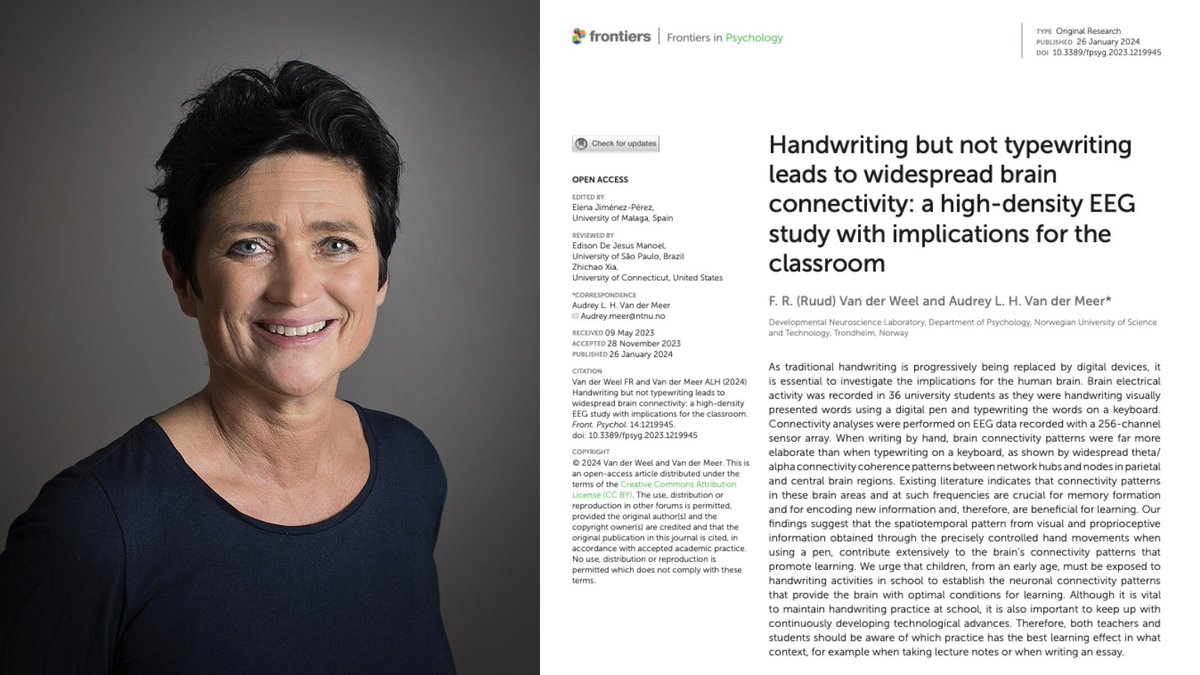
A Norwegian neuroscientist spent 20 years proving that the act of writing by hand changes the human brain in ways typing physically cannot, and almost nobody outside her field has read the paper.
Her name is Audrey van der Meer.
She runs a brain research lab in Trondheim, and the paper that closed the argument was published in 2024 in a journal called Frontiers in Psychology. The finding is brutal enough that it should have changed every classroom on Earth.
The experiment was simple. She recruited 36 university students and put each one in a cap with 256 sensors pressed against their scalp to record brain activity. Words flashed on a screen one at a time.
Sometimes the students wrote the word by hand on a touchscreen using a digital pen, and sometimes they typed the same word on a keyboard. Every neural response was recorded for the full five seconds the word stayed on screen.
Then her team looked at the part of the data most researchers had ignored for years, which is how different parts of the brain were communicating with each other during the task.
When the students wrote by hand, the brain lit up everywhere at once.
The regions responsible for memory, sensory integration, and the encoding of new information were all firing together in a coordinated pattern that spread across the entire cortex. The whole network was awake and connected.
When the same students typed the same word, that pattern collapsed almost completely.
Most of the brain went quiet, and the connections between regions that had been alive seconds earlier were nowhere to be found on the EEG.
Same word, same brain, same person, and two completely different neurological events.
The reason turned out to be something nobody had really paid attention to before her work. Writing by hand is not one motion but a sequence of thousands of tiny micro-movements coordinated with your eyes in real time, where each letter is a different shape that requires the brain to solve a slightly different spatial problem.
Your fingers, wrist, vision, and the parts of your brain that track position in space are all working together to produce one letter, then the next, then the next.
Typing throws all of that away. Every key on a keyboard requires the exact same finger motion regardless of which letter you are pressing, which means the brain has almost nothing to integrate and almost no problem to solve.
Van der Meer said it plainly in her interviews.
Pressing the same key with the same finger over and over does not stimulate the brain in any meaningful way, and she pointed out something that should scare every parent who handed their kid an iPad.
Children who learn to read and write on tablets often cannot tell letters like b and d apart, because they have never physically felt with their bodies what it takes to actually produce those letters on a page.
A decade before her, two researchers at Princeton ran the same fight using a completely different method and ended up at the same answer. Pam Mueller and Daniel Oppenheimer tested 327 students across three experiments, where half took notes on laptops with the internet disabled and half took notes by hand, before testing everyone on what they actually understood from the lectures they had watched.
The handwriting group won by a wide margin on every question that required real understanding rather than surface recall.
The reason was hiding in the transcripts of what the two groups had actually written down.
The laptop students typed almost word for word, capturing more total content but processing almost none of it as they went, while the handwriting students physically could not write fast enough to transcribe a lecture in real time, which forced them to listen carefully, decide what actually mattered, and put it in their own words on the page.
That single act of choosing what to keep was the learning itself, and the keyboard had quietly skipped the choosing and skipped the learning along with it.
Two studies. Two countries. Same answer.
Handwriting makes the brain work. Typing lets it coast.
Every note you have ever typed instead of written went into your brain through a thinner pipe. Every meeting, every book highlight, every idea you captured on your phone instead of on paper was processed at half depth.
You did not forget those things because your memory is bad. You forgot them because typing never woke the part of the brain that would have made them stick.
The fix is the thing your grandmother already knew.
Pick up a pen. Write the thing down. The slower road is the faster one.
ANDALUSIA: THE GREAT AUDIOVISUAL ENCYCLOPEDIA
Ubrique — Chapter 230
Province
Cádiz
Region / Natural Area
Sierra de Cádiz / Sierra de Grazalema Natural Park
Population (approx.)
Ubrique: 16,500 inhabitants
Geolocation
Ubrique: 36.6776° N · 5.4467° W
Historical & Cultural Overview
Ubrique is one of the most distinctive towns of the Sierra de Cádiz, known internationally for its long tradition of leather craftsmanship. Its origins reach back to Roman times, when the nearby city of Ocuri occupied a strategic position in the region. Over centuries, the town evolved into a centre of artisanal production, particularly leather goods, a craft that today connects Ubrique with major international fashion houses.
Despite its global reputation in the leather industry, Ubrique maintains a strong local identity rooted in mountain traditions, communal life, and cultural continuity.
Landscape & Heritage
Nestled within the mountains of the Sierra de Grazalema Natural Park, Ubrique is surrounded by limestone peaks, deep valleys, and Mediterranean forests. The white houses climb the slopes of the terrain, adapting to the narrow valley carved by the Ubrique River.
The dramatic relief of the surrounding mountains and the compact urban layout create one of the most visually striking settings in the province of Cádiz, where nature and settlement appear closely interwoven.
Audiovisual Note
The images featured in this chapter were filmed on 35 mm cinematic film at the end of the 20th century, following full professional production standards, carried out by some of the finest technicians in Spanish cinema. The version currently published represents less than 20% of the original photographic and chromatic quality, as the material is undergoing an extensive digital scanning and restoration process toward 8K resolution, ensuring the preservation of its historical and visual value for future generations.
Juan Lebrón
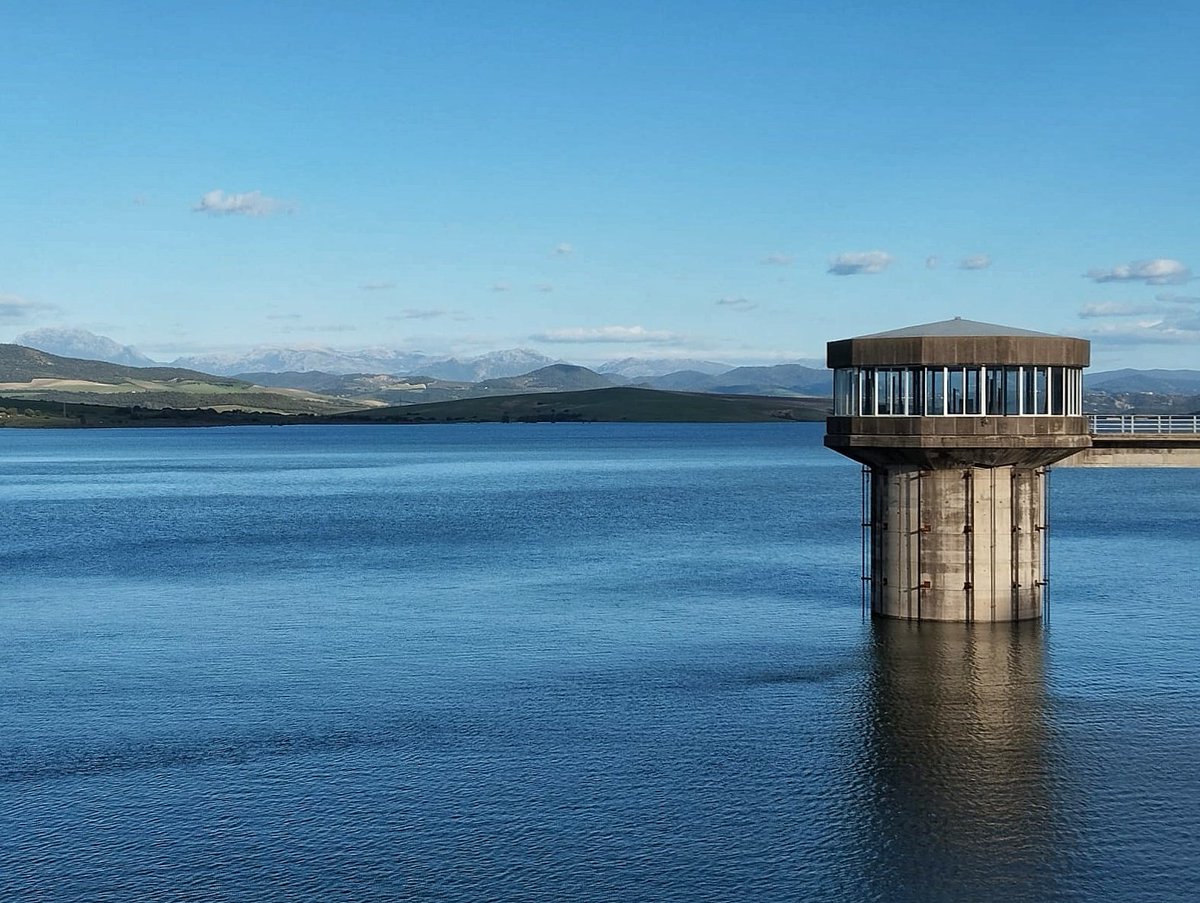
Imagen actual del embalse de Guadalcalcín tras las abundantes lluvias, con la Sierra de Grazalema al fondo. Se encuentra al 93.4 % de su capacidad, con 747.28 hm³ almacenados. Pocas veces lo vemos así. #Cádiz 🌧️
Efecto Venturi.
Se ha estudiado para explicar la singularidad pluviométrica de #Grazalema (➡️ https://t.co/PX8cVMaoVk)
Si, además, impacta (como ha pasado ahora) un río atmosférico, se cae el cielo, tal y como ha ocurrido.
🥺 Se apaga el micrófono, pero se queda el eco de 38 años de pasión por contar la vida.
📻 Hoy Elena Gijón cierra una etapa de su vida: 35 años en Onda Cero y media vida al frente de las noticias de cada mediodía.
🗣️ "La radio ha sido mi vida", con esas palabras se despide hoy nuestra querida Elena. Y nosotros, desde el otro lado del cristal, solo podemos decirte: Gracias, Elena, porque durante 35 años, tú has sido y siempre serás un trocito de Onda Cero.
💚 Gracias, Elena, por enseñarnos que la radio se hace con el corazón. Onda Cero siempre será tu casa.
Eran novios se habían comprometido esa misma noche, salieron a celebrarlo, no sabían que iban a ser sus últimos besos, sus últimos bailes. Cuando regresaban a casa (#Beasain) les acribillaron. El claxon sonó 27 minutos, nadie les socorrió. Eran Hortensia y Antonio.
#1979
🧵
Este es el respeto que el @aytoubrique muestra por los vecinos de la Avenidade España. La misma historia del año pasado y la misma del año que viene. Parece no importarles el derecho al descanso que todo ciudadano merece. Debería haber elecciones siempre. O carnavales...
😠 Catalunya Ràdio rabia contra Rosalía por cantar en castellano con la Escolanía de Montserrat: «Es una humillación para los catalanes y para ella misma, es una falta de respeto y es comprar un marco españolista hasta el fondo».
📹 @CatalunyaRadio