IESE Macrofinance NYC 2025 — The Global Dollar System in Transition
On November 3–7, 50 IESE MBAs will descend on New York City — our classroom for a week-long applied Macrofinance module on the changing architecture of the global dollar system.
Built on Zoltan Pozsar’s Bretton Woods III framework, the course explores how policy, markets, and liquidity are being rewired in real time.
We’ll hear directly from those shaping this new era — across the Fed, Treasury, Wall Street, and beyond — to understand how the next monetary system is being built, traded, and contested.
Follow along here at #IESENYC as we map the shifting fault lines between: Markets and Money / Nominal and Real / Policy and Power.
The dollar system isn’t ending — it’s evolving.
The architect of US defense strategy, Elbridge Colby, published his playbook years before taking office. Most haven't read it. In my report I break down his framework, show its influence on the NSS, & why the "spheres of influence" theory gets it wrong.
https://t.co/3tyHU5Cpg3
Alright, let’s go down the rabbit hole but keep one foot in reality.
If this really were intentional, the most logical explanation isn’t some wild political conspiracy, it’s strategic liquidity management or put more bluntly, fiscal engineering dressed up as coincidence. Keeping the Treasury General Account bloated at $1 trillion while the government is technically closed drains liquidity from the system. Every dollar parked there is a dollar pulled out of bank reserves. That kind of reserve scarcity makes funding markets squeal causing repo rates to tighten, liquidity thins, and banks start feeling pressure.
Now, here’s where it gets interesting. A little bit of funding stress tends to freak the Fed out, they hate disorder in money markets because it risks spilling into credit and equities. So if Treasury wanted to quietly force the Fed’s hand, this is one way to do it. Starve the system of reserves, make things feel tight, and let markets start whispering about QE or market functioning operations. The Fed steps in not to ease, but to stabilize. Different words, same playbook.
Why would they want that? Because Treasury’s sitting on a mountain of debt to roll over through 2026. The government needs lower long term rates, but can’t politically say “we need QE again.” So if markets tighten just enough to justify intervention, the Fed gets dragged back into the game without calling it stimulus. It’s like forcing the fire department to show up without admitting you lit the match.
There’s also a timing benefit. Hoard cash now during the shutdown, hold the TGA high, and then when things reopen unleash a burst of spending that feels like a mini stimulus. You drain liquidity when you want to cap inflation, and then inject it when you want to juice growth. It’s not elegant, but it’s powerful.
None of this requires backroom plotting just incentives lining up. Treasury wants cheaper funding. The Fed wants calm markets. Dealers want more flow. The mechanism is simple, just stress the system just enough to make intervention look like prudence, not policy.
If that’s what’s happening, it’s less of a conspiracy and more of a controlled burn and a way to get the Fed back into liquidity management without ever calling it QE.
JD Vance did not dress as himself—he dressed as the simulation of himself. The meme, that infinitely reproducible pixelated idol, had already become more real than the man.
The meme is his double, but also his salvation. It circulates faster, believes harder, and suffers less. In donning his own caricature, Vance affirms that the true campaign is not waged in Ohio or Washington, but in the hyperreal expanse of feeds and timelines where identity is pure liquidity.
What once would have been satire now becomes liturgy. The mask is not worn to mock, but to merge—to collapse the distinction between image and original.
17 years after the white paper, the Bitcoin network is still operational and more resilient than ever. Bitcoin never shuts down.
@SenateDems could learn something from that.
China Banking News: "Lian Ping, director of the China Chief Economist Forum, argues that China continues to face risks and perils on multiple fronts, all of which threaten to undermine its economic growth prospects."
https://t.co/MJGxj0PPph
It’s called “The Wall Street Journal” and not “The Main Street Journal” for a reason: the @WSJ Editorial Board has a built-in bias towards big banks. That bias was on full display this month in an editorial that shrugged off the damage Dodd-Frank has inflicted on small and mid-sized banks.
In a response to the Board, @SenatorHagerty and I explain how raising the FDIC limit to capture business and payroll accounts could pave the way for a community bank comeback.
https://t.co/OsZoQIAOPv
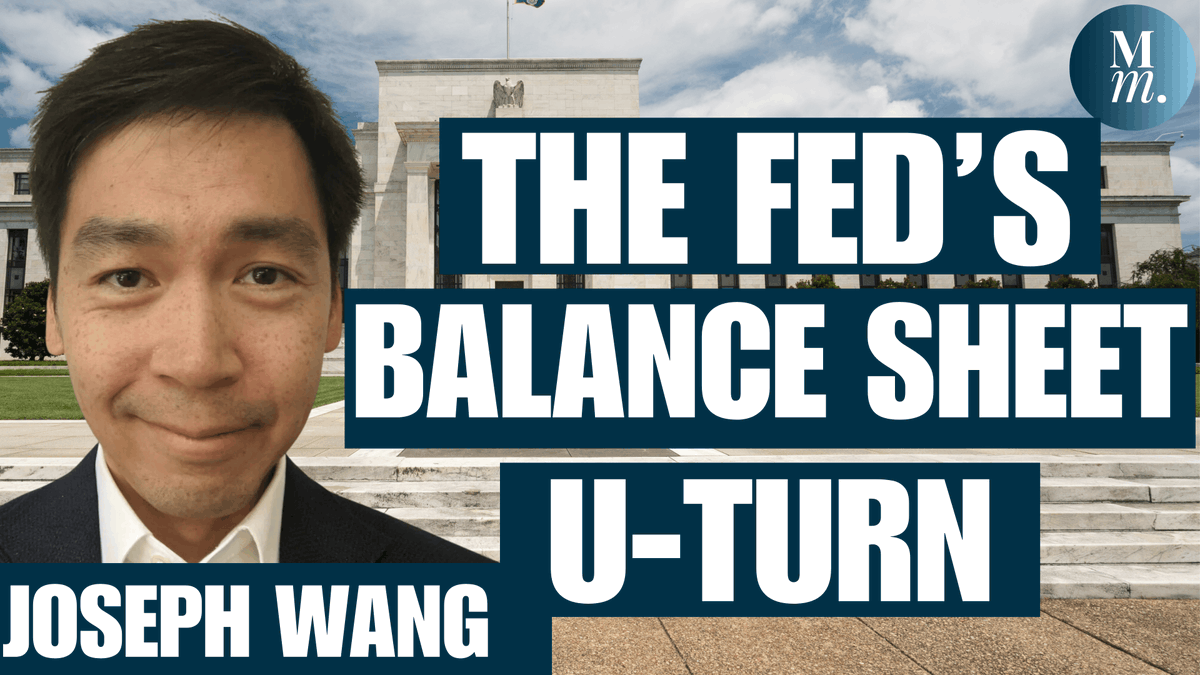
OUT NOW - Joseph Wang @josephwang argues funding stress in the repo market likely to force Fed to expand its balance sheet to avoid losing control
Apple 🔊https://t.co/YZGZZw88uM
Spotify 🔊https://t.co/y3kGjYpLmV
China is portrayed as the winner in this week's agreement with the US, but the reality is that China desperately needed a deal. You just have to look at how Chinese goods are flooding countries around the world to see the damage US tariffs are causing...
https://t.co/MxLJSY0bKv
1/5
China Banking News says that former PBoC governor Zhou Xiaochuan disagrees with the claim that China's refusal to run trade deficits limits the global role of the renminbi. He also believes that to do so would undermine Chinese manufacturing.
https://t.co/bVqgHyW9OR
Joseph Wang's argument in a nutshell:
The tremendous fiscal deficit is stoking repo (overnight collateralized borrowing) demand that requires reserves... if Fed doesn't inject liquidity, they could "lose control over interest rates" - @josephwang
https://t.co/YZGZZw8Gkk
My report on @commonplc explains how China used subsidies to dominate critical supply chains, while we sat back refusing to provide support. The US must now use strategic investment as part of its industrial policy toolkit or accept permanent dependency
https://t.co/eJrB6psi5F
It is not often I read something that blows my mind, but this did. 🤯
I would highly recommend taking the 5 minutes to read it, and then an additional 5 minutes to pause and reflect to consider all the ways our world is about to radically change.
h/t @matthew_pines
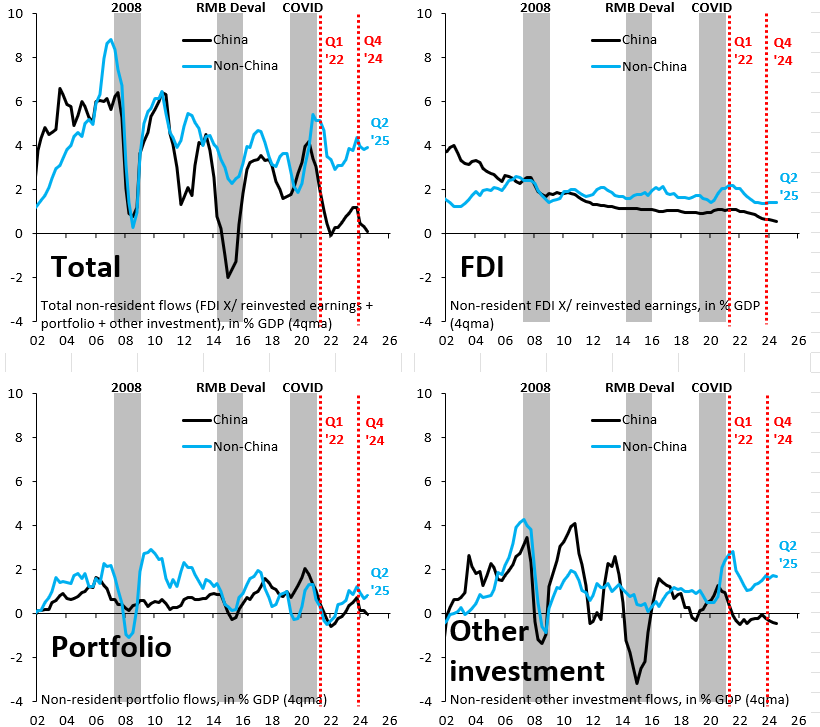
With its aggressive bullying - from rare earths to Taiwan - China is isolating itself globally. Global markets are pulling back, a trend that began after the pandemic and pre-dates this year's tariffs. China is driving itself into financial isolation...
https://t.co/aT5wkXKbCk
As highlighted on the chart below, the 10-year yield has been in a down channel since hitting 4.62% on May 22.
If Gross is correct (repost below) and the 10-year yield rises to 4.25% in the short-term, it will exceed its 4.20% "lower high" in late September and mark the first "higher high" in six months.
Should a "higher high" happen, that would mean the highlighted downtrend ended on October 17 at 3.93%.
As I write, the 10-year is trading at 4.09%, up 11 basis points from yesterday afternoon and 11 basis points from a "higher high." So, halfway there in less than one day.
When the Fed begins buying treasury bills in a swap for central bank reserves in a few months,
is that money printing?
Is it QE?
Fully open to views and curious peoples thoughts
The U.S. isn’t rebuilding China’s rare-earth empire — it’s leapfrogging it.
Science, finance & alliances are converging into a multi-pronged strategy that could compress decades into years
The membrane story was just the start..🧵
A New Treasury-Fed Accord & The Cryptodollar Frontier
The line between fiscal and monetary policy responsibilities has blurred, the relationship between the Fed and Treasury must adapt.
The next Accord won’t be about independence, but interdependence.
Meanwhile, stablecoins, CBDCs, and crypto-collateral test the edges of par.
The global dollar system is evolving. Stay tuned.
#IESENYC
🧵 Thread: “The Global Dollar System in Transition”
The global dollar system isn’t ending — it’s evolving.
Next week, 50 IESE MBAs take New York City as our classroom to map how policy, markets, and money are being rewired in real time.
Here’s the 10-point narrative guiding our #Macrofinance journey. 🧵
#IESENYC #BrettonWoodsIII
Capitalism with Chinese Characteristics
National industrial policy is back.
Re-shoring and strategic equity stakes blur fiscal and industrial strategy.
The U.S. balance sheet is becoming an investment portfolio.