Valuation-wise, Indonesia is arguably one of the cheapest equity markets in Asia today. Many well-known blue-chip companies are trading at what can only be described as crisis-like multiples despite maintaining healthy balance sheets, dominant market positions, and attractive dividend yields.
BBCA trades at roughly 11x forward earnings and 2.6x book value. Bank Mandiri trades at around 6x forward earnings and 1.2x book value. BRI trades at approximately 7x forward earnings and 1.3x book value. Astra sits at 6x forward earnings. Kalbe trades at 9x forward earnings. Amman trades at roughly 10x forward earnings. The list goes on.
Many of these companies also offer high single-digit dividend yields, with some names approaching double-digit yields. On paper, this should attract significant investor interest. Yet share prices continue to drift lower.
The obvious question is: where are the buyers? Where are all the investors who have spent years believing Indonesia’s long-term potential? Indonesia’s weight in MSCI Emerging Markets remains only around 0.5-0.6%, remarkably small relative to the size of its economy, population, and long-term growth aspirations.
More importantly, where is Danantara? It was presented as a potential new source of domestic capital and a stabilizing force for Indonesian financial markets. If the local market is trading at distressed valuations, this should be the type of environment where a large domestic institutional investor helps establish confidence.
The problem, however, is that cheap valuation alone is rarely enough. Markets ultimately pay for growth.
Indonesia’s core challenge today is not valuation. It is earnings growth. Aggregate earnings growth for the market has slowed materially, with many sectors struggling to generate meaningful expansion. Compare that with South Korea and Taiwan, where investors are being offered direct exposure to AI, semiconductors, advanced manufacturing, memory, and high-performance computing. Foreign investors are naturally willing to pay higher multiples for companies whose earnings are compounding rapidly.
Currency concerns add another layer of complexity. Investors are not simply underwriting Indonesian corporate earnings. They are also underwriting the rupiah. If currency depreciation continues to offset equity returns, valuation discounts can persist far longer than expected.
There is also a credibility issue that should not be ignored. For years, many foreign investors have complained that parts of the Indonesian market function primarily as distribution channels rather than genuine capital formation venues. Domestic equity sales teams routinely promote names that later become exit liquidity for local institutions seeking to reduce exposure. Over time, repeated experiences like this erode trust.
The persistent allegations of wash trading, questions around effective free float, concentrated ownership structures, and concerns over genuine liquidity have further damaged confidence. Investors do not simply buy low valuations. They buy governance, transparency, liquidity, and confidence in future earnings.
This is why cheap markets can remain cheap for years. A stock trading at 6x earnings can still fall to 5x. Valuation itself is not a catalyst.
The harsh reality is that Indonesia does not have a valuation problem. It has a growth and confidence problem.
Until investors see stronger earnings growth, more credible policy execution, better market governance, improved liquidity, and a clearer path for capital to generate attractive real returns, low multiples alone will not be enough to attract meaningful foreign capital back into the market.
Cheap without growth is a value trap. Cheap with deteriorating confidence is even worse.
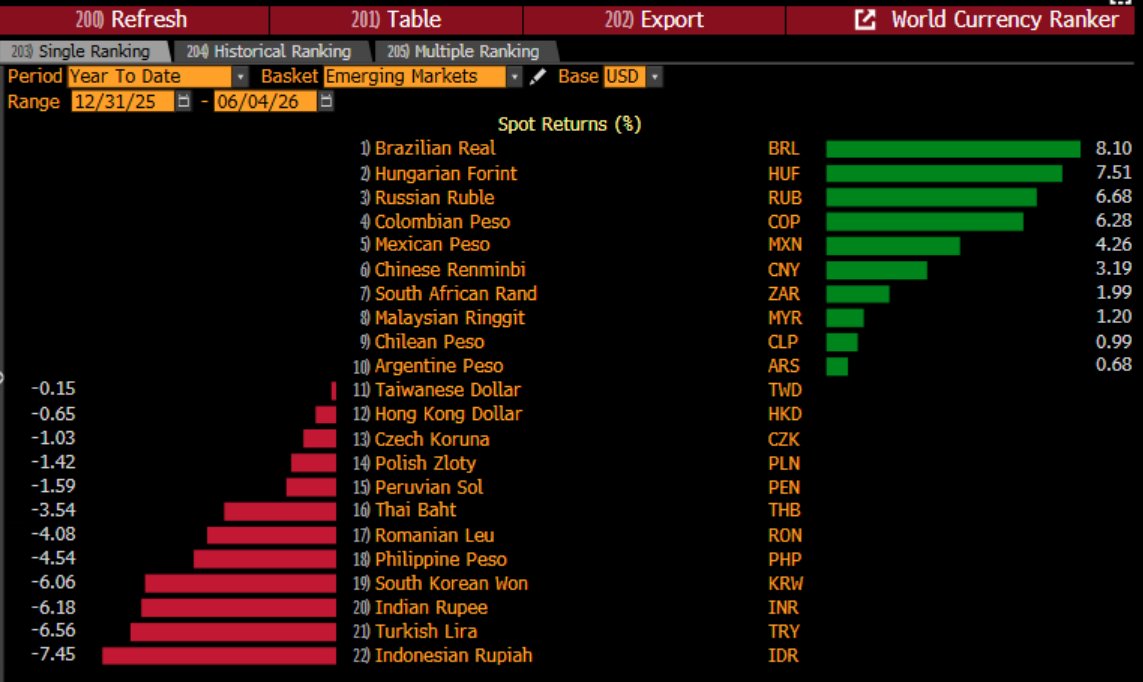
Indonesia’s attempts to target everything – inflation, growth, currency stability – are not working. Something has to give, and in this case it’s IDR, which sits at the bottom of the 2026 EMFX league table. Reports on strengthening BI’s pro-growth mandate raised more red flags
Realising Apple went public at under $2 billion and 15 times revenue in 1980.
SpaceX wants you to buy at $2 trillion and 100 times revenue in 2026.
That is not getting in early. That is being the exit for venture capitalists who have held this equity for years at a fraction of what you are being asked to pay.
Almost none of the retail investors buying this IPO will read the 300 pages before the book closes on June 11.
That is your entire competitive advantage right there.
Prabowo Subianto is centralising power, marginalising opposition and spending beyond Indonesia’s means. He could undo 20 years of economic and political progress https://t.co/Br1pQc0xUG
We revise our rupiah target back to our initial base case of Rp18,500/USD from Rp20,000/USD as the larger-than-expected 50bps hike by Bank Indonesia should provide at least some near-term anchor for the currency.
The move signals that BI is willing to front-load policy tightening more aggressively than markets previously expected in order to defend macro stability and contain depreciation pressure.
That said, the hike also comes with a cost. The scale of the move reinforces the perception that policymakers are becoming increasingly desperate in defending the rupiah. And ironically, once central banks begin looking defensive rather than proactive, speculative pressure can actually intensify because macro traders and FX funds start testing how sustainable the defense really is.
This is especially true when the underlying market concern is no longer simply about interest rate differentials. The broader issue increasingly revolves around fiscal credibility, policy consistency, external vulnerability, and investor confidence toward Indonesia’s macro management framework itself. To be fair, fiscal credibility improved modestly after the government announced a reduction in the free meal program budget from Rp335 trillion to Rp268 trillion, implying roughly Rp67 trillion or around 20% in cuts. Markets will likely view this as an acknowledgment that fiscal discipline still matters despite aggressive growth ambitions.
However, global macro conditions remain unfavorable for emerging market currencies overall. US Treasury yields continue moving structurally higher while Japanese bond yields are also repricing upward after decades of ultra-loose monetary policy. That combination reduces the relative attractiveness of emerging market assets and tightens global liquidity conditions simultaneously.
The biggest external risk now remains oil. If geopolitical tensions escalate further and inventory depletion accelerates, there is a meaningful possibility that oil prices could become parabolic. Indonesia remains highly sensitive to higher oil prices through imported inflation, subsidy pressures, fiscal deterioration, trade balance risks, and further rupiah weakness.
In that scenario, BI may ultimately find itself trapped between defending the currency aggressively or protecting domestic growth momentum.
Our base case now is that the rupiah could stabilize or strengthen modestly in the short term following the surprise hike. But over the medium term, we still expect global yield repricing, tighter liquidity conditions, and external risks to continue pressuring the currency structurally.
Indonesia’s markets fell as speculation mounted that the government will centralize commodity exports to control capital flows and shore up a plunging currency https://t.co/6OxYFZ3hp0
Elon Musk avait dit un truc qui m'avait marqué sur l'allocation de ressources. En substance : passé un certain niveau de richesse, l'argent n'est plus de la consommation, c'est de l'allocation de capital.
Cette phrase change tout.
L'économie, dans le fond, c'est juste un problème d'allocation. Tu as des ressources finies et des usages infinis. Qui décide où va quoi ?
Imagine une cour de récré. 100 enfants, des paquets de cartes Pokémon distribués au hasard. Tu laisses faire. Très vite, un ordre émerge. Les bons joueurs accumulent les cartes rares, les collectionneurs trient, les négociateurs trouvent des deals. Personne n'a planifié. Et pourtant chaque carte finit dans les mains de celui qui en tire le plus de valeur. Le système maximise le bonheur total de la cour. C'est ça, la main invisible.
Maintenant fais entrer la maîtresse. Elle trouve ça injuste. Léo a 50 cartes, Tom en a 3. Elle confisque, redistribue, impose l'égalité. Trois effets immédiats. Les bons joueurs arrêtent de jouer, à quoi bon. Les mauvais n'ont plus de raison de progresser, ils auront leur part. Les échanges s'effondrent. La cour est égale, et morte. Elle a maximisé l'égalité, elle a détruit le bonheur.
Le problème de la maîtresse, c'est qu'elle ne peut pas avoir l'information que la cour avait collectivement. C'est le problème du calcul économique de Mises, formulé en 1920. L'URSS a essayé de le résoudre pendant 70 ans avec le Gosplan. Résultat : pénuries, queues, effondrement. Pas parce que les Soviétiques étaient bêtes, parce que le problème est mathématiquement insoluble en mode centralisé.
Quand Musk a 200 milliards, il ne les consomme pas, il les alloue. SpaceX, Starlink, Neuralink, xAI. Chaque dollar est un pari sur le futur. Et lui a un track record. PayPal, Tesla, SpaceX. Il a démontré qu'il sait identifier des problèmes immenses et y allouer des ressources avec un rendement spectaculaire.
L'État aussi a un track record. Hôpitaux qui s'effondrent, éducation qui décline, dette qui explose, services publics qui se dégradent malgré des budgets en hausse constante. Le marché identifie les bons allocateurs, la politique identifie les bons communicants.
Le profit n'est pas une finalité, c'est un signal. Il dit : tu as alloué des ressources rares vers un usage que les gens valorisent suffisamment pour payer. Plus le profit est gros, plus la création de valeur est grande. Quand Starlink est rentable, ça veut dire que des millions de gens dans des zones rurales ont enfin internet. Quand un ministère est en déficit, ça veut dire qu'il consomme plus qu'il ne produit. L'un crée, l'autre détruit, et on appelle ça redistribution.
Dans nos sociétés il y a deux catégories d'acteurs. Les entrepreneurs et les bureaucrates. L'entrepreneur prend un risque personnel pour identifier un problème, mobiliser des ressources, créer une solution. S'il se trompe il perd. S'il a raison, ses clients gagnent, ses employés gagnent, ses fournisseurs gagnent, l'État collecte des impôts. Il est la cellule de base du progrès humain.
Le bureaucrate ne prend aucun risque personnel. Son salaire est garanti. Au mieux il maintient une rente existante. Au pire il la détruit par excès de réglementation, mauvaise allocation forcée, incitations perverses qui découragent ceux qui produisent. Mais dans aucun cas il ne crée.
Regarde les 50 dernières années. iPhone, internet civil, SpaceX, Tesla, Google, Amazon, Stripe, mRNA, ChatGPT. Toutes des inventions privées, portées par des entrepreneurs, financées par du capital risque. Pas un seul ministère n'a inventé quoi que ce soit qui ait changé ta vie au quotidien.
La France est devenue le laboratoire mondial de la dérive bureaucratique. 57% du PIB en dépenses publiques, record absolu. Une administration tentaculaire, une fiscalité qui pénalise la création de richesse. Résultat : décrochage face aux États-Unis, à l'Allemagne, à la Suisse. Fuite des cerveaux. Désindustrialisation. Dette qui explose.
Et le pire c'est que la mauvaise allocation s'auto-renforce. Plus l'État prélève, moins les entrepreneurs créent. Moins ils créent, moins il y a de base fiscale. Plus l'État s'endette et taxe. Boucle de rétroaction négative parfaite. La maîtresse pense qu'elle aide, et chaque année la cour produit moins.
Dans nos sociétés, ce sont les entrepreneurs, toujours, qui font avancer la civilisation. Les bureaucrates au mieux maintiennent une rente, au pire la détruisent. Aucune société n'a jamais progressé en taxant ses créateurs pour subventionner ses gestionnaires.
La question n'est jamais qui a combien. C'est qui alloue le mieux la prochaine unité de ressource pour maximiser le futur de l'humanité. La réponse depuis 200 ans n'a jamais changé. Ce ne sont pas les fonctionnaires.
Look who just made it to the top 4! 👀🎉
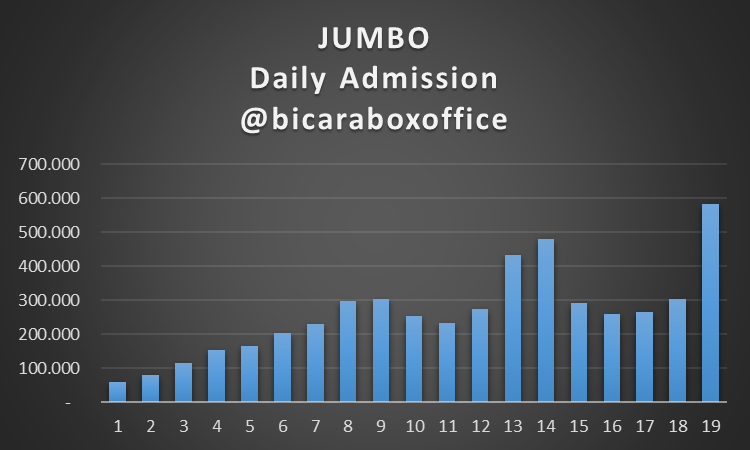
#Jumbo is now Indonesia’s 4th highest film by admissions. ✨
We’re so proud and honestly still in awe that our darling #Jumbo has won hearts and reached this incredible height. 🥹❤️🌟
FILM JUMBO SUDAH DISAKSIKAN LEBIH DARI 5.000.000 PENONTON 🥺
Kami terharu dan bersyukur karena energi baik yang diberikan ke JUMBO sungguh luar biasa 🫶🏻
Perjalanan film ini yang sudah melewati kurang lebih 5 tahun dapat sambutan dari kalian semua yang benar-benar melebihi mimpi ✨
Terima kasih untuk setiap langkah kaki menuju bioskop, untuk setiap ajakan ke keluarga dan sahabat, untuk setiap review dan cerita yang kalian bagikan.
Terima kasih sudah jadi bagian dari #BuzzerJUMBO dengan cinta yang luar biasa 🤗
Kami masih ingin melihat lebih banyak senyum di kursi-kursi bioskop. Yuk jadi bagian dari film JUMBO, amankan tiketnya sekarang di: https://t.co/AMla28ohHt
#JumboUntukSemua #JUMBO #FilmJumbo
Frozen II (2019): 4,632,081
Jumbo (2025): 4,376,162
Looking straight at Elsa's record as Indonesia's highest-grossing animated film...
And ready to leave it in the dust! 🔥🚀
#JUMBO
Ini lebih di luar nalarku..👇🏾😭💔
User TikTok @elmerrybs meng-cover “Selalu Ada di Nadimu” (BCL Vers.) dalam bahasa Korea. 😭😭😭
BAGUS BANGET GILAK merinding gak berujung.
THANK YOU THANK YOU THANK YOU.
#FilmJUMBO masih tayang di bioskop.
@laleilmanino@itsmebcl_ DENGERIN😭💔
JUMBO resmi jadi film animasi terlaris sepanjang masa di Asia Tenggara!
Per 13 April (3,2 juta penonton) udah meraih lebih dari 8 juta USD. Melewati rekor sebelumnya yang dipegang MECHAMATO (2023) dgn 7,68 juta USD.
Masih akan terus bertambah!
Via Deadline.