How to Speak Cork (1972)
"There's one thing about us in Cork. We have a beautiful accent."
Cork man James N. Healy takes a look at the Cork accent through the ages.
Clip from Hall's Pictorial Weekly, broadcast on RTE on 21 October 1972.
We see our home planet as a whole, lit up in spectacular blues and browns. A green aurora even lights up the atmosphere. That's us, together, watching as our astronauts make their journey to the Moon.
It's Spy Wednesday, let's look at how Italian masterpiece "The Taking of Christ" by murderous hellraiser Caravaggio ended up hanging in a dining room in Leeson Street!
The iconic scene depicts Judas Iscariot betraying Jesus in the Garden of Gethsemane, identifying him to the Roman soldiers with a kiss. The work was commissioned by Ciriaco Mattei, a Roman nobleman in 1602.
Michelangelo Merisi da Caravaggio (1571-1610) had a life as full of shadows and violence as his paintings. The master of baroque was a notoriously violent criminal. His signature technique was manipulating shadow, utilising tenebrism and chiaroscuro. When he wasn't in exile or prison for assault or murder, he was one of the most famous and sought-after artists in Rome.
Whether you are a Christian or not, the masterpiece has an astonishing power within it. The vividness of the moment, the chemistry of the interrelationships depicted, has a universal quality.
And of course, that mesmerising play of light and shadow. Incidentally, the man on the right holding the lantern is believed to be Caravaggio himself! Perhaps it takes a sinner to truly capture the drama and betrayal of such a moment.
The masterpiece was lost and presumed destroyed for centuries. In 1786, an 18th-century engraver and topographer called Giuseppe Vasi misattributed the painting, not merely as a Dutch copy, but to a specific artist: Gerrit van Honthorst, known in Italy as Gherardo delle Notti, one of Caravaggio's own followers.
The label stuck, repeated in every successive inventory, including a Mattei family stock-taking in 1793. There was even a telling typo that would prove crucial centuries later: the label consistently misspelled Honthorst's nickname as "Gherardo della Notte" rather than the correct "Gherardo delle Notti." That small error, faithfully copied across generations of documents, would become one of the key clues in the eventual authentication.
In 1802, Duke Giuseppe Mattei, needing to pay his debts, sold the painting along with others to William Hamilton Nisbet, a wealthy Scottish art collector then in Rome. The "Honthorst" hung in his Scottish home until 1921, when it was sold at auction in Edinburgh, passing through one more set of hands before ending up with a Dublin woman named Marie Ryan, better known by her married name, Marie Lea-Wilson.
She had a heartbreaking reason to be in Scotland. Her husband, Captain Percival Lea-Wilson, had been a District Inspector of the Royal Irish Constabulary, shot dead on a Gorey street in June 1920 by the IRA on the direct orders of Michael Collins. The killing was revenge for Lea-Wilson's treatment of republican prisoners after the Rising, when he famously ordered the elderly Proclamation signatory Tom Clarke to strip naked in public. Collins, who had witnessed the humiliation, waited four years to settle the account.
In the aftermath of that devastating loss, Marie received spiritual support from the Jesuits, particularly Father Thomas Finlay SJ at the Leeson Street community house. When she had qualified as a doctor she gifted the religious painting to Fr Finlay as a token of her gratitude.
It hung on the wall of the dining room at 35 Leeson Street, where it would sit quietly for the next six decades, admired as a fine old Honthorst by anyone who thought about it at all.
In 1990, Father Noel Barber, then Superior of the Leeson Street community, contacted the National Gallery of Ireland about restoring some paintings. The Gallery's Assistant Director, Dr Brian Kennedy, came to it with senior conservator Sergio Benedetti. Benedetti took one look at the canvas and felt his pulse quicken.
After 3 of painstaking analysis, it was confirmed an original. Much of the archival credit belongs to Francesca Cappelletti and Laura Testa, PhD students at the University of Rome. You can view it in National Gallery of Ireland in Dublin.
Buy the Dublin Time Machine a pint and support the DTM Book https://t.co/U7jtCrOTtb
“A pint of plain is your only man.” 🍺
Written by Flann O'Brien in the 1940s and later turned into a pub classic by The Dubliners.
A tongue-in-cheek piece of Dublin pub philosophy suggesting that when things go wrong, the answer might simply be a pint of stout.
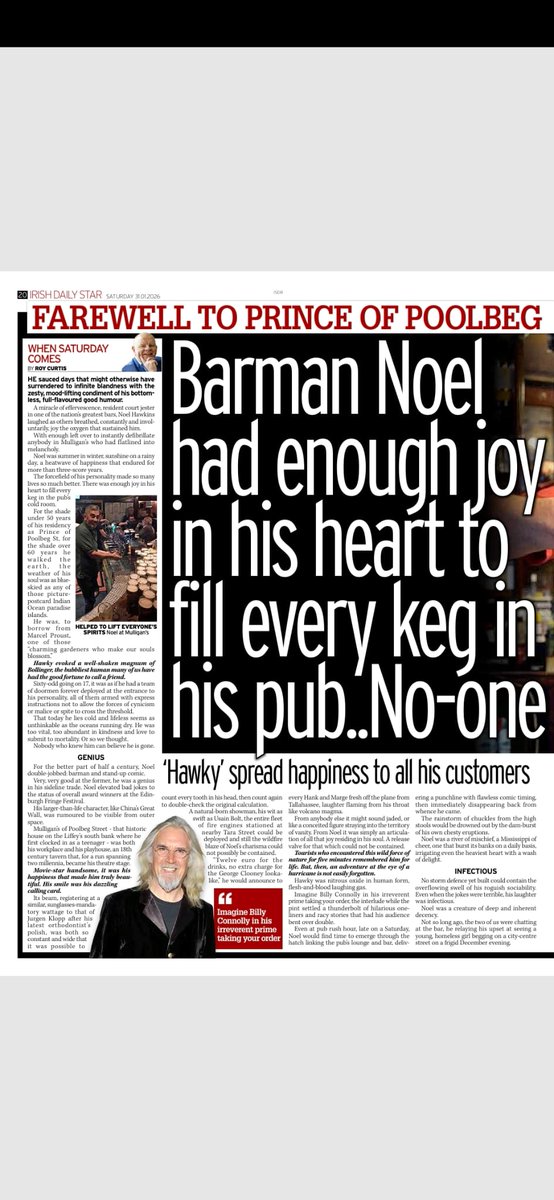
A column on one of Dublin's most joyous men.
For almost 50 years, Noel Hawkins dispensed porter and good humour at @Mulligans6
Hard to believe he has left us.
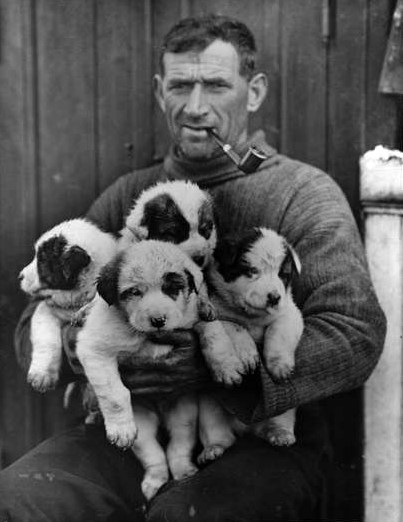
Adventurer Tom Crean was born in 1877 in Annascaul, Kerry. He joined the Royal Navy at 15, lied about his age and drifted steadily southwards until he reached the edge of the known world. By the time the so-called Heroic Age of Antarctic Exploration reached its brutal peak, Crean was already a veteran. He would serve on 3 major expeditions, under Robert Falcon Scott and Ernest Shackleton, and he would outlive many of the men whose names now loom larger in the history books.
Crean’s first great test came during Scott’s ill-fated Terra Nova expedition. By January 1912, Scott’s party was pushing south towards the Pole, supported by rotating teams who were ordered to turn back at set distances. Crean was part of the final support party, alongside Bill Lashly and Lieutenant Edward “Teddy” Evans.
They were just 150 miles from the Pole when Scott made his decision. Crean was ordered to turn back. The return journey was a slow collapse. Evans fell gravely ill with scurvy. He was disoriented, frostbitten and barely able to stand. Crean and Lashly tied him to a sledge and dragged him north across the Ross Ice Shelf, hauling a grown man for hundreds of miles in sub-zero temperatures. By the time they reached Hut Point, Evans was close to death and Lashly was near exhaustion.
This is where Crean made the decision that defines his reputation. With no tent, no sleeping bag, and only two sticks of chocolate and three biscuits in his pocket, he set off alone for the final 35 miles to Cape Evans to fetch help. He walked for eighteen hours straight through a blizzard, navigating by instinct and memory across a white nothingness. He reached the hut just as a massive storm closed in behind him.
The rescue party returned in time. Evans survived. Lashly survived. Crean was awarded the Albert Medal for Bravery, one of the highest civilian honours for lifesaving. He accepted it without fuss and never spoke of it again. Scott, meanwhile, marched on and died with his polar party on the return from the Pole.
Shackleton’s Endurance expedition revealed his ability to survive disaster without surrender. The ship Endurance was trapped in pack ice in the Weddell Sea in early 1915 and slowly crushed over months, until she finally sank beneath the ice. The crew were stranded for over a year, hauling boats, supplies and each other across a landscape dissolving under their feet.
When the ice finally broke up, the men launched 3 small lifeboats and made for remote inhospitable Elephant Island. During the brutal open-boat journey, Crean effectively took command of one boat when the navigator collapsed, steering by instinct and experience through freezing seas.
Elephant Island offered no rescue. Shackleton knew that if they stayed, they would die. He selected 5 men to attempt a suicide mission. An 800-mile voyage across the worst ocean on Earth in a modified 22-foot lifeboat, the James Caird. Crean was an obvious choice.
For 17 days they battled the Southern Ocean, 60-foot waves and hurricane winds. The boat iced over constantly. Men bailed water day and night. Sleep only for minutes at a time. Crean took turns at the tiller and sang to keep morale up.
They made landfall on the wrong side of South Georgia. The whaling stations lay on the far side of the island, separated by unmapped mountains, glaciers, and ridges rising to over 3,000 feet. No one had ever crossed the interior.
They'd no tent or mountaineering equipment. They hammered screws through their boots for grip. For 36 hours they climbed without stopping. Faced with a steep descent and night closing in, they sat on their coiled rope and slid 1,500 feet down a snow slope into complete darkness. They reached the whaling station at Stromness. Within months, Shackleton returned and rescued everyone on Elephant Island.
Crean returned to Ireland, married and opened a pub in Annascaul called The South Pole Inn. He rarely spoke of Antarctica, even to his own family. He died in 1938, aged 61.
🚨🇦🇺 BONDI HERO AHMED AL AHMED HANDED $2.5 MILLION CHECK IN HOSPITAL: "GOD PROTECT AUSTRALIA"
The Syrian refugee who wrestled a rifle from one of the Bondi Beach terrorists has received a $2.5 million check from 43,000 donors, including a $99,999 contribution from American billionaire Bill Ackman.
When handed the enormous check in his hospital bed, Ahmed Al Ahmed asked three words:
"I deserve it?"
"Every penny," he was told.
Al Ahmed, 42, was shot five times while tackling gunman Sajid Akram.
His lawyer says he's "riddled with bullets" and may lose his arm.
He remains hospitalized but told media he doesn't regret what he did.
King Charles asked Australia's Governor-General to pass along thanks for his "absolute heroics."
Al Ahmed has been nominated for the Cross of Valour, Australia's highest bravery award.
Prime Minister Albanese:
"He found himself at a moment where people were being shot in front of him.
He decided to take action."
A man who fled war in Syria, now being celebrated for saving lives on an Australian beach.
Source: @Breaking911 / NewsComAU
@behemoth_mark@wallacemick Bot. Supports Palestine fighting against imperialism while also supporting Russian imperialists. Some mental gymnastics there
@john_mcguirk Carlson was fired by Fox for being too extreme even for them. Kimmel was fired because of threats from the president and the FCC. There's a bit of a difference
@wallacemick His country was invaded by the most genocidal, mass murderer of the 21st century. What did you expect him to do Moscow Mick? Roll over for your hero Putin? By the way the most corrupt country in Europe is your favourite one, Russia
He's done it again 🤩
Stuart McCarthy once again lifts the roof off Turner's Cross by hitting the bar in yesterday's @Dominos_ROI Crossbar Challenge! 👏🏼
Go on Stuey! 🔥
#CCFC84 🇮🇹