The moment someone tells you Elon Musk should solve world poverty with his wealth, you're listening to someone who fundamentally misunderstands both wealth and poverty. Musk's billions exist almost entirely as Tesla and SpaceX stock, not cash sitting in a vault waiting to be redistributed.
The real issue runs deeper than liquidity. Poverty is fundamentally a productivity problem, not a resource shortage. If throwing money at poverty solved it, the $4.3 trillion the US government has spent on welfare programs since 1965 would have eliminated American poverty decades ago. Instead, the poverty rate has remained virtually unchanged since the War on Poverty began.
You can't redistribute your way out of poverty because wealth isn't a fixed pie that rich people hoard. Musk created his fortune by building companies that produce electric vehicles, rockets, and satellite internet. His wealth represents the market's valuation of those productive assets. When politicians demand he liquidate those holdings to fund welfare programs, they're demanding he destroy the very capital that generates ongoing prosperity.
The countries with the lowest poverty rates didn't achieve that through foreign aid or wealth transfers. South Korea went from Third World to First World status in two generations through property rights, free markets, and rule of law. Meanwhile, sub-Saharan Africa has received over $1 trillion in foreign aid since 1960 and remains impoverished. Poverty reduction requires institutions that enable production, not redistribution schemes.
Real poverty reduction happens when entrepreneurs like Musk build productive enterprises that create jobs, generate tax revenue, and drive down costs through innovation. But that requires you to understand that capitalism creates wealth rather than just moving it around.
This is a long write-up but worth the read for Tesla investors who are interested in the prospect of a Tesla / SpaceX merger. @smdcapital@DanBTC916
As a former big law M&A attorney, I have been thinking about this potential transaction for many months now, trying to figure out how it would work, what the timing would be, mechanics, structure, etc.
With the recent decline in TSLA stock and negative sentiment following last week’s call, many Tesla bulls (I won’t name names) are now working overtime to convince followers that a near-term merger following SpaceX’s IPO is the right path forward. Indeed, Elon seemed to be dropping some hints with his commentary about Terafab, particularly the inherent conflicts and the difficulty in parsing out rights and responsibilities between each company.
And I do think Elon has had this thought in the back of his mind for the past few years, seeing the combination of his companies under a single structure as inevitable. I also think, through his actions and inactions (delays, missed deadlines, moving goal posts, divisiveness, politics, lack of enthusiasm on quarterly calls, etc.), he has kept the TSLA share price suppressed with that ultimate goal in mind. Occam’s razor.
So here are the mechanics. SpaceX is expected to IPO at a $1.75-$2.0T valuation. It will have a dual-class share structure, where Elon retains the voting shares.
Tesla has a single class share structure where each share has both voting and economic interests.
For a near-term merger to be viable, Elon has to ensure SpaceX maintains or exceeds its IPO valuation, and Tesla valuation stays at or below current levels.
Why? It is almost guaranteed that SpaceX would be the surviving entity in a merger scenario, so Elon can maintain the dual-class share structure and thus, maintain majority voting control. It is not legally possible to implement this type of structure at Tesla post-IPO, so the only way to keep it is if SpaceX is the surviving entity. And in order to convince Tesla shareholders to give up their voting rights in exchange for non-voting, economic shares in SpaceX (which is how such deals are commonly structured), SpaceX will have to offer a premium to Tesla holders — precedent is in the range of 20-40%.
If Tesla is trading at a similar valuation to SpaceX, e.g., $2.0 trillion, and SpaceX has to pay a 20-40% premium to entice Tesla shareholders to approve the deal and give up their voting rights, then SpaceX shareholders would be diluted and are less likely to approve the transaction.
If SpaceX is trading at $2.0 trillion and TSLA at its current $1.4 trillion market cap ($375/share), SpaceX can offer a 40% premium ($2.0 trillion valuation, $525/share, top-end of precedent) and avoid dilution. TSLA shareholders would almost certainly approve such an offer in light of current sentiment and Elon’s recent guidance (or lack thereof).
Keeping the TSLA share price suppressed is the only way any near-term merger is viable in my opinion.
I understand why Elon wants to combine the companies. It would significantly simplify governance and streamline his workload. And I ultimately think a combination of the two companies in the future makes sense.
But the reality is, we have waited patiently for years now (with the stock trading lower today than it traded 5 years ago!), and we are finally on the cusp of a significant re-rating once robotaxi is scaled and Optimus goes into volume production. As a Tesla shareholder, I would prefer to consider a merger with SpaceX after the re-rating, when Tesla is trading at a much higher valuation. Why give it up now in the 11th hour when we’ve waited this long already?
At the end of the day, what’s good for Elon isn’t necessarily good for Tesla shareholders.
Elon, from the bottom of my broken heart, thank you. ❤️
You’ve kept my beautiful daughter Liv’s memory alive in the most extraordinary way, by making Asteroid, the official mascot for SpaceX.
Liv poured her whole soul into designing that little dog in a spacesuit, dreaming of the stars just like you. Seeing her creation soar on Polaris Dawn already brought tears of joy. Knowing it will now be a part of every SpaceX mission, flying among the stars forever? That’s healing I can’t even put into words.
You didn’t just honor a young girl’s dream, you are keeping her spirit alive. Liv’s love, her laughter, her unbreakable fight lives on through Asteroid, and every time a Falcon roars or Starship climbs toward orbit, a piece of my girl flies with it.
I’m crying grateful tears right now. Thank you for this priceless gift.
You’ve turned our deepest pain into something eternal and beautiful among the stars. @elonmusk
"But Elon said Robotaxi would cover half the U.S. population by 2026!"
Let me introduce you to Elon Musk, because you must not be acquainted. Elon has been predicting that Tesla would launch Robotaxis every year for practically the last decade. He predicted a coast to coast autonomous drive in 2020. The first documented instance was in 2025, by David Moss. Getting surprised that Elon set an aggressive timeline and then missed it is like watching Jersey Shore and acting surprised every time they get drunk.
You may laugh at Elon and call him a fool when he misses these goals. But zoom out and realize that there is a reason Tesla is the only automaker in U.S. running a live driverless Robotaxi service ope to the public. The reason is that Elon sets insane, aggressive targets for the company.
Most companies optimize for achievable targets, because they don't want people to miss the target and have people laugh at them. But they end up still missing the achievable target and getting nowhere. If you miss an ambitious target you'll be ridiculed, but you'll likely end up further ahead than your competitors who set their sights lower.
That's why Musk continues to set ambitious targets. While the rest of the market is optimizing for hitting targets, he's optimizing for winning the market.
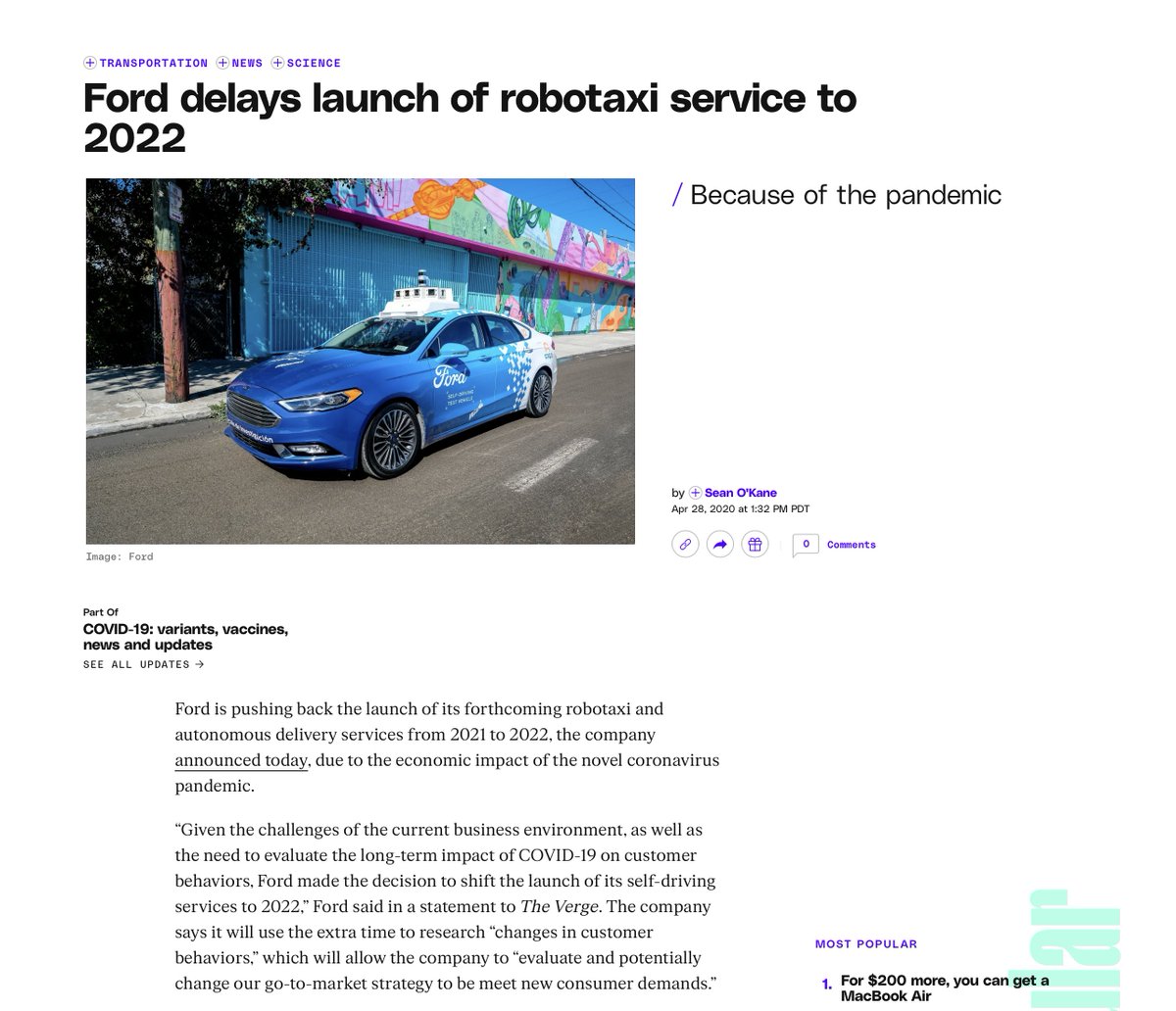
And really, people focus on his projections because Tesla is actually doing self-driving. We've conveniently forgotten about all the other automakers that promised self-driving and Robotaxis and were never able to do anything. Remember when Ford claimed that they would launch a Robotaxi service in 2021? And how when they didn't end up launching, they blamed it on the COVID pandemic? Everyone conveniently forgets about these missed targets from nearly every legacy automaker. Instead they mock the only automaker that actually launched a real Robotaxi service.
Musk's aggressive targets, despite being widely criticized, are actually the reason Tesla is years ahead of every other automaker in self-driving. Many investors who don't understand Tesla may see this as eroding credibility and sell their shares, and that's okay. Those of us who have been on the Tesla ride since before the company was profitable have learned that if you're never missing any targets, they're not ambitious enough. If more companies adopted this philosophy and set more aggressive goals for themselves, I think GDP would explode.