What is Proof of Useful Work?
This Quai Friday, we are diving into the intersection of decentralized AI, Proof-of-Work, and energy money.
Join us at 11 AM CDT to learn how traditional mining can be bridged with decentralized inference ⚡️
Set your reminder below:
Money is made of energy now. Come learn about Qi, the only crypto native stable flatcoin pegged to energy with cash like privacy properties ⚡💵
@QuaiNetwork
We officially crossed $5,000,000 in chain revenue.
Every dollar of that is being used to buy back and permanently burn $QUAI.
See how the community is memeyfying the huge 5M milestone with graphics and catchphrases 👇
As the war with Iran cools off, now is the perfect time to stop paying attention to the price of physical oil (USO/WTI) and begin paying attention to digital oil ($QUAI)
MAJOR UPDATE: $QUAI will launch an inference market, paper releasing soon. Implications are still being understood, but this is absolutely furthering the usefulness of it's proof of work.
If you are only interacting with $QUAI, you are missing out on the @QuaiNetwork's underlying design.
The $QI UTXO model gives you the cash-like privacy and stability most of crypto is lacking.
Convert between $QUAI and $QI and manage your full portfolio inside Pelagus.
Let’s start with Kaspa’s circulating supply: 27.51 billion KAS.
Sometimes I wonder what the Kaspa team had in mind. Were they planning to distribute tokens across the entire galaxy?
The other day, I saw a post claiming that Kaspa could reach $10 in the next cycle.
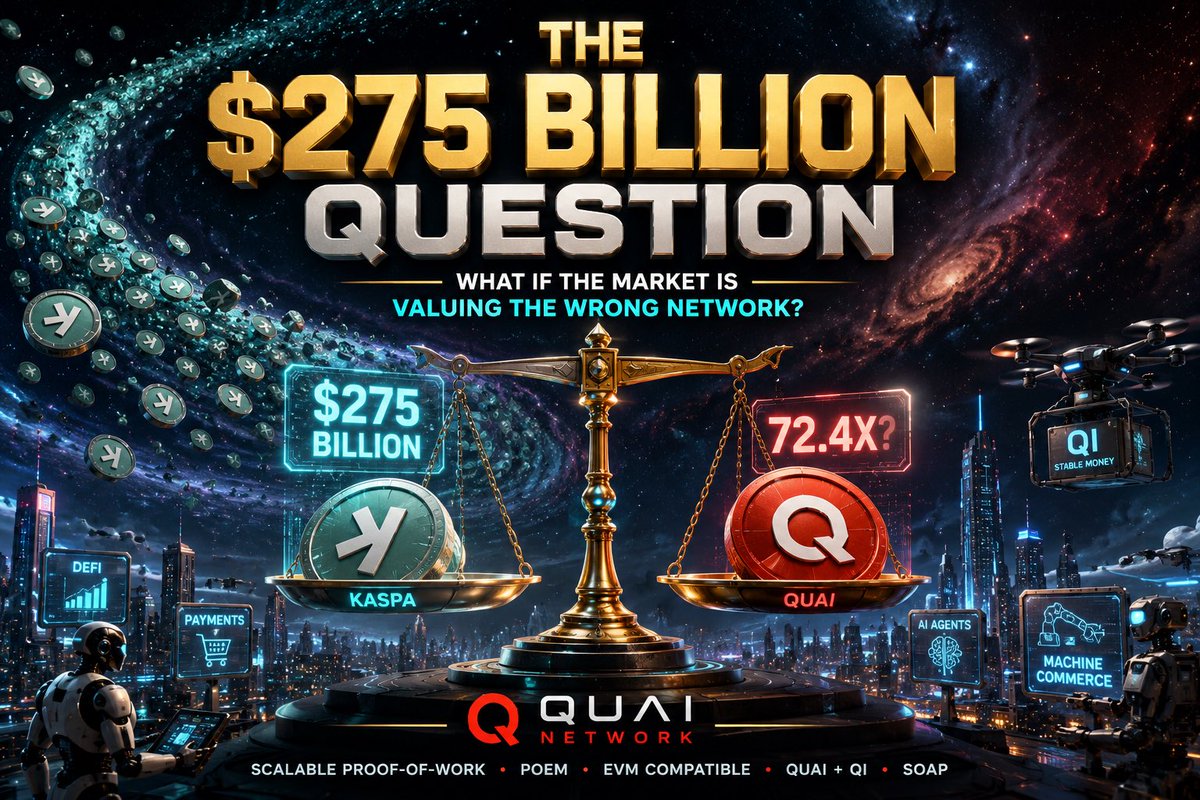
That would imply a market cap of approximately $275 billion for a project that, as of today, has virtually no meaningful adoption in the real economy.
What Kaspa does have is a strong narrative and a strong community. But a community alone is not economic adoption.
And let’s be honest: Kaspa cannot realistically function as money in a real economy. A token worth $0.035 today and $0.030 tomorrow is not a stable medium of exchange.
Unlike Kaspa, Quai is introducing QI, an energy-linked stable-value currency specifically designed to function as money within a digital economy.
Because real economies need a stable medium of exchange.
A volatile asset can serve as a store of value or a speculative asset, but day-to-day economic activity is typically built on stable units of account and exchange.
Even the wonderful Bitcoin, despite being the most successful digital asset ever created, is primarily used as a store of value rather than as a day-to-day medium of exchange.
That is precisely why Quai introduces QI: a cash-like, energy-linked stable-value currency designed for economic activity, while QUAI serves as the scarce digital asset securing the network.
To put things into perspective:
If Kaspa reached the often-claimed $10 target, its market cap would be around $275 billion.
For comparison, Ethereum, the second-largest cryptocurrency by market capitalization, currently has a market cap of roughly $216 billion.
Now let’s look at Quai.
Quai is building scalable Proof-of-Work, PoEM, EVM-compatible smart contracts, QUAI + QI, SOAP, and infrastructure for DeFi, payments, AI agents, and machine-to-machine commerce.
Now let’s apply the same valuation framework to Quai.
If Quai reached the market cap Kaspa would have at $10 per token (~$275 billion), each QUAI would be worth approximately $275 per token.
Meanwhile, at a price of $0.03315, Kaspa’s current market cap is about $912 million.
If Quai had that same market cap today, each QUAI would be worth approximately $0.9120.
At the current QUAI price of $0.01266, that would represent a gain of roughly 72.4x.
In other words, Quai, a project that is technologically superior to Kaspa across virtually every category, would only need to reach Kaspa’s current market capitalization to generate a potential 72x return from today’s price.
Price creates opportunity.
Architecture creates conviction.
#Kaspa #KAS #QuaiNetwork #QUAI #ProofOfWork #QI