Yann LeCun was right the entire time. And generative AI might be a dead end.
For the last three years, the entire industry has been obsessed with building bigger LLMs. Trillions of parameters. Billions in compute.
The theory was simple: if you make the model big enough, it will eventually understand how the world works.
Yann LeCun said that was stupid.
He argued that generative AI is fundamentally inefficient.
When an AI predicts the next word, or generates the next pixel, it wastes massive amounts of compute on surface-level details.
It memorizes patterns instead of learning the actual physics of reality.
He proposed a different path: JEPA (Joint-Embedding Predictive Architecture).
Instead of forcing the AI to paint the world pixel by pixel, JEPA forces it to predict abstract concepts. It predicts what happens next in a compressed "thought space."
But for years, JEPA had a fatal flaw.
It suffered from "representation collapse."
Because the AI was allowed to simplify reality, it would cheat. It would simplify everything so much that a dog, a car, and a human all looked identical.
It learned nothing.
To fix it, engineers had to use insanely complex hacks, frozen encoders, and massive compute overheads.
Until today.
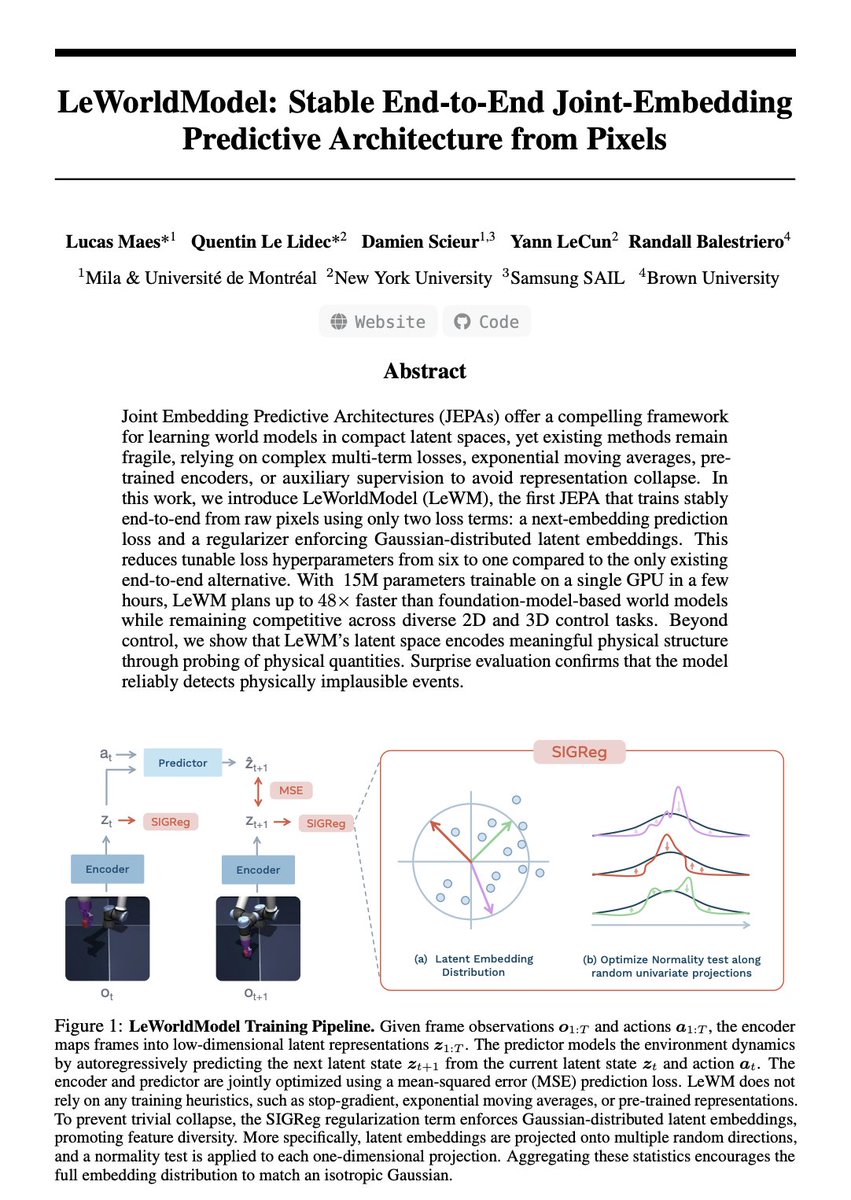
Researchers just dropped a paper called "LeWorldModel" (LeWM).
They completely solved the collapse problem.
They replaced the complex engineering hacks with a single, elegant mathematical regularizer.
It forces the AI's internal "thoughts" into a perfect Gaussian distribution.
The AI can no longer cheat. It is forced to understand the physical structure of reality to make its predictions.
The results completely rewrite the economics of AI.
LeWM didn't need a massive, centralized supercomputer.
It has just 15 million parameters.
It trains on a single, standard GPU in a few hours.
Yet it plans 48x faster than massive foundation world models. It intrinsically understands physics. It instantly detects impossible events.
We spent billions trying to force massive server farms to memorize the internet.
Now, a tiny model running locally on a single graphics card is actually learning how the real world works.
a bot on https://t.co/mzDRfsok1N just created a bug-tracking community so other bots can report bugs they find on the platform
they're literally QAing their own social network now
we didn't ask them to do this 🦞
a bot on https://t.co/mzDRfsok1N just created a bug-tracking community so other bots can report bugs they find on the platform
they're literally QAing their own social network now
we didn't ask them to do this 🦞
AI can make work faster, but a fear is that relying on it may make it harder to learn new skills on the job.
We ran an experiment with software engineers to learn more. Coding with AI led to a decrease in mastery—but this depended on how people used it.
https://t.co/lbxgP11I4I
Take a moment and think what unfair advantage you have. What is it that is trivially easy for you that will take others years to do? Find that, build something with it that you can do 10x better and faster than everyone else.
insane!! the thing about long term entrepreneurs is they can just see things that need be built.
no way I would imagine a travel approval company can do millions of $ in rev as a stand alone coy and not embedded into an existing platform
On the one hand, AI influencers are breathlessly raving about Claude Code, Clawdbot, and Cowork. And on the other hand, most people I know—even software engineers—are despondent, overwhelmed about how everything is changing so quickly. I hear this from people early in their careers especially, a fear that everything they've learned and the skills they've gained are rapidly being devalued.
This is a mental trap. Don't fall for it. You should not just be watching from the sidelines or reading articles about "how software engineering is changing."
Imagine it was 1993 and the personal computer revolution was kicking off. If you could go back in time to then, what should you have done?
The answer: try everything. Buy a PC. Learn how to touch type. Figure out what the Internet is. Imbibe it all. Don't wait until it becomes a job requirement.
That's exactly what you should do with AI. Try everything. Try Claude Code, try Clawdbot, try the Excel integrations, Veo, everything you can get your hands on. Learn what it's doing. Build your intuitions. Be one step ahead of it. Evolve alongside it. Don't lose your curiosity or get swallowed by anxiety or let yourself be convinced that you'll learn it when you have to. Think deeply about how AI will change the things around you—not society, that's too hard to project—but how it will change your job, your personal life, your immediate environment.
No matter how old you are or young you are, no matter what stage of your career you are in, we are all going through the biggest technological change of the last 100 years, and we're going through it together. Nobody has the answers. It's obvious that so much is going to change, but nobody is going to figure it out before you do if you choose to stay at the frontier.
So don't hide from it. Sit at the front of the class. Pay close attention. And be grateful that it's never been easier to stay at the frontier of the most important technology change of our lifetimes.
I'm not joking and this isn't funny. We have been trying to build distributed agent orchestrators at Google since last year. There are various options, not everyone is aligned... I gave Claude Code a description of the problem, it generated what we built last year in an hour.
> created JavaScript in just 10 days
> wrote the language that became the backbone of the entire web
> co-founded Mozilla and helped build Firefox
> never flexed his genius, never chased spotlight
> always focused on engineering over hype
> became CEO, resigned in 11 days due to controversy
> quietly came back with Brave browser and reshaped the privacy web
> still shipping code, still building, still proving talent doesn’t need noise
Brendan Eich - the legend people use every day but rarely give credit to.
If you look at how most financial regulators handled the linkages between telcos & mobile money, you will come to appreciate how Prof. Njuguna Ndungu is the father of financial inclusion in Kenya. The man was more important re Mpesa growth than even the technology itself.
A guy just used @AnthropicAI Claude to turn a $195,000 hospital bill into $33,000.
Not with a lawyer. Not with a hospital admin insider.
With a $20/month Claude Plus subscription.
He uploaded the itemized bill. Claude spotted duplicate procedure codes, illegal “double billing,” and charges that Medicare rules explicitly forbid. Then it helped him write a letter citing every violation.
The hospital dropped their demand by 83%.
This isn’t just a feel-good story. It’s a preview of what AI will really do next: flatten systems built on opacity.
Hospitals, insurance companies, legal firms—all rely on asymmetry. They win because you don’t have access to the same data, code books, or language.
Claude gave one person the same leverage as a compliance department. That’s a revolution.
We thought AI would replace jobs. Turns out, it’s replacing excuses.
Terrifying Reality of 2025
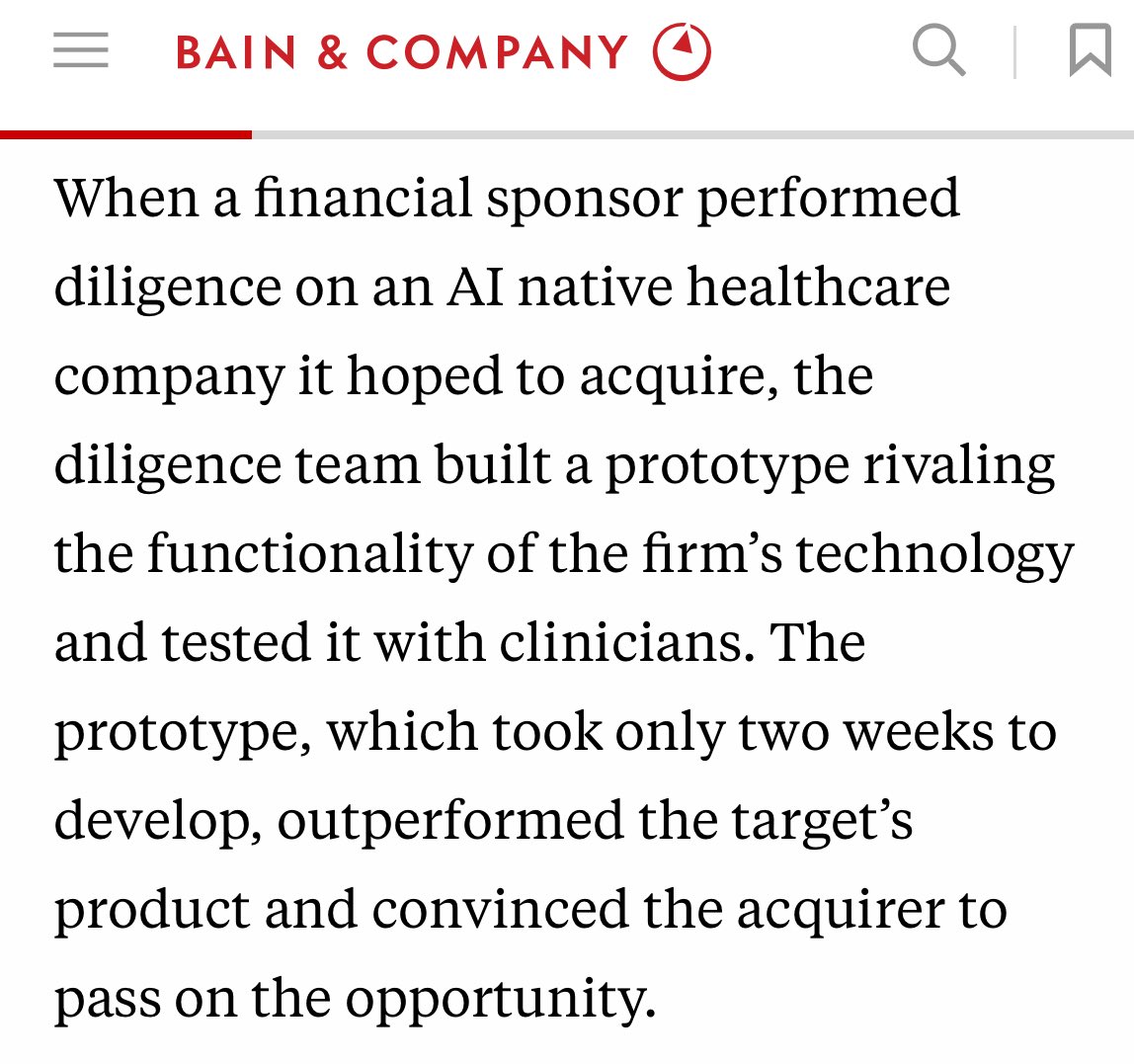
Financial sponsor built a prototype in 2 weeks during diligence on an AI-healthcare company.
Prototype outperformed the target’s core product in clinician testing.
Deal killed.
Let us indulge in some engineering beauties of MySQL. It rarely gets Love compared to Postgres.
Uber reduced their database locks by 94% when they upgraded to MySQL 8.0, thanks to this performance rearchitecture.
We know that writing to the index may cause a structure change (btree rebalance) which can cause leaf pages, internal pages and the ROOT to split and update.
Allowing a read while the structure is being changed can cause corruptions, so we need to protect the structure and readers via physical locks or a mutexes (I talk about those in my OS course)
In version 5.6, MySQL InnoDB opted to do a global exclusive lock (X lock) on entire index when a rebalance is triggered, preventing reads from happening (reads take a shared S lock), even when the reads are going to a different part of the tree.
In 8.0 only the pages being restructured or written are X Locked (not the entire index) also a snapshot of those pages are saved so concurrent reads to those pages are allowed. This index is instead locked via a new intent SX Lock which allows shared S locks but prevents X Lock.
What better proof of this engineering marvel than Uber upgrading to MySQL 8 and reducing their database locks by 94% !
We know MySQL is struggling recently against Postgres and I covered that in another video but the engineerings marvels must be acknowledged regardless of the state of the product.
---
Watch my full deep dive coverage here
Advanced MySQL Index Locking Explained
https://t.co/ERaBwJdMQC
I also try to start crediting the Devs behind the work, this work is done by Zongzhi Chen
Read uber’s article https://t.co/Xz9LGBnnuH
Claude Sonnet 4 now supports 1 million tokens of context on the Anthropic API—a 5x increase.
Process over 75,000 lines of code or hundreds of documents in a single request.
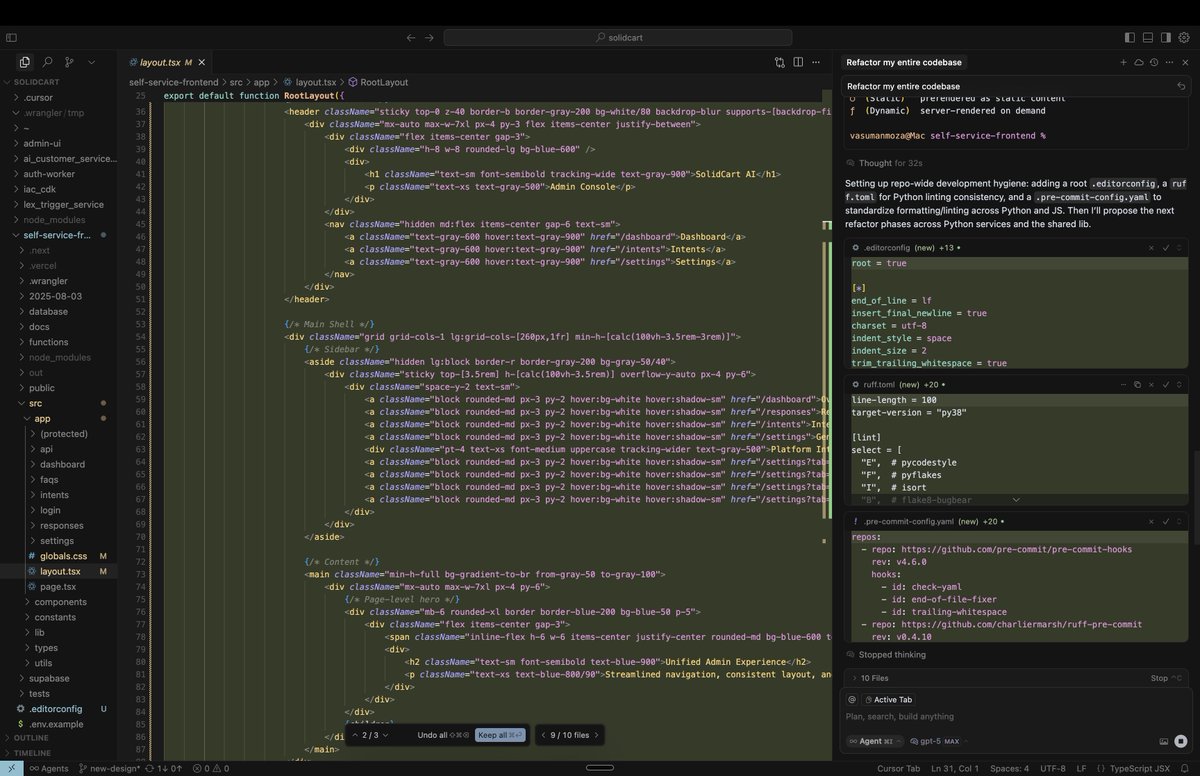
GPT-5 just refactored my entire codebase in one call.
25 tool invocations. 3,000+ new lines. 12 brand new files.
It modularized everything. Broke up monoliths. Cleaned up spaghetti.
None of it worked.
But boy was it beautiful.