Stop AI hallucinations. Most AI tools generate answers from incomplete information. Daypart gives them verified, cited facts so they stop making things up.
So we did what nobody else covering this did. Traced it to the filings: what a stick of memory actually costs to build, where the money goes, and why three companies set the price for everyone. Full breakdown, sourced end to end 👉 https://t.co/WkcwCW5cqc
Apple just raised prices on nearly every Mac and iPad. Everyone's saying "RAM shortage." The real story starts in an AI data center. Here's how it actually works 👇
And it's fast. Contract memory prices jumped ~90% in a single quarter, with another ~60% projected. Apple's own words: it has "never seen a component price increase this much, this quickly." This isn't a blip you wait out. It runs into 2027.
What used to be a moat is now a tag.
A decade ago, "single origin" was how a serious roaster signaled they were serious. The phrase carried specific information. This coffee comes from a defined geography, often a single farm or cooperative, and the brand is willing to attach the name of that origin to the product. It signaled traceability, a relationship with the source, and a willingness to be judged on terroir rather than on blend craft.
Today, 80 percent of the category prints the same tag.
The tag still does what it did. The phrase still has informational content for a customer who knows what to look for. What it no longer does is differentiate, because every shelf in the category is full of it. The signal is intact. The position is gone.
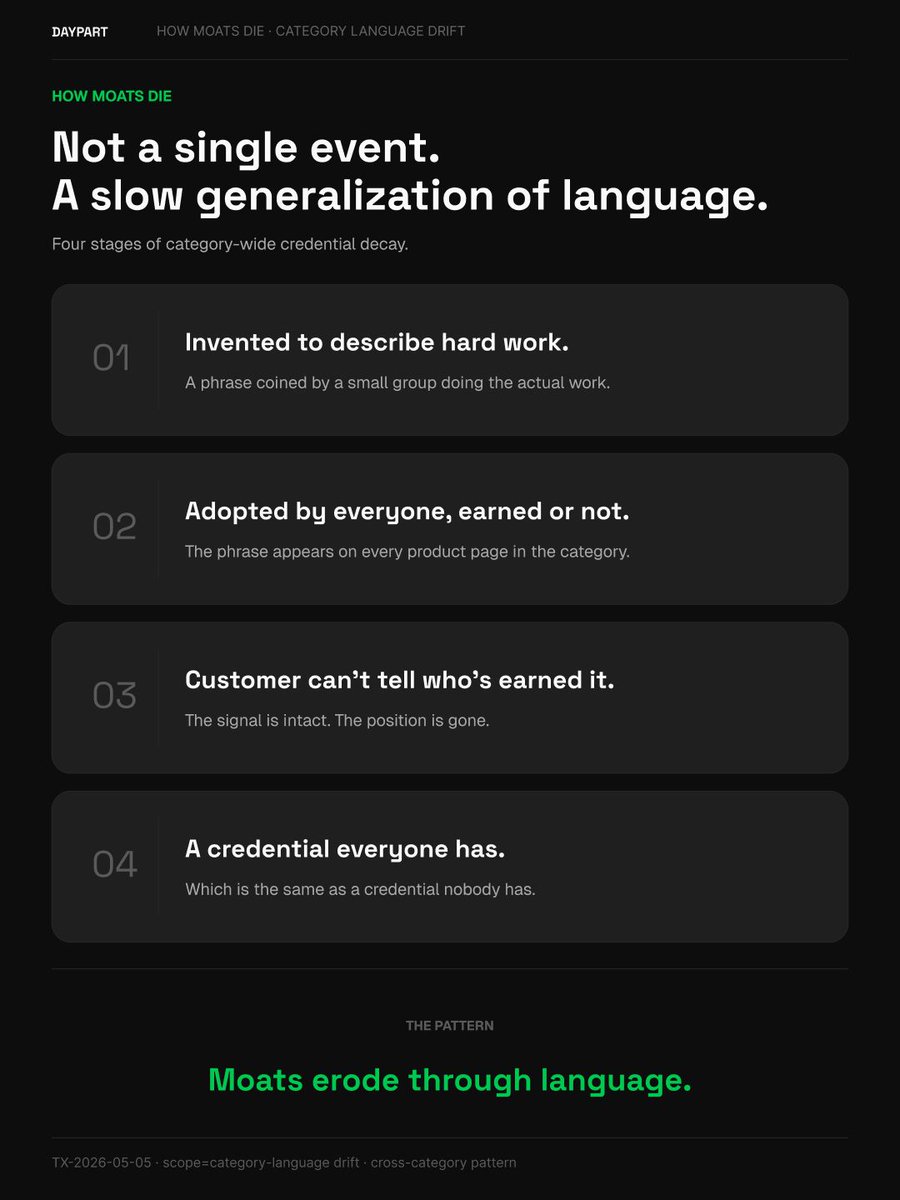
This is how moats die. Not in a single competitive event, but through the slow generalization of language. A category invents a phrase to describe a small group of operators doing something hard. The phrase eventually shows up on every product page, including the ones where it is not really earned. The customer cannot tell who is doing the underlying work anymore. The phrase has decayed into a credential everyone has, which is the same as a credential nobody has.
Where the next layer of differentiation actually lives in this category, based on what is still rare in the data:
Named producers, treated as a product line rather than a footnote. Process detail (washed, natural, anaerobic, honey) given the same prominence as roast level. Lot level transparency, with traceable economics back to the farm gate. Variety callouts (Geisha, Bourbon, Pacamara, SL28) on the front of the package, not buried in the description.
These are the language moves the leading specialty roasters are starting to make. They are still rare in the data, which is what makes them differentiating. They will not stay rare for long.
The lesson holds beyond coffee. Any phrase that every operator in your category prints on the package has stopped doing work. Read your own packaging the way a skeptical customer reads it. If everything on the label could be true of any peer in your set, the label is not selling.
A 32GB memory kit costs about $45 in parts and labor. In mid-2026 it sells for around $510.
Daypart went looking for the missing $465. The useful part is that none of it required guesswork. Almost every number is sitting in a public filing.
Start with the build. Strip a kit to components and the non-memory parts, the circuit board, the power chip, the heat spreader, the hundred-odd passives, assembly and test, come to about $19, and they barely move across the cycle. The memory itself is sixteen chips. Independent teardown analysts measured the die at 37 to 66 square millimeters depending on node, so a 300mm wafer yields on the order of 1,000 to 1,800 of them. A processed wafer runs about $1,600. The arithmetic puts the silicon at one to three dollars a chip, so the memory in a kit is about $24 to $48 to make. Total: roughly $45, and it drifts down as the process shrinks.
That cost is basically physics. It does not care what month it is.
The price does. One maker discloses its memory price changes year by year in its SEC filings: up 37% in one year, down 34% in another, down nearly 50% in a third, then up more than 40% in the next. Same factories. Same bill of materials. The thing that swings is not the cost. It is the price.
Then look at who sets it. Three companies make roughly 90% of the world's memory. Their own annual reports show 2025 gross margins around 40% and 60%. The tier below them, the firms that buy chips and assemble the finished sticks, runs on single-digit margins, and one well-known module brand posted a company-wide net loss in the same period. There is no competitive layer beneath the three to push the price back down.
This is the part Daypart finds genuinely useful, and it is not cynical. Memory is one of the most checkable markets in the world. The makers publish their margins and disclose their price swings. The raw-material picture is public at the U.S. Geological Survey. The chips can be physically measured by anyone willing to open one. The shortage story does not have to be taken on faith, because the receipts exist.
In fairness to the makers, the same filings show the other half of the cycle. One of them ran a negative 9% gross margin in 2023 and sold below cash cost at the bottom. A third to half of what it costs to run a fab is depreciation that accrues whether or not a chip sells, so brutal peaks partly pay for brutal troughs. That context is in the filings too. That is the point. Both facts can be true at once because both are documented.
This is the gap that matters. A market this important is legible because the claims behind it are written down and checkable.
AI is not there yet. Stanford researchers found in 2024 that leading models, asked specific legal questions, hallucinated and gave false answers between 69% and 88% of the time. They sound exactly as confident when they are wrong.
AI should not just answer confidently.
It should know which claims have been checked.
That is the verified layer Daypart is building.
Second, when investing in your own review acquisition, the marginal review at scale matters more than the rating average suggests.
The brands that take this seriously are running a quiet review machine that almost no competitor can catch up to without years of customer volume.
In this week's specialty coffee benchmark:
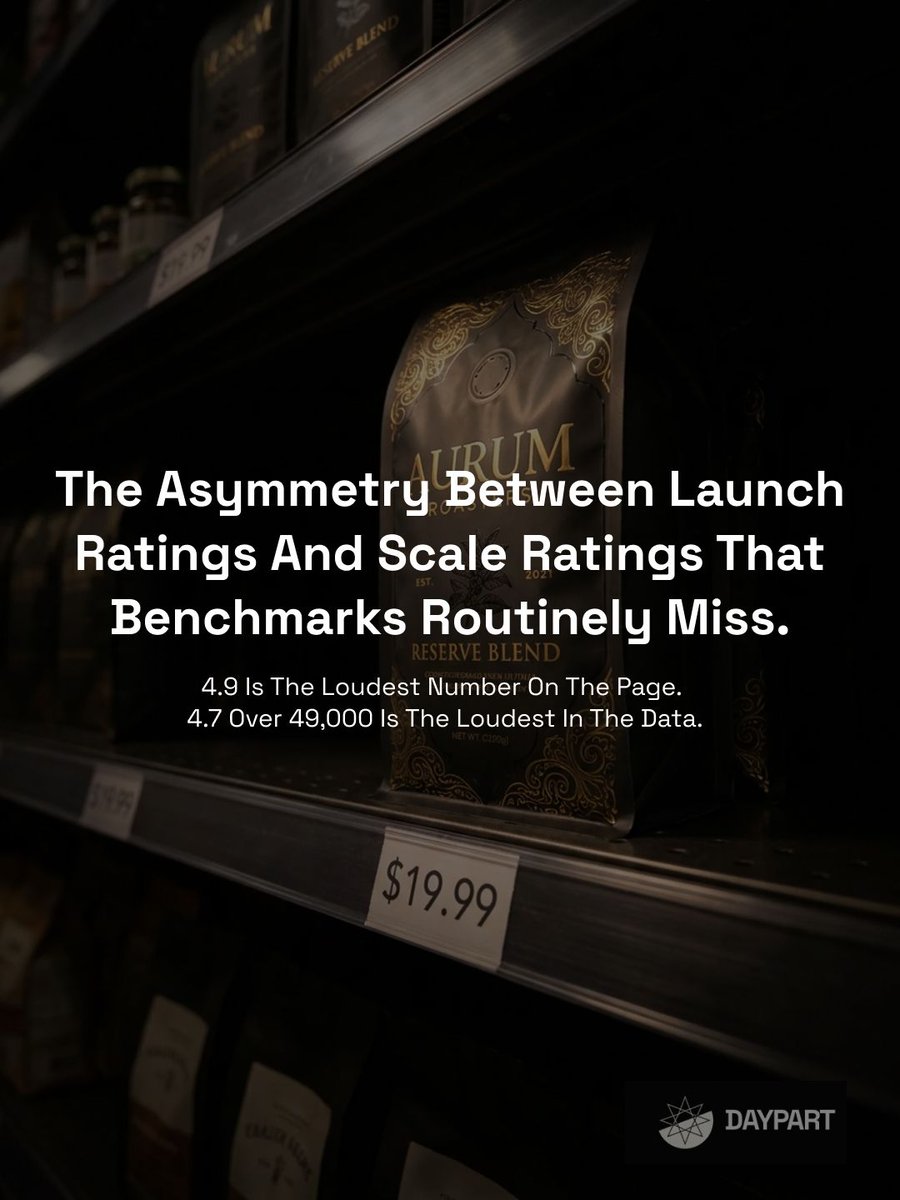
Category average Google Shopping rating across 47 peers: 4.6.
The benchmarked brand: 4.7.
The benchmarked brand's review count: approximately 49,000. The plus 0.1 delta sounds small.
It isn't.
Two practical implications. First, when comparing a competitive set, sort by review count first and rating second. The top of the count list is your true peer set.
Everything else is noise that will reset the next time the brand has a bad month.
I feel like they can make my claude smarter who can help em do that ... or what is the smartest ai program available to the people? Because the things I am learning in a week would take me 5 years to learn.