“Children, know this:
the husband is to the wife
and the wife to the husband:
lover and friend
the essence of companionship
every desire and every wealth
life itself.”
- Malati and Madhava, Bhavabhuti, 700 CE
"In his 1994 book Descartes’ Error, neuroscientist Antonio Damasio uses the fruits of a lifetime’s work to demolish the notion that anything like an abstracted ‘reason’ existed. Reason, he showed, was intimately connected to emotion; one could not exist without the other... Reason, it turned out, was not a superior alternative to intuition, emotion or instinct, but a manifestation of it. There could be no mind without the body; no unprejudiced ‘concepts’ or unpolluted ‘models’ of reality. There could, in short, be no Reason without the messy world it was embedded in.
But if Reason as a thing in and of itself is nonexistent, then any culture built on its back must, in the end, fail. Awkwardly, this takes in not only Bezos’s Star Trek future but most of the modern world as well, including pretty much the entirety of the modern West. It includes not only the great globe-spanning economic system which is currently eating the Earth alive, but also all of our rational, topdown clever-clever proposals for ‘saving’ it, and every abstract ideological proposition that modernity has produced, from Marxism to neoliberalism. The entirety of the system of global governance and the ‘laws’ of classical economics, based as they are on notions of humans as rational actors weighing up their enlightened self-interest and deciding accordingly between Pepsi and Coke, is also holed below the waterline.
Liberal modernity, in short, is doomed. If this is true, then another conclusion also suggests itself: that older ways of seeing and speaking—mythology, folk cultures and the mystical underpinnings of religious faith—might have been on to something after all. The standard choices presented to us—reason versus superstition, progress versus barbarism, past versus future, Earth versus space, growth versus stasis—were always chimeras. The choice is not between ‘going forward’ or ‘going back’, but between working with the complexity of human and natural realities, in all their organic messiness, or attempting to supersede them with abstractions which can never hope to contain them."
Paul Kingsnorth (Against the Machine: On the Unmaking of Humanity)
We bid goodbye to one of the rare men of our age who understood that the great crisis of modern civilisation was not simply environmental, economic or technological. It was a crisis of belonging. May the earth you so loved receive you gently, Wendell Berry.
From 'The Unsettling of America':
"The disease of the modern character is specialization. Looked at from the standpoint of the social system, the aim of specialization may seem desirable enough. The aim is to see that the responsibilities of government, law, medicine, engineering, agriculture, education, etc., are given into the hands of the most skilled, best prepared people. The difficulties do not appear until we look at specialization from the opposite standpoint—that of individual persons. We then begin to see the grotesquery—indeed, the impossibility—of an idea of community wholeness that divorces itself from any idea of personal wholeness.
The first, and best known, hazard of the specialist system is that it produces specialists—people who are elaborately and expensively trained to do one thing. We get into absurdity very quickly here. There are, for instance, educators who have nothing to teach, communicators who have nothing to say, medical doctors skilled at expensive cures for diseases that they have no skill, and no interest, in preventing. More common, and more damaging, are the inventors, manufacturers, and salesmen of devices who have no concern for the possible effects of those devices. Specialization is thus seen to be a way of institutionalizing, justifying, and paying highly for a calamitous disintegration and scattering-out of the various functions of character: workmanship, care, conscience, responsibility.
Even worse, a system of specialization requires the abdication to specialists of various competences and responsibilities that were once personal and universal. Thus, the average—one is tempted to say, the ideal—American citizen now consigns the problem of food production to agriculturists and “agribusinessmen,” the problems of health to doctors and sanitation experts, the problems of education to school teachers and educators, the problems of conservation to conservationists, and so on. This supposedly fortunate citizen is therefore left with only two concerns: making money and entertaining himself. He earns money, typically, as a specialist, working an eight-hour day at a job for the quality or consequences of which somebody else—or, perhaps more typically, nobody else—will be responsible. And not surprisingly, since he can do so little else for himself, he is even unable to entertain himself, for there exists an enormous industry of exorbitantly expensive specialists whose purpose is to entertain him."
@infinitchy@SubramaniReddy3 Totally. One of the greatest thinkers. As always, many had a hard time understanding his point of view in light of never-ending consumption. Thanks for quoting him many times in your videos too.
https://t.co/b5KLwxHXFZ
I am in dire financial help to help sustain my mothers medical expenses.
Please do support me financially. I am running out of funds to support my mother health maintenance.
Please do help.
Here is my UPI Id:meeramk585@okicici
My bank account details
Name Meera MK
Bank A/c details
Canara Bank A/c ;1881101009050
IFSC Code:CNRB0001881
I am in dire financial help to help sustain my mothers medical expenses.
Please do support me financially. I am running out of funds to support my mother health
Here is my UPI Id:meeramk585@okicici
My bank account details
Name Meera MK
Bank A/c details
Canara Bank A/c ;1881101009050
IFSC Code:CNRB0001881
a fantastic conversation on the iran crisis with @ruchirsharma_1 who i always learn so much from. one of the most incisive voices on geopolitics today.
how can someone come to the conclusion that a woman needs to live by her husband’s law school’s motto, otherwise “dharma will fail to protect her”? how much do we need to hear about “brahminical patriarchy” before we call out this calumny? my rebuttal:
https://t.co/2IeukoaGsS
I need your financial help to help sustain my mothers medical expenses
Please do support me financially. I am running out of funds to support my mother
Here is my UPI Id:meeramk585@okicici
My bank account details
Name Meera MK
Bank A/c details
1881101009050
IFSC Code:CNRB0001881
I think Muslims will have a little better case if they rather say that terrorists follow a different “sect” of Islam, rather than saying that they do not follow “true Islam”.
1. First of all, saying that terrorists who attack civilians do not follow “true” Islam invites the “no true Scotsman fallacy”. It gives an unfalsifiable proposition and lets anyone (who is inconvenient to the narrative that any Muslim wants to make) escape by being conveniently declared that they are not a “true” Muslim. It feels like an ex-post facto damage control rather than an epistemically informative explanation.
2. There is absolutely nothing called “true” Islam for a faith that is 1400 years old. Like any other old faith, it has split into several rival sects and each sect claims that it is the only true Islam. I am pretty sure that a practising Hanafi Sunni Muslim will say that what a Twelver Shia Muslim practises is not true Islam. In that case, when each sect claims that only its is the true Islam and all others are false, that is an internal theological debate which does not concern any ordinary outsider to Islam who only wants to know why they are extremely likely to hear only “Allahu Akbar” chants before a terror attack rather than “Shama Israel” or “Glory to Jesus” or “Jai Shri Ram”. Why should a causal non-Muslim observer consider some of the rival sects of Islam as “true Islam” (when they themselves reject each other as false) whereas only terrorists who blow up stuff are “false” Islam ; when they themselves, like any other rival sect, claim that their ideology is the only true Islam.
3. Obviously no sane person wants to suspect all Muslims who number in billions. But, what an ordinary person wants is accountability - a transparent means to identify those few Muslims who are more likely to perform terror from those other ordinary Muslims - a kind of a litmus test for identifying terrorist ideologies. The dichotomy between “true” Islam and “false” Islam is hardly useful to weed out terrorism from its roots, and as already said, it only serves as only an ex-post facto damage control. On the other hand, if you say that terrorists practise another sect of Islam, say Salafi Jihadism (for ISIS) or Deobandi sect (for Taliban), then the suspicion can be safely narrowed down to these sects and all other normal Muslims can escape suspicion. But, Muslims not doing this only makes others think that they want to protect and do not want to snitch out their brethren in these sects who are more likely to become terrorists.
4. If Muslims feel that extremists and terrorists do not belong to any one particular sect and are spread across all traditional sects, then their clerics can officially ex-communicate extremist Muslims from their community. I have hardly seen any Muslim cleric do that when they have time to issue fatwas on random useless things. When have clerics of an Islamic sect excommunicated anyone before they end up as suicide bombers? If there are a lot of ex-communications happening on a regular basis for weeding out extremists (rather than a namesake ex-post facto damage control after every terrorist act by declaring an already dead terrorist as a false Muslim), it will help bring down the suspicions on the entire religion. When terror groups can excommunicate others as false Muslims, why not the normal Muslim establishments? The various Christian sects have mechanisms to deny communion to those from other churches and for the clergy to excommunicate someone from their church (if they believe that he has broken away from the church’s core doctrines) and deny them communion. Why don’t I see that happening in the Islamic world ?
6. Spare us the criticism of terrorists cherry-picking verses out of context. Christians do the same with Old Testament to predict Jesus, Mahayana Buddhist sects cherry-pick books in their vast canon, all of which can’t be read by a single person. It is not something new that only Islamic terrorists do.
What Kharge ji has quoted from the Gautama Dharmasūtra, was never traditionally understood as a punishment for a Śūdra who learnt Vedas.
Those who care about evidence can see this tweet: https://t.co/9M0z2UuzGb
Those who don't care about evidence can skip this thread.
+
A Saga of Dharma
long thread please read. you wont regret!
- Ashwin Sampatkumaran , Advocate
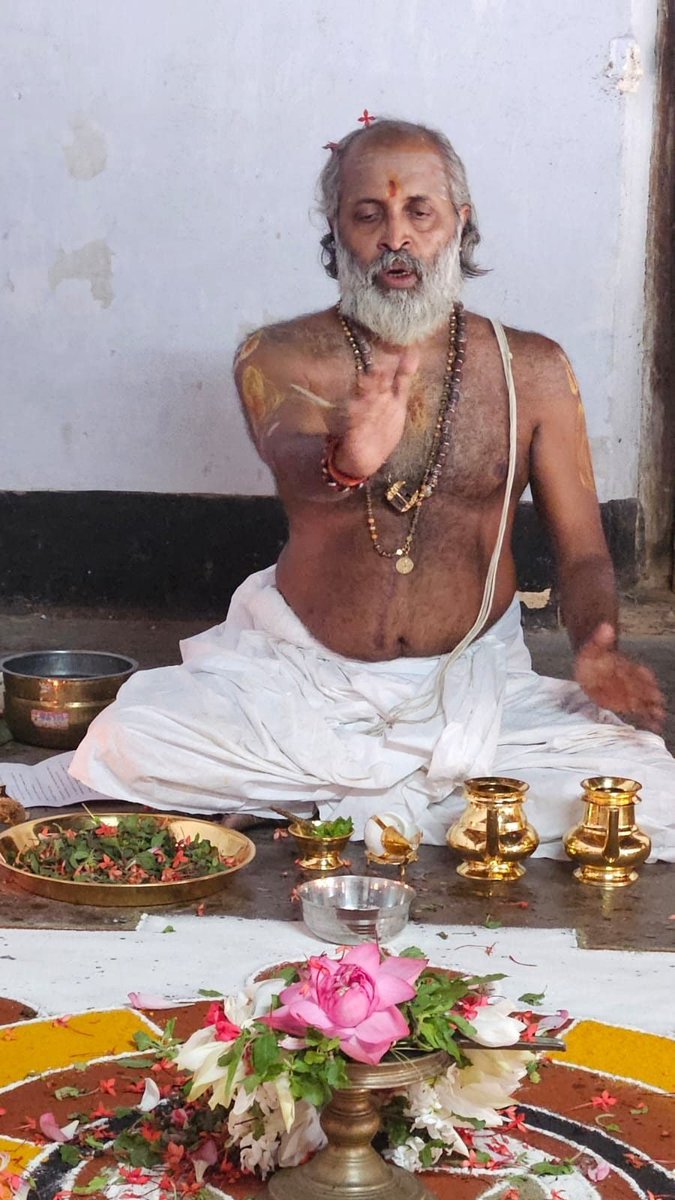
For the past couple of years, every time I traveled with Satheeshan Namboothiripad, I couldn’t help but notice a fascinating routine—his unwavering commitment to waking up at 3 AM for japa. But one incident truly etched itself into my memory.
We had landed in Bangalore late one night—our flight touched down at 1 AM, and by the time we reached home, it was 2:30 AM. Exhausted, I was ready to sink into the comfort of a warm bed, the cool Bangalore weather only making sleep more tempting. But as I prepared to drift off, there he was—Satheeshan Namboothiripad—calmly stepping out for a bath. At 2:30 AM. In the biting cold.
I watched, amazed, as he completed his bath, settled into his spot, and began his japa with serene focus. There he sat, completely immersed, while the rest of the world was fast asleep. This continued until 5:30 or 6 AM, unwavering and undisturbed.
It wasn’t the first time I had seen his dedication to Dharma, but every such moment reinforces my belief in the strength of his resolve. It’s in these small yet extraordinary acts that his true character shines through.
And this, dear reader, is just the tip of the iceberg. Hold your breath as you read on—his journey of devotion is long but profoundly inspiring, and by the end of it, you might just find yourself covered in goosebumps!
The years 2020–2021 were a testing time for humanity. The pandemic weighed heavily on all of us, changing our routines, and filling our days with uncertainty. But amidst the chaos, Satheeshan Namboothiripad of Nedumapally Tharananaloor Illom chose to embark on an extraordinary mission—a commitment to chant the Gayatri mantra 1,008 times every single day.
It wasn’t just about the japa; it was about showing that even in the darkest of times, Dharma lights the way forward. And so, while the world grappled with lockdowns and restrictions, he quietly began his spiritual endeavor, creating a ripple of positivity and resolve that would inspire many.
As the world slowly opened up and travel restrictions were lifted, he seized the opportunity to do something even more profound. One day, at his ancestral home, he organized a Gayatri Homam, assisted by his loyal parikarmis who had been with him through countless rituals.
During this sacred occasion, he shared a thought that had been stirring in his mind—a desire to adopt a mantra for upasana (spiritual practice). After deliberation, the choice became clear. The mantra would be:
"Vedo Akhilo Dharma Moolam"
(The entire Vedas are the root of Dharma)
Gayatri, being the foremost mantra for a Brahmin, naturally complemented this choice. With this decision, a spiritual journey began—one that would demand not only time but also relentless determination and unwavering faith.
Purashcharana: A Herculean Effort in Three Phases
In Vedic tradition, for a mantra to bear fruit, it must be fortified through Purashcharana, a series of disciplined practices. Following the guidelines of the Rigvidhana, Satheeshan Namboothiripad undertook this rigorous endeavor in three monumental stages:
Phase 1:
• Gayatri Japa: 30,000
• Gayatri Homa: 3,000
• Time Taken: 15 Days
This was only the beginning. His focus sharpened as he entered the next phase.
Phase 2:
• Gayatri Japa: 1,00,000
• Gayatri Homa: 10,000
• Time Taken: 2 Months
The numbers were growing, and so were the stakes. Yet, his resolve remained unshaken as he moved into the final phase—a feat that could humble even the most disciplined.
Phase 3:
• Gayatri Japa: 24,00,000
• Gayatri Homa: 2,40,000
• Gayatri Tarpana: 24,000
• Gayatri Abhisekam: 2,400
• Gayatri Namaskaram: 240
• Brahmana Bhojanam: 24
The sheer scale of this phase is staggering. It demanded countless hours of chanting, meticulous rituals, and a deep reservoir of physical and mental strength. And today, he has completed Phase 3, a momentous milestone in his spiritual journey.
Satheeshan Namboothiripad’s commitment doesn’t end with personal practice. His vision for Dharma is far-reaching, and he has worked tirelessly to bring others along this path of light.
1. Hari Valam:
At the Padmanabhaswamy Temple in Thiruvananthapuram, he initiated this practice where devotees chant the Hare Rama Hare Krishna while circumambulating the temple’s outer fort on every Ekadasi.
2. Mass Vishnu Sahasranama Japa:
He organized a historic event where 5,000 devotees came together to chant the Vishnu Sahasranama six times in a single day. The energy of thousands chanting in unison was nothing short of divine.
Satheeshan Namboothiripad’s life is guided by a single desire:
Dharma should thrive. Our culture should flourish. Temples should prosper. And in this, mankind will find its ultimate prosperity.