When should a warning sign become a phone call?
In our design, when the trading carries on. An order above the firm's size limit gets a text. A new trade within 10 minutes turns it into a call.
Stronger signs, like a larger order seconds after a loss, go straight to a call.
We wrote about how often a coaching call should ring. The other half is how soon.
Our phone calls are designed to ring within 5 seconds of the warning sign. That is a target; carriers vary.
The aim is a call that lands while that sign is still the last thing on the screen.
I read about a new AI dialer today. On a sales call, the result comes before you hang up: booked or not now.
An AI coaching call after a run of losses has no result yet when the trader hangs up. It shows in the next trade, and a quick one is the worry.
When an AI assistant drafts a client's order, the readback confirms the order: instrument, direction, size, price, stops.
It confirms nothing about the client. A larger order placed seconds after a loss passes every line of it.
https://t.co/suQl2dQSqK
A trader on the way out does not always go quiet first.
The last stretch can look like their busiest: more instruments, more trades, a run of losses, then silence. Read as activity, it looks like a good week.
https://t.co/ldbQyyUThR
None of our warning-sign rules reads a price, a direction or a balance, so our trade feed refuses those fields by name.
Seven fields come in. Six are refused: entry price, exit price, stop-loss, take-profit, direction and balance.
A person who knows each client is the best retention a firm can offer.
It also thins out as the firm grows: more clients on one list, and the worst moments arrive at hours when nobody is at the desk.
https://t.co/smy3g345G9
Five or more trades inside 15 minutes is one of six rules we use to decide when a trader gets a coaching call.
It reads time and count only: no price, no direction, no view on whether the trades were good.
https://t.co/s9UQB2N9NP
Where a vendor says its AI never strays into advice, that answer is an assurance until the firm has tested it. How many of its calls could your team hear in a month? https://t.co/rpWymtzG5Z
A prop firm evaluation pass is real information about a trader, taken before funding changed what a breach can cost.
Is your breach rate higher in an account's first funded weeks, or about the same across its life? https://t.co/SAZEnK8PyV
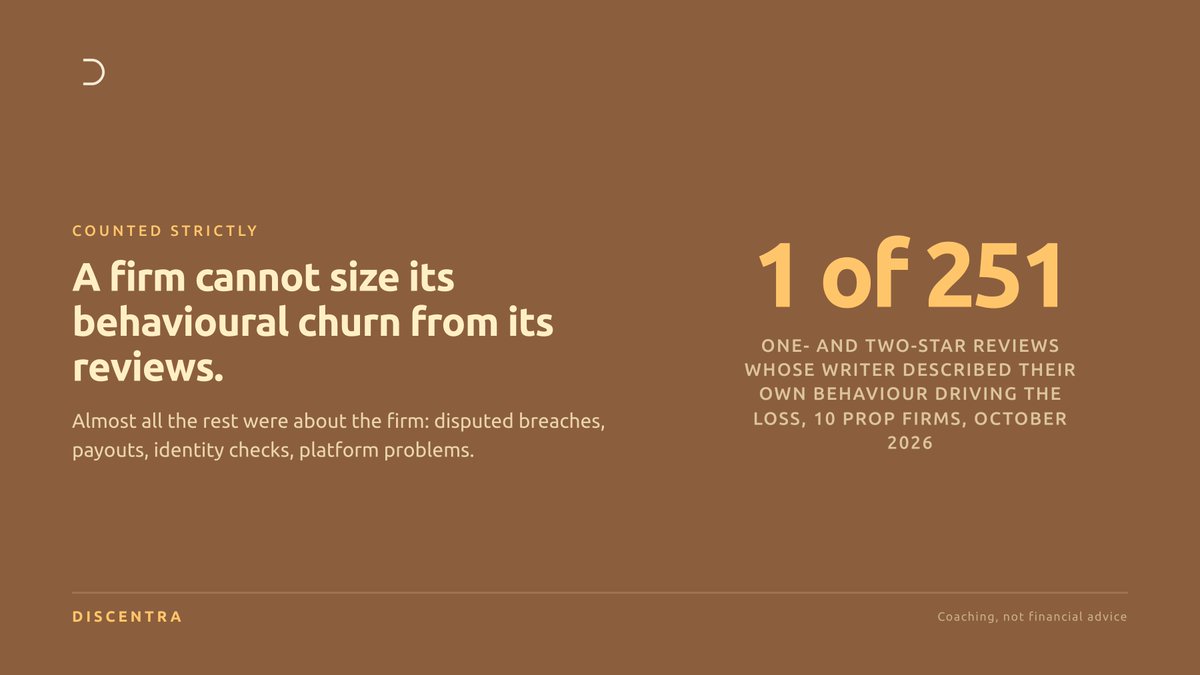
We read 251 one- and two-star reviews of 10 prop firms, counting only those whose writer described their own behaviour driving the loss.
One.
A firm cannot size its behavioural churn from its reviews.
A retention product's own success measures show what it is built to do: raise a client's activity, or slow the next decision.
Coaching, not financial advice.
What does your retention report count as success? https://t.co/5F2mIKqooX
A trader takes a loss and places a bigger order a few seconds later. Neither trade is an account event, so no lifecycle message goes out.
The first message comes at the breach. By then, the decision it was meant to change is over.
A real rise in 90-day retention from 25% to 32.5% shows up fewer than half the time when 150 coached traders are compared with 1,000 others. Coaching, not financial advice. How large is the group behind the retention figure your firm reports each quarter? https://t.co/gb58oZRdbP
The quiet trader is a known failure mode. Smaller size, skipped setups, breaching nothing.
A second one arrives first and reads as the opposite. New markets, odd hours, twice last month's trades, none of it planned.
Both end at zero. Only one looks like trouble on the way.