The case for climate action cannot be made in the language of economics alone. Technocratic solutions cannot make a different future feel possible, desirable, or worth its cost. Where energy systems and digital public infrastructure are the technical foundations of the green transition, arts and culture form its social infrastructure: how societies imagine alternative futures, build the legitimacy to pursue them, and hold together as change happens.
New @IIPP_UCL paper published today as part of our Public Value of Arts and Culture research, ahead of tomorrow's International Seminar on Culture and Climate Change at Somerset House, hosted by the Ministry of Culture of Brazil during London Climate Action Week [@london_climate].
If you sell clothes, you need customers.
An economy where the poor have money is good as then you will have customers. Poor people need clothes.
An economy where the Billionaires have everything may mean you'll struggle to have customers.
The @IIPP_UCL Forum 2026: Rethinking the State. Two days at University of London's Senate House, as part of @UCL's bicentenary year. exploring how governments build the capabilities to tackle the grand challenges of our time.
I'll be participating in multiple sessions, including a book talk for my new book, The Common Good Economy, and panels on green budgets, how we evaluate mission-led policies, and reclaiming finance for public purpose.
16–17 June | Senate House, London | Find details of all our fantastic sessions at the link in replies.
The strangest criticism of Keynesian economics is the claim that government spending cannot create wealth because it only redistributes existing money.
By that logic, no investment creates wealth. Building a factory merely redistributes money to construction workers. Hiring engineers merely redistributes money to engineers.
The point is not the money. The point is what the money mobilizes.
When an economy has unemployed workers, idle factories, and unused resources, the problem is not a lack of productive capacity. The problem is a lack of spending to activate that capacity.
A dollar spent hiring an unemployed worker does not simply transfer income. It increases output. The worker now produces goods and services that did not exist before.
Wealth is not money. Wealth is production.
The Common Good Economy: a new compass is out today. We are good at setting goals: the Sustainable Development Goals (SDGs), climate targets, pandemic preparedness frameworks. We are bad at achieving them. The compass ensures that the way we pursue collective goals is as carefully designed as the goals themselves.
How we pursue collective goals matters as much as what those goals are. This book is an attempt to change the conversation: not just what economic objectives we set, but how we actually reach them together.
On @SkyNews with @SophyRidge and @WilfredFrost at 8:30 BST this morning. How we set out to achieve collective goals, matters as much as what those goals are. We are good at setting goals. We are bad at achieving them.
The Common Good Economy introduces a compass to navigate the gap: five elements that hold everyone who claims to pursue the common good accountable. Links in replies.
Tune in at 8:30am on @SkyNews ➡️ https://t.co/dfdoNPvczj
Order the book ➡️ https://t.co/LtFX7xNwpa
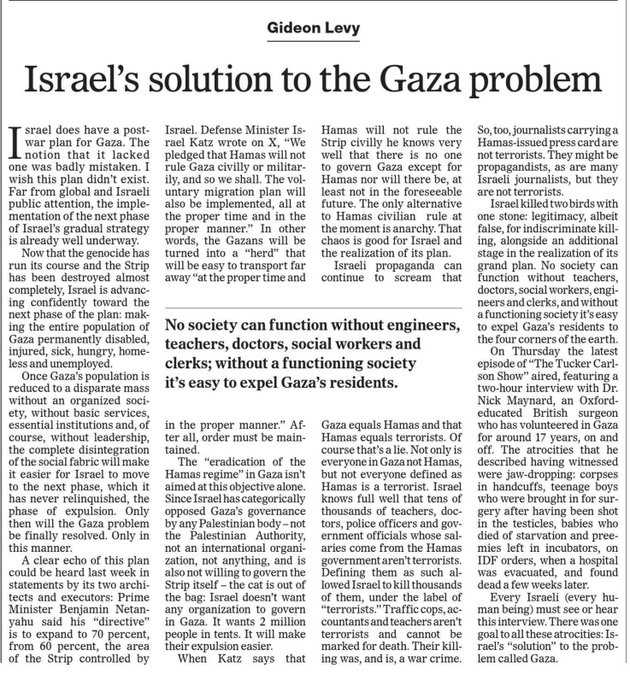
Now that Gaza lies in ruins—shattered, like a beloved face after a long brutality—Israel moves with a terrible confidence to the next act: The act of leaving every soul there not merely wounded, but permanently disabled. Injured, sick, hungry, homeless, without work, without hope. This is not war’s collateral damage. This is design.
As my friend Gideon Levy writes—and he knows, he knows—this is the prelude to expulsion. Think of it: a society without teachers, without doctors, without social workers, without engineers, without clerks. That is not a society. That is a holding pen. A slow erasure. And when nothing functions—no school, no hospital, no office, no heart—then it becomes ‘easy,’ they tell themselves, to scatter the people to the four corners of the earth. Like seeds from a broken pod, except no soil will take them.
We must name this. Not with rage alone, though rage is honest. But with the cold, clear tears of recognition: they are making life impossible so that departure becomes the only ‘choice.’ And the world watches, adjusts its spectacles, and calls for restraint. Restraint! There is no restraint in a slow drowning.
The question @guardian poses is the right one: what is economic growth actually for? Link in replies.
"Kickstart economic growth" cannot be a mission because it has no direction. Growth is not a compass, it is a rate. The Common Good Economy sets out what that compass looks like and outlines a set of principles that move us from a reactive corrective economics towards proactive, shared objectives.
As evidenced by the unbridled promotion and implementation of technology at the expense of human dignity, we are truly experiencing an eclipse of the sense of what it means to be human. It is imperative to recover an understanding of the true meaning and grandeur of humanity as intended by God. It is in this sense that the challenge we currently face is not technological, but anthropological, and it is my hope that the Encyclical Letter to be published within a few days will contribute to answering this challenge.
“If we look at the different income groups in the United States, it’s really the richest of the rich who benefit from this. The majority of people hardly have any benefit from it and are in fact carrying a much larger cost burden.” ~@IsabellaMWeber





![MazzucatoM's tweet photo. The case for climate action cannot be made in the language of economics alone. Technocratic solutions cannot make a different future feel possible, desirable, or worth its cost. Where energy systems and digital public infrastructure are the technical foundations of the green transition, arts and culture form its social infrastructure: how societies imagine alternative futures, build the legitimacy to pursue them, and hold together as change happens.
New @IIPP_UCL paper published today as part of our Public Value of Arts and Culture research, ahead of tomorrow's International Seminar on Culture and Climate Change at Somerset House, hosted by the Ministry of Culture of Brazil during London Climate Action Week [@london_climate].](https://pbs.twimg.com/media/HLqP0xWWQAACMkT.jpg)