@negi_frm_hills@TwerlyVinsmoke@Bakwabaasa Plus, it transforms them from passive objects to active participants. There is no medium required to understand and access the divine.
@negi_frm_hills@TwerlyVinsmoke@Bakwabaasa Common folks have always chosen the easy path to divinity. It's the clergy, nobility and the royalty which is associated with austere and elaborate rituals.
The popularity of Bhaktimarg can be attributed to the liberty it offers to devotees.
@negi_frm_hills@TwerlyVinsmoke@Bakwabaasa Talking 'bout my community, it's one of the few allied closely with Vaishnavism. But it is not what ISKCON & allies promote. It's rough, fragmented and jaggy.
@gegenprxss@Bakwabaasa Obviously chanting can be in any language. But what I'm highlighting here is that the Rakshan Mantras we have here are Gorakh Mantras.
Just because a phenomenon is universal doesn't mean that we undermine spatial uniqueness.
@gegenprxss@Bakwabaasa Nah, there can be other generic mantras. But the ones comprising terms such as "Ful Mantaro Ishvar Vacha" "Guru Adesh" are associated with Nath sect.
@Khadhangi Yes, Bholnath, Barmi & Bala
Three of them had become Bhutas.
They were pacified through numerous Upchar, Tantric & Muryo pujas.
The Ashta Bhairavas of Almora Nagar were established as a part of it.
@Fieldnotesind@negi_frm_hills@TwerlyVinsmoke@Bakwabaasa Certain princes got murdered and their spirits began tormenting the murderers; so in order to pacify them, their godhood was acknowledged & they came to be known as Rajangi devtas.
Everyone now knows about Kartik Swamy temple of Rudraprayag.
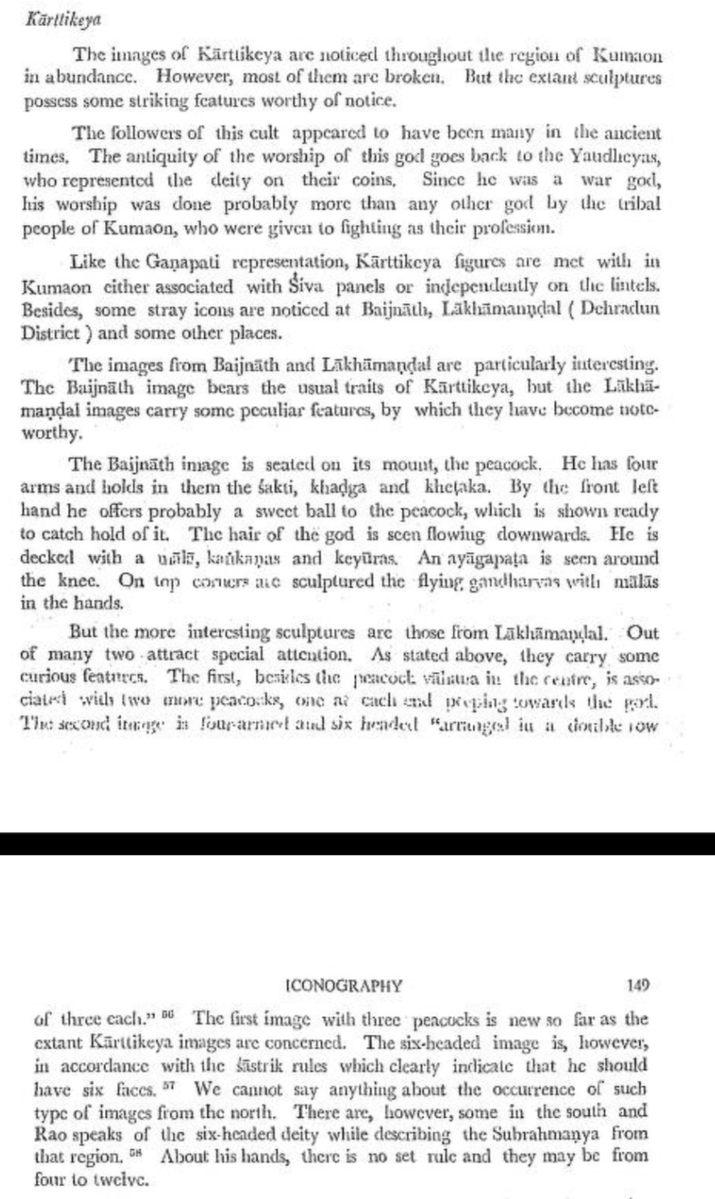
But we had older temples of Kartikeya at Baijnath in Bageshwar(ancient Kartikeyapur) and Lakhamandal.
We have found murtis of Skanda there.
As the city itself is named after Kartikeya, he would be one of chief Gods.
@negi_frm_hills@Fieldnotesind@TwerlyVinsmoke@Bakwabaasa The Bhairav shrines of the Almora (Kal Bhairav, Bal Bhairav, Shai Bhairav, Khutkuni Bhairav, Vatuk Bhairav, Lal Bhairav, Ban Bhairav, Shankar Bhairav) all owe their origin to the legend of Bholnath.
@TwerlyVinsmoke@Bakwabaasa Kashmiri Shaivism represents one expression of a broader Dharmic tradition that permeated the Himalayan region and manifested itself in diverse forms across its cultural landscapes. It cannot be considered the root of every traditional practice.