Ex MEP East of England 2009-19. Now Reform UK. Strategic consultant, writer, media spokesman. Chairman Freedom Association. Pro Brexit. RTs NOT endorsements.
Fury as UK 'nominates Iran' to key UN committee overseeing counterterrorism - after Ed Miliband's handshake with Tehran minister https://t.co/fZBC8Cg39J
SS United States wreck dive, November 12, 2026.
The top deck will be roughly 55 to 65 feet below the surface, with the bottom on the seafloor around 180 feet down.
Video credit Casey Walentowicz.
#ssunitedstates
📊 RESULT for Cheddleton (Staffordshire Moorlands) Council By-Election
Reform GAIN from Labour
➡️ RFM: 37.8% (New)
🌳 CON: 26.3% (-5.6)
🥀 LAB: 17.1% (-10.5)
🙋 Ind: 12.5% (New)
⬛ RES: 4.4% (New)
🌍 GRN: 1.8% (-11.1)
No Ind (-19.1) or LDM (-8.5) as previous
#Cheddleton #ByElection #StaffordshireMoorlands #ReformUK [@electionmapsuk]
🚨🇺🇸 ÚLTIMA HORA: Islamistas enmascarados en Nueva York se dirigen en estos momentos hacia el árbol de Navidad del Rockefeller Center y la catedral de San Patricio.
Ya se han producido numerosas detenciones por agresiones a la policía.
For more than five years, Abu Bakr al-Baghdadi, the self-proclaimed caliph of the Islamic State (ISIS), orchestrated a reign of global terror across Iraq, Syria, and Europe before vanishing into the shadows after his territorial caliphate collapsed in 2019.
Intelligence agencies hunted him across deserts and urban safehouses, offering a $25 million bounty for his capture.
Believing he was safest hiding far from former ISIS strongholds, Baghdadi slipped into northwestern Syria’s Idlib province, a region controlled by rival militant factions and patrolled by Russian and Syrian forces.
He took shelter inside a high-walled compound in the village of Barisha, just four miles from the Turkish border, surrounded by olive orchards and hidden beneath an elaborate network of reinforced underground tunnels.
The intelligence breakthrough came from inside his own inner circle.
In the summer of 2019, Iraqi intelligence interrogators and CIA analysts captured one of Baghdadi's trusted couriers and one of his wives, extracting critical location coordinates and travel routines.
Working alongside the Syrian Democratic Forces (SDF), intelligence operatives placed an undercover informant inside the Barisha compound, who reportedly stole a pair of Baghdadi's worn underwear and a sample of his blood so CIA geneticists could run a definitive DNA match against samples collected when Baghdadi was detained at Camp Bucca in Iraq in 2004.
With his identity confirmed, US President Donald Trump authorized the mission, naming it Operation Kayla Mueller in honor of the 26-year-old American humanitarian aid worker who was kidnapped, tortured, and killed while held captive by Baghdadi in 2015.
On the night of October 26, 2019, the strike force launched from an airfield in Erbil, Iraq.
Operators from the US Army’s elite 1st Special Forces Operational Detachment–Delta (Delta Force) and the 75th Ranger Regiment boarded eight MH-47 Chinook and MH-60 Black Hawk helicopters flown by the 160th Special Operations Aviation Regiment ("Night Stalkers").
The flight required over an hour of low-altitude, nap-of-the-earth flying across northern Syria, requiring precise deconfliction clearances from Russian and Turkish military commanders to avoid surface-to-air missile fire.
Just after midnight local time on October 27, the helicopters descended on the Barisha compound, engaging hostile militants who opened fire from the outer treeline.
Rather than risk booby-trapped front doors, Delta operators executed an explosive wall breach.
Demolition teams blew massive entry holes directly through the compound’s concrete exterior walls.
Operators cleared the main house room by room, detaining several surrendered fighters while eliminating militants who refused to lay down their arms.
Eleven young children inside the structure were safely escorted out of the line of fire by American troops.
Cornered, Baghdadi fled downward into a subterranean escape tunnel beneath the compound, dragging two of his young children with him.
Delta Force operators sent Conan, a decorated Belgian Malinois military working dog, down the pitch-black shaft to pursue him.
Reaching the collapsed dead end of the tunnel with Conan closing in and American operators shouting surrender demands behind him, Baghdadi triggered a suicide explosive vest.
The detonation collapsed the tunnel roof, killing Baghdadi and both children instantly. Conan was injured by exposed live electrical wires in the blast, but survived and later returned to active duty.
Forensic teams cleared the rubble within minutes to verify the kill.
Combat medics and biometric specialists extracted tissue samples from the remains inside the tunnel and ran a field DNA comparison using rapid-processing equipment on-site.
Within fifteen minutes of the blast, genetic verification confirmed a 100% match to Abu Bakr al-Baghdadi.
.
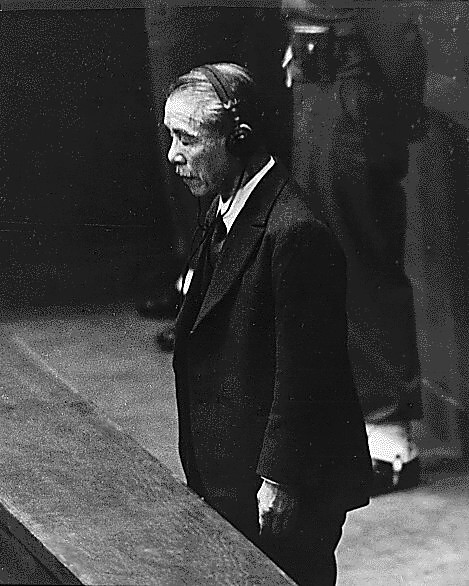
Former Prime Minister Koki Hirota listening to Sir William Webb of Australia sentencing him to death at the International Military Tribunal for the Far East at Ichigaya Court, Tokyo, Japan, 12 November 1948.
Hirota was convicted on three counts and sentenced to hang, the only civilian among the seven men executed after the Tokyo trial.
The first count was conspiracy to wage aggressive war. The tribunal looked mainly at his time as Prime Minister from 1936 to 1937. His cabinet restored the rule that the army and navy ministers had to be active-duty officers, which gave the military an effective veto over any government. It also adopted the 1936 "Fundamental Principles of National Policy," which committed Japan to expansion on the Asian continent and southward, and it signed the Anti-Comintern Pact with Germany. The judges treated these as building blocks of a plan for aggression.
The second count was waging aggressive war against China. Hirota was Foreign Minister in Konoe's cabinet when full-scale war broke out in 1937. He backed the escalation and supported the January 1938 declaration that Japan would no longer deal with Chiang Kai-shek's government, which closed off a negotiated settlement.
The third count, and the one that mattered most for the death sentence, was Count 55: deliberately and recklessly disregarding his legal duty to prevent atrocities. As Foreign Minister he got reports of the Nanking massacre in late 1937 and early 1938. The tribunal found that he accepted War Ministry assurances that it would stop, while reports of atrocities kept coming in for at least a month. It also found that he never pushed the cabinet to take immediate action. The judgment called that a dereliction of duty amounting to criminal negligence.
The verdict was controversial then and still is. The vote for death was reportedly 6 to 5, the narrowest of any defendant. Judge Pal of India would have acquitted every defendant. Judge Röling of the Netherlands dissented specifically on Hirota, arguing that he should be acquitted entirely and that a civilian diplomat shouldn't be executed for failing to control the army. Webb himself opposed death sentences in general. Hirota made matters harder for himself by refusing to testify or mount much of a defense. Many historians see that as a kind of fatalistic acceptance of responsibility for the government he had served. Appeals to MacArthur and the U.S. Supreme Court failed, and he was hanged at Sugamo Prison on 23 December 1948.
🚨 BRITISH COUPLE CONFRONTED OVER REMEMBRANCE DAY POPPIES!
Imagine being harassed in your own country for honoring the men and women who sacrificed their lives for it.
Absolutely DISGUSTING. A British couple confronted at London's Victoria Station while wearing Remembrance Day poppies, and the woman ends up in tears.
These poppies honor those who fought and died for their country. The sheer disrespect is infuriating.
Britain, what the hell is happening to your country?!
Now we find out that much of the output from new offshore windfarms off East Anglia, including the £12bn Vanguard projects will go as low value exports to the EU, subsidised by British billpayers. Another scandal in the making.
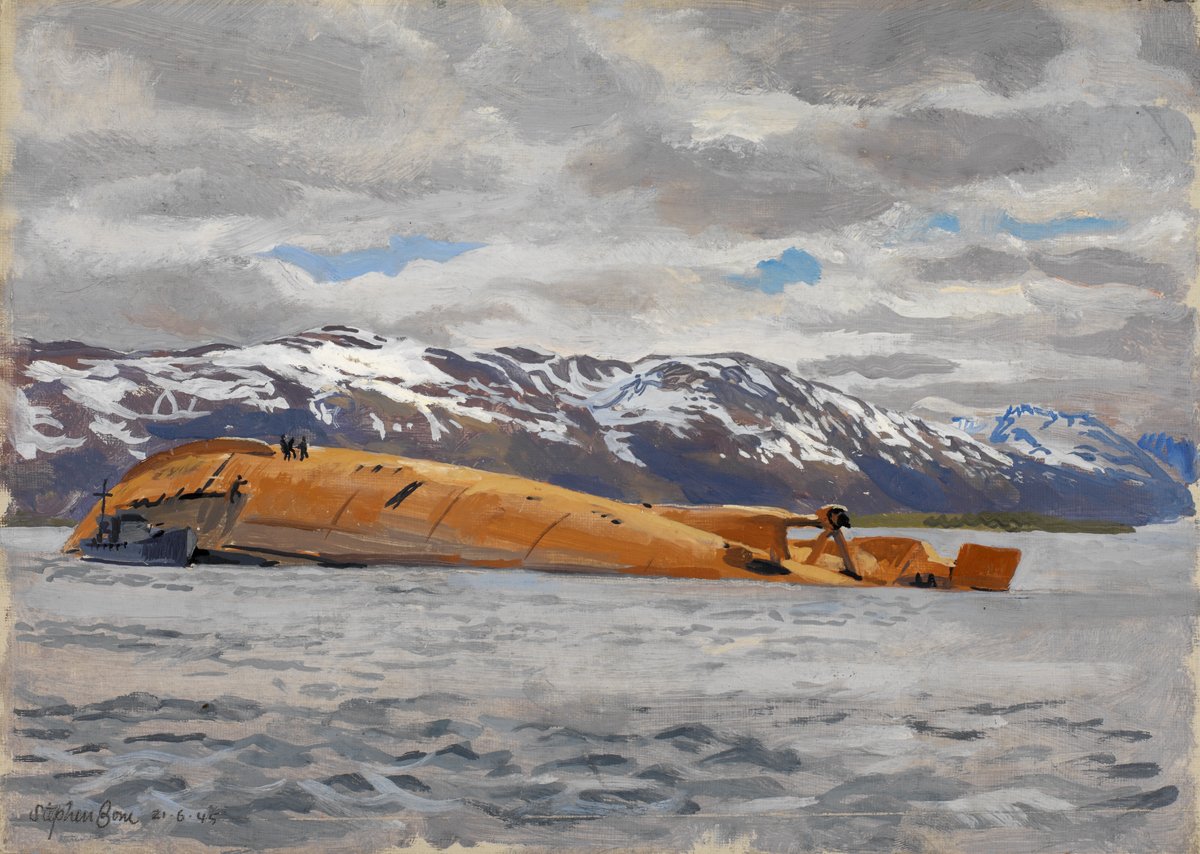
On this day in 1944, after years of hunting, British bombers finally destroyed the Tirpitz, the most feared battleship in the German navy. She capsized in a Norwegian fjord with around a thousand of her crew, and one of the longest, most obsessive manhunts of the entire war came to an end. This is the death of the Lonely Queen of the North.
The Tirpitz was the sister of the legendary Bismarck, one of the largest and most powerful battleships ever built in Europe, a steel monster of some fifty thousand tons bristling with huge guns and sheathed in heavy armor. After the Bismarck was hunted down and sunk in 1941 in one of the most famous chases in naval history, the Tirpitz inherited her terrible reputation and became the great remaining nightmare of the northern seas.
What made her so dangerous was something strange. She almost never fought. Through most of her career she lurked at anchor in the deep, narrow fjords of occupied Norway, hiding behind the mountains, rarely firing a shot. She did not have to. Her very existence was a weapon. As long as she was lying up there, poised to burst out into the Arctic, the Allies were forced to keep a powerful fleet of their own battleships and carriers standing by at all times, just in case she came out to fall upon the convoys carrying vital supplies to the Soviet Union. A single battleship, by doing nothing but existing, tied down enormous Allied forces.
And once, the mere threat of her was enough to cause a catastrophe. In the summer of 1942, a false report that the Tirpitz had sailed to attack a Russia bound convoy caused the British to order that convoy to scatter. The merchant ships, now alone and defenseless, were hunted down one by one by German aircraft and U-boats, and most of the convoy was annihilated. The Tirpitz had helped destroy it without firing a single gun.
The Allies were desperate to kill her, and the campaign against her became one of the longest and most determined of the war. They tried everything imaginable. They sent tiny midget submarines creeping up the fjord and under her hull, where the crews laid charges that heaved her out of the water and crippled her for months in an almost suicidal raid. A Soviet submarine fired torpedoes at her. Carrier aircraft swept in over the mountains to bomb her. Wave after wave of heavy bombers came after her. Again and again she was hit, damaged, written off, and again and again the Germans patched her up and she remained afloat, a threat that simply would not die.
By late 1944 she had been battered by yet another bombing raid using enormous deep penetrating bombs, hurt so badly that she could barely be considered a fighting ship any longer. She was moved north to an anchorage near the town of Tromso, where she sat as little more than a floating gun battery. But the Allies would not rest while she still floated. One more raid had already been turned back by cloud. They were determined to finish her.
The end came on the morning of November 12. A force of about thirty Lancaster heavy bombers, drawn from the Royal Air Force's most elite squadrons, the specialists who carried out the war's most difficult precision attacks, flew the long, freezing route to Tromso led by one of the RAF's finest bomber commanders. They were armed with the Tallboy, a colossal bomb weighing many tons, designed to smash through armor and earth. This time the weather was clear. The Tirpitz lay exposed beneath them, and the German fighters based nearby, which might have torn the bombers apart, never arrived in time to save her, a failure for which German officers would afterward be court martialed.
From high above, the Lancasters released their giant bombs. Several found their mark, scoring direct hits and tremendous near misses that hammered the battleship and threw the fjord into chaos. The damage was mortal, and worse was to come. By most accounts, one of the hits set off a catastrophic explosion in one of her ammunition magazines, blasting the ship open. The Tirpitz heeled over, rolling further and further, and within minutes she capsized completely, turning upside down in the water.
Hundreds of men were trapped alive inside the overturned hull as it filled, sealed into pockets of air in the dark. Rescuers worked frantically, cutting through the steel of the capsized battleship, and managed to save several dozen men from inside, but far more could not be reached in time. Something approaching a thousand German sailors died with their ship.
The Lonely Queen of the North was dead at last. The battleship that had haunted the Arctic for years, that had helped doom an entire convoy without firing on it, that had survived midget submarines and torpedoes and bomb after bomb, was finally finished, lying capsized in a Norwegian fjord. The vast hunt that had consumed so much effort and so many lives was over, ended by a handful of bombers and their giant bombs on this day in 1944.
DAN HODGES: Ten-year plan? The PM barely has a ten-week plan. Everyone in No10 can see that he doesn't know what he's doing.
'But the problem is that they can't get Andy to take a clear decision on any of the fundamental issues.'
All they know how to do is raise taxes, increase immigration, bankrupt the country, drive wealth makers abroad, pursue net zero by making the price of electricity skyrocket, increase the cost of living for everyone, pursue two tier justice, clamp down on freedom of speech, give their cronies about inflation pay rises and punish anyone who saves or works hard and lie outrageously about everything Labour is doing. He's a wrecking ball for the country, just as Starmer was.
https://t.co/Ah2md4jKDc
The co-architect of the September 11 attacks stepped onto the third-floor balcony of a guarded diplomatic neighborhood safehouse in central Kabul to enjoy the early morning breeze, unaware that an American drone circling miles above had fired two kinetic missiles carrying no explosive warhead, deploying six spinning steel blades that sliced through him without blowing out a single windowpane or harming his family inside.
The reason might surprise you.
For more than twenty years after 9/11, Ayman al-Zawahiri, an Egyptian surgeon who succeeded Osama bin Laden as the supreme emir of Al-Qaeda, evaded the world’s largest manhunt:
Intelligence agencies tracked him through the rugged mountains of Tora Bora, the tribal belt of Waziristan, and remote rural compounds while maintaining a $25 million bounty for his capture.
Following the August 2021 US withdrawal from Afghanistan and the Taliban's return to power, Zawahiri relocated to the heart of Kabul, moving into a three-story brick residence in the upscale Sherpur district, formerly an enclave of foreign diplomats and senior Afghan officials.
The safehouse was owned by a top aide to Sirajuddin Haqqani, the Taliban's acting Interior Minister and leader of the Haqqani Network, violating the Taliban's Doha Agreement pledge never to harbor Al-Qaeda operatives.
In early 2022, CIA human intelligence and signals analysts picked up the first trail:
Operatives tracked Zawahiri’s wife, daughter, and grandchildren moving into the Sherpur safehouse.
Over several months of persistent overhead drone surveillance and ground reconnaissance, analysts observed a recurring behavioral pattern: Zawahiri never left the building on foot, avoiding open-air exposure, except for one daily habit.
Each morning around sunrise, the 71-year-old militant leader walked out onto the third-floor balcony alone to read and sit in the cool air for sustained periods.
CIA engineers built a detailed scale architectural model of the Sherpur house inside Langley, Virginia, briefing President Joe Biden on sun angles, structural wind loads, and the exact balcony dimensions to ensure zero civilian casualties.
At 6:18 AM Kabul time on July 31, 2022, the strike was executed:
An unmanned CIA aerial drone circling high above the city launched two AGM-114R9X Hellfire missiles, a classified, non-explosive variant developed jointly by the Pentagon and the CIA, colloquially dubbed the "Flying Ginsu" or "Ninja Bomb".
Instead of packing high explosives that create an indiscriminate blast wave and shrapnel radius, the R9X replaces the warhead with over one hundred pounds of dense inert metal and six long, razor-sharp steel blades stowed inside the fuselage.
Seconds before impact, the blades deploy outward like a spinning halo, turning the missile into a supersonic kinetic sword designed to shred a single point target while sparing anyone standing just feet away.
The impact was instantaneous and surgical:
Both kinetic projectiles struck the third-floor balcony directly where Zawahiri stood.
He was killed on impact.
Post-strike photographs of the Sherpur building revealed a blackened scorch mark and shattered balcony railing on the third floor, while the glass windows on the floors directly below and adjacent residences remained completely intact.
Members of Zawahiri's family were inside the adjoining rooms at the moment of impact and emerged completely unharmed.
Taliban security forces immediately cordoned off the entire Sherpur neighborhood, stripping interior furnishings and hanging tarpaulins over the damaged balcony to conceal the breach before initially claiming an empty house had been struck by a rocket. Two days later, Washington formally confirmed that the twenty-one-year pursuit of bin Laden’s successor was over.
Thank you Malawi 🇲🇼 for such a refreshing African view on Britain stopping slavery. Arab slavery might still be going if it wasn’t for the British Empire. https://t.co/MJlG4clBxJ @MalawiGovt