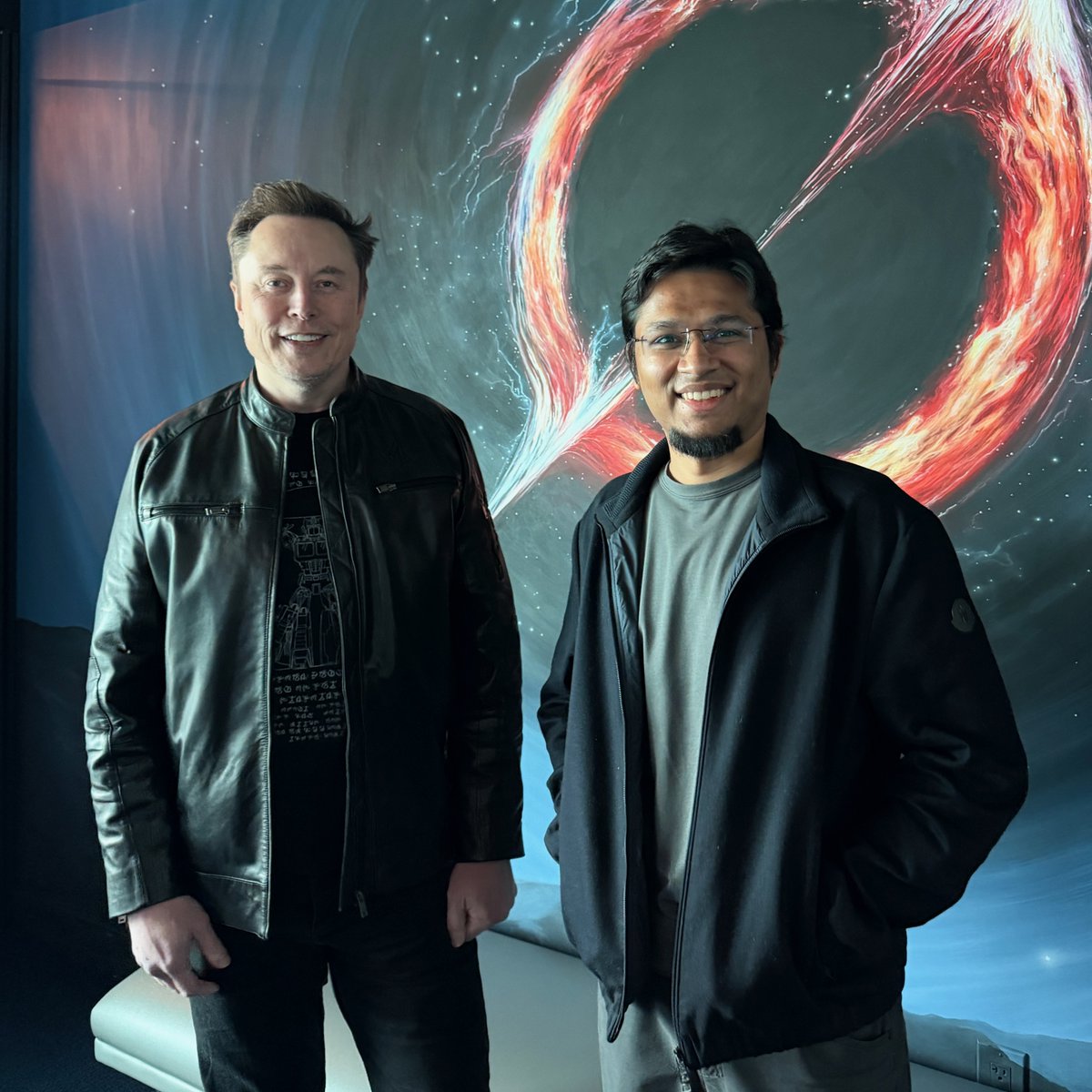
I'm joining SpaceX and xAI, working closely with Elon and team to build superintelligence.
Together SpaceX and xAI combine physical and digital intelligence under a leader who understands hardware at the deepest level. Add a high-agency culture with frontier-scale resources, and you get the possibility to achieve something truly unique.
I’m excited to advance the fields I’ve obsessed over for years, from robotics research to building AI models on the founding teams of Mistral and TML. Both were extraordinary journeys with extraordinary people that shaped how I think about building intelligence from the ground up.
Grateful for everything that brought me here and can’t wait to get started.
Today, we are releasing Inkling-Small.
Inkling-Small achieves comparable performance to Inkling at a quarter of its size. It features 276B total parameters, 12B active. We are making the full weights available.
https://t.co/BtYNcpkDRA
Fine-tune it on Tinker today, or chat with it in text, image, and audio on Tinker Playground.
Releasing the model weights and technical report of Kimi K3.
Kimi K3 is our most capable model: a 2.8T MoE model with native visual understanding and a 1M-token context window.
New model architecture: 2.5x the intelligence per unit of compute, not just more params.
Alongside Kimi K3, we're opening up more of the stack behind it — high-performance attention kernels, MoE communication library, and infrastructure for running agent environments at scale.
Model weights: https://t.co/7m7eEg6Y0B
Tech report: https://t.co/yeu6cjpMCT
Tech blog: https://t.co/YTfiMSNM1f
For my first post, I’m sharing a letter @NVIDIA signed on why open models matter.
AI will transform every industry, power every company, and be built by every country.
Open models strengthen safety and cybersecurity, accelerate innovation and diffusion, and enable sovereignty.
The world needs both frontier closed models and frontier open models.
https://t.co/AUKzoQ5Ikb
I’ve been asked several times whether Zhilin Yang, the founder of @Kimi_Moonshot was my PhD student. The answer is yes and he is absolutely brilliant.
But I’ve been incredibly fortunate to work with so many outstanding PhD students over the years. So I thought I’d brag a little about them and their career paths (of course there are also many MSc and undergraduate students, sorry if I missed anyone):
Founders / Founding Team Members
Devendra Chaplot @dchaplot PhD, Founding Member Thinking Machines / Mistral
Zhilin Yang PhD, Founder & CEO, Moonshot AI
Jimmy Ba @jimmybajimmyba MSc/PhD, Co-founder xAI
Hubert Tsai PhD, Co-founder Spuree, Apple
Nitish Srivastava @nitishsr PhD, Co-founder Perceptual Machines; Co-founder Vayu Robotics
Charlie Tang PhD, Co-founder Perceptual Machines, DE Shaw.
Professors
Paul Liang @pliang279 PhD, MIT
Ben Eysenbach @ben_eysenbach PhD, Princeton University
Ruosong Wang @RuosongW PhD, Peking University
Bhuwan Dhingra @bhuwandhingra PhD, Duke University
Roger Grosse @RogerGrosse Postdoc, University of Toronto
Alexander Schwing Postdoc, UIUC
Research Scientists
Shuyan Zhou @shuyanzh36, Postdoc, Meta Superintelligence Lab
Tiffany Min @SoYeonTiffMin PhD, Microsoft AI
Murtaza Dalal @mihdalal PhD, Tesla AI
Minji Yoon @MinjiYoon90 , PhD, Microsoft AI
Shrimai Prabhumoye PhD, NVIDIA AI, Mistral
Haitian Sun @sun_haitian PhD, Google DeepMind
Emilio Parisotto PhD, Google DeepMind
Lisa Lee PhD @rl_agent, Google DeepMind
Manzil Zaheer @ManzilZaheer PhD, Google DeepMind
Jamie Kiros PhD, Google Brain, OpenAI
Yuri Burda PhD, OpenAI, Anthropic
Cody Severinski PhD, Amazon
I’ve been asked several times whether Zhilin Yang, the founder of @Kimi_Moonshot was my PhD student. The answer is yes and he is absolutely brilliant.
But I’ve been incredibly fortunate to work with so many outstanding PhD students over the years. So I thought I’d brag a little about them and their career paths (of course there are also many MSc and undergraduate students, sorry if I missed anyone):
Founders / Founding Team Members
Devendra Chaplot @dchaplot PhD, Founding Member Thinking Machines / Mistral
Zhilin Yang PhD, Founder & CEO, Moonshot AI
Jimmy Ba @jimmybajimmyba MSc/PhD, Co-founder xAI
Hubert Tsai PhD, Co-founder Spuree, Apple
Nitish Srivastava @nitishsr PhD, Co-founder Perceptual Machines; Co-founder Vayu Robotics
Charlie Tang PhD, Co-founder Perceptual Machines, DE Shaw.
Professors
Paul Liang @pliang279 PhD, MIT
Ben Eysenbach @ben_eysenbach PhD, Princeton University
Ruosong Wang @RuosongW PhD, Peking University
Bhuwan Dhingra @bhuwandhingra PhD, Duke University
Roger Grosse @RogerGrosse Postdoc, University of Toronto
Alexander Schwing Postdoc, UIUC
Research Scientists
Shuyan Zhou @shuyanzh36, Postdoc, Meta Superintelligence Lab
Tiffany Min @SoYeonTiffMin PhD, Microsoft AI
Murtaza Dalal @mihdalal PhD, Tesla AI
Minji Yoon @MinjiYoon90 , PhD, Microsoft AI
Shrimai Prabhumoye PhD, NVIDIA AI, Mistral
Haitian Sun @sun_haitian PhD, Google DeepMind
Emilio Parisotto PhD, Google DeepMind
Lisa Lee PhD @rl_agent, Google DeepMind
Manzil Zaheer @ManzilZaheer PhD, Google DeepMind
Jamie Kiros PhD, Google Brain, OpenAI
Yuri Burda PhD, OpenAI, Anthropic
Cody Severinski PhD, Amazon
Today, we are introducing Inkling.
Inkling reasons efficiently across text, image, and audio modalities. We are making the full weights available.
https://t.co/Ghebq5mG30
Available today for fine-tuning on Tinker. Play with it in the Inkling Playground. 🧵
Most businesses don’t need just any software. They need a way to turn how they actually work into software
That’s what @emergentlabs is becoming: the operating system for businesses
Today we’re announcing our $130M Series C at a $1.5B valuation to put that future in their hands
Announcing Grok 4.5, our first model trained specifically for coding and agents. It was trained with Cursor and offers frontier intelligence at leading speeds and cost efficiency.
https://t.co/i8HpU7w64k
Humanoid robots don't need to look human.
Meet Eno, our first general-purpose robot.
Not a machine pretending to be human, but intelligence given a body.
At Genesis, we’re building a future where robots don’t feel cold or distant, but capable, calm, and ready to help.
Available Q4 this year.
We are back again :) After three weeks of quiet building.
Introducing Genesis World 1.0, our latest simulation platform, the second release in our full-stack suite. Open-sourced.
Robotics is still bottlenecked by the 1× speed of the physical world. Every model, checkpoint, and data recipe eventually needs to be tested on physical hardware, slowly, expensively, and with limited coverage.
One hour in reality can become 100 days in simulation. That is how robotics model iteration moves from a wall-clock bottleneck to a compute problem.
To make this work, simulation has to be both fast and trustworthy.
Over the past year, we rebuilt the entire stack: a GPU-accelerated cross-platform compiler, penetration-free multi-physics contact solvers, unified rigid and deformable physics, and a photo-realistic renderer purpose-built for physical AI applications.
We built Nyx, a high-performance path-traced rendering engine for robotics application.
Genesis World 1.0 achieves near realtime performance with our latest development for penetration-free IPC solver, supporting various types of deformables beyond rigid bodies. It supports contact-rich, dexterous manipulation simulation across different embodiments: unitree, sharpa, wuji, genesis hand and various types of grippers.
Under the hood is Quadrants, our effort in pushing forward cross-platform GPU-accelerated computation. Quadrants started as a fork of Taichi, and we rebuilt most of the critical parts for optimizing simulation workloads, giving 10x faster launch time and up to 4.6x runtime performance compared to the initial Genesis release.
Together, they bring us to an unprecedentedly low sim-to-real gap, enabling zero-shot real-to-sim model evaluation and much faster iteration of GENE.
All available today.
Genesis World 1.0: https://t.co/aknCM3eqws
Quadrants: https://t.co/uXqPNI4cb6
Nyx: https://t.co/R8j0djqGnV
People talk, listen, watch, think, and collaborate at the same time, in real time. We've designed an AI that works with people the same way.
We share our approach, early results, and a quick look at our model in action.
https://t.co/AFJZ5kH7Ku
We are back. After one year of quiet building.
Introducing GENE-26.5, our first robotic brain that takes a major step toward human-level capability.
For years, robotics has struggled to learn from the world’s largest and valuable data source: Humans.
Solving it means rethinking the whole stack from the ground up:
- A robotics-native foundation model.
- A 1:1 human-like robotic hand.
- A noninvasive data collection glove for motion, force, and touch.
- A simulator that turns weeks of experiments into minutes.
GENE-26.5 is trained across language, vision, proprioception, tactile, and action. We designed a set of tasks to test how far we can go with this new paradigm.
Fully autonomous, 1x speed, one model, same weights. (Enjoy with sound on)
We are approaching the endgame for robotics.
And this is just a beginning.
SpaceXAI and @cursor_ai are now working closely together to create the world’s best coding and knowledge work AI.
The combination of Cursor’s leading product and distribution to expert software engineers with SpaceX’s million H100 equivalent Colossus training supercomputer will allow us to build the world’s most useful models.
Cursor has also given SpaceX the right to acquire Cursor later this year for $60 billion or pay $10 billion for our work together.