@KhusbooT14835 Projects tell Claude what to know.
Skills tell Claude what to do.
MCP tells Claude where to get data.
Understanding this stack changes everything.
Makakonekta gamit ang mabilis at maaasahang internet para sa streaming, mga video call, online gaming, at marami pang iba.
Umorder online sa loob lang ng ilang minuto.
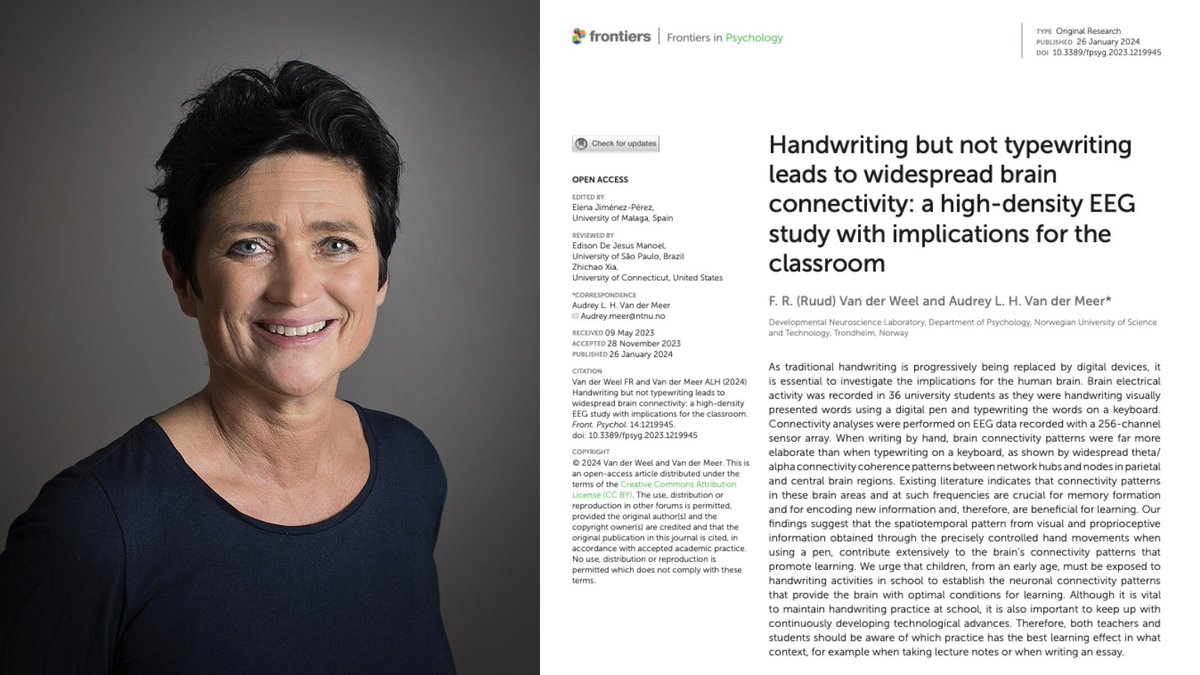
A Norwegian neuroscientist spent 20 years proving that the act of writing by hand changes the human brain in ways typing physically cannot, and almost nobody outside her field has read the paper.
Her name is Audrey van der Meer.
She runs a brain research lab in Trondheim, and the paper that closed the argument was published in 2024 in a journal called Frontiers in Psychology. The finding is brutal enough that it should have changed every classroom on Earth.
The experiment was simple. She recruited 36 university students and put each one in a cap with 256 sensors pressed against their scalp to record brain activity. Words flashed on a screen one at a time.
Sometimes the students wrote the word by hand on a touchscreen using a digital pen, and sometimes they typed the same word on a keyboard. Every neural response was recorded for the full five seconds the word stayed on screen.
Then her team looked at the part of the data most researchers had ignored for years, which is how different parts of the brain were communicating with each other during the task.
When the students wrote by hand, the brain lit up everywhere at once.
The regions responsible for memory, sensory integration, and the encoding of new information were all firing together in a coordinated pattern that spread across the entire cortex. The whole network was awake and connected.
When the same students typed the same word, that pattern collapsed almost completely.
Most of the brain went quiet, and the connections between regions that had been alive seconds earlier were nowhere to be found on the EEG.
Same word, same brain, same person, and two completely different neurological events.
The reason turned out to be something nobody had really paid attention to before her work. Writing by hand is not one motion but a sequence of thousands of tiny micro-movements coordinated with your eyes in real time, where each letter is a different shape that requires the brain to solve a slightly different spatial problem.
Your fingers, wrist, vision, and the parts of your brain that track position in space are all working together to produce one letter, then the next, then the next.
Typing throws all of that away. Every key on a keyboard requires the exact same finger motion regardless of which letter you are pressing, which means the brain has almost nothing to integrate and almost no problem to solve.
Van der Meer said it plainly in her interviews.
Pressing the same key with the same finger over and over does not stimulate the brain in any meaningful way, and she pointed out something that should scare every parent who handed their kid an iPad.
Children who learn to read and write on tablets often cannot tell letters like b and d apart, because they have never physically felt with their bodies what it takes to actually produce those letters on a page.
A decade before her, two researchers at Princeton ran the same fight using a completely different method and ended up at the same answer. Pam Mueller and Daniel Oppenheimer tested 327 students across three experiments, where half took notes on laptops with the internet disabled and half took notes by hand, before testing everyone on what they actually understood from the lectures they had watched.
The handwriting group won by a wide margin on every question that required real understanding rather than surface recall.
The reason was hiding in the transcripts of what the two groups had actually written down.
The laptop students typed almost word for word, capturing more total content but processing almost none of it as they went, while the handwriting students physically could not write fast enough to transcribe a lecture in real time, which forced them to listen carefully, decide what actually mattered, and put it in their own words on the page.
That single act of choosing what to keep was the learning itself, and the keyboard had quietly skipped the choosing and skipped the learning along with it.
Two studies. Two countries. Same answer.
Handwriting makes the brain work. Typing lets it coast.
Every note you have ever typed instead of written went into your brain through a thinner pipe. Every meeting, every book highlight, every idea you captured on your phone instead of on paper was processed at half depth.
You did not forget those things because your memory is bad. You forgot them because typing never woke the part of the brain that would have made them stick.
The fix is the thing your grandmother already knew.
Pick up a pen. Write the thing down. The slower road is the faster one.
A tiny bee just did what chemotherapy couldn't.
Scientists in Australia discovered that honeybee venom can wipe out 100% of aggressive breast cancer cells in under 60 minutes.
And the healthy cells around them? Barely touched.
The breakthrough came from Dr. Ciara Duffy and her team at the Harry Perkins Institute of Medical Research, working alongside the University of Western Australia.
They tested venom drawn from 312 honeybees and bumblebees across Australia, Ireland, and England.
The target: triple-negative breast cancer and HER2-enriched breast cancer. Two of the deadliest, most stubborn forms of the disease.
The weapon: melittin. The same tiny peptide that makes a bee sting burn.
At one specific dose, melittin tore through cancer cell membranes completely within an hour. Within just 20 minutes, it shut down the chemical signals cancer cells need to grow and multiply.
Bumblebee venom, which lacks melittin, did nothing. Zero effect, even at high concentrations.
Scientists then recreated melittin synthetically in the lab and got almost identical results, meaning no bees need to be harmed to develop the therapy.
Published in the peer-reviewed journal npj Precision Oncology, the findings are still early-stage. Human trials haven't happened yet.
But one thing is clear. Nature has been hiding answers in plain sight all along, sometimes inside the smallest creatures on Earth.
Source: Harry Perkins Institute of Medical Research / npj Precision Oncology (Dr. Ciara Duffy et al.)
ICC as Political Theater: When Justice Becomes a Prop in Manila’s Political Circus
By: Anna Malindog-Uy
May 12, 2026
The latest International Criminal Court (ICC) drama in the Philippines is being sold, predictably, as a grand morality play about accountability, justice, and the rule of law. But scratch the surface, and the performance begins to look less like principled legal action and more like domestic political theater with international costumes.
At the heart of this spectacle are two legal questions that cannot be brushed aside by press statements, political noise, or sanctimonious slogans.
First, if the National Bureau of Investigation (NBI) acted against a sitting senator, did it fully respect Article 145 of the Revised Penal Code, which deals with parliamentary immunity? Or are legal shortcuts now the new fashion accessory in the country’s “rule of law” department? In a democracy, the law is NOT supposed to be applied like mood lighting — bright when useful, dim when inconvenient.
Second, if the CIDG has already issued a subpoena involving alleged extrajudicial killing (EJK) matters, does that not indicate an active domestic proceeding? And if there is an active domestic proceeding, how does this square with the ICC’s principle of complementarity under the Rome Statute?
Complementarity is not a minor technicality. It is the core logic of the ICC system. The ICC is supposed to be a COURT OF LAST RESORT, NOT a court of first political convenience.
Under Article 17 of the Rome Statute, a case may be inadmissible if a state is genuinely investigating or prosecuting the matter. Under Article 19, states and accused persons may challenge the Court’s jurisdiction or admissibility precisely on that ground.
So the question becomes unavoidable: Is the Philippines unwilling and unable to act — or is it already acting, but selectively, chaotically, and politically?
The Rome Statute is clear on the architecture of ICC arrest warrants. Article 58 allows the Pre-Trial Chamber to issue a warrant when there are reasonable grounds to believe a person committed a crime within ICC jurisdiction and when arrest is necessary to ensure appearance, prevent obstruction, or stop continuation of the crime.
Article 59 requires the custodial state to bring the person before a competent judicial authority (a court) to verify identity, the warrant’s validity, and the rights of the arrested person.
Article 89 governs surrender to the Court, while Articles 86 and 91 address cooperation and the contents required in arrest-and-surrender requests.
But here is the inconvenient legal reality: the ICC has no police force. It depends on state cooperation, domestic courts, executive action, and political will. That is precisely why ICC warrants are often politically explosive. They do not float above politics; they land directly in the middle of it. And in the Philippines, that middle is already chaotic.
The ICC issue is no longer merely about international criminal justice. It is now tied to the combustible domestic politics of survival, vengeance, alliances, and warfare among the political elite. The danger is that law becomes less about justice and more about sequencing: who gets targeted, when, by whom, and for whose political benefit.
If institutions are truly pursuing justice, then due process must be respected even for the politically inconvenient. But if institutions are merely performing legal theater, then the ICC becomes another prop in the long-running circus of Philippine power politics.
Because in a democracy, due process is NOT a political accessory. It is a constitutional safeguard. It should NOT be worn when convenient and discarded when inconvenient.
Justice must not look like revenge wearing a robe.
To end: the last time I checked, the Philippines is NOT a failed state. It is a sovereign republic with a functioning—though imperfect—judicial system.
So the real question is this: when domestic institutions are still operating, who gave an international tribunal the license to barge in and act as if Philippine sovereignty is merely a procedural inconvenience?
A major ADB study exposes the depths of poverty among older Filipinos. For one,they rely mostly for income from fragile remittances and unpredictable family support. For another,the country’s pension system is broken; it is ranked nearly last in the world.
https://t.co/yEd1LVW7gS
Andrew Scott es un artista contemporáneo conocido por sus obras basadas en la ilusión óptica, donde las figuras parecen atravesar el cristal y extenderse más allá del marco.
'GREATEST ROBBERY OF A GOVERNMENT'
Late dictator Ferdinand Marcos received this distinction from the Guinness World Records after the Philippine government identified a total national loss worth $5 billion to $10 billion from November 1965. #NeverAgain#NeverForget
JUST IN | Ibinunyag ni Sen. Imee Marcos ang umano’y plano na ipwesto si Boying Remulla sa Ombudsman para makasuhan at mapakulong si VP Inday Sara Duterte at mga kaalyado nito.
(1/2)