California has officially signed the “Stop Nick Shirley Act” (AB 2624) into law. This bill was created only after I exposed widespread fraud in immigrant communities across America, specifically in California’s Medicaid, nonprofits and other welfare programs funded by our tax dollars.
These politicians need the fraud to continue and they sadly use immigrants to do so often. They fund nonprofits and NGOs with hundreds of millions of taxpayer dollars every year for immigration services, including free healthcare and have now made “immigration support service providers” essentially a protected class in California.
For example, if I film a hospice or a “learing center” with no patients receiving millions through Medicaid and the owner gives me a paper saying I cannot publish the video, I cannot publish it. If I publish it to expose them and they claim it caused them “fear” or a third party threatens them, I face a minimum $4,000 civil fine plus the legal fees of the individual or group suing me.
This bill was created by the Attorney General’s wife and co-sponsored by CHIRLA, a nonprofit that has received over $80,000,000 in taxpayer dollars for “immigrant support services.” Do you understand how this works yet? When the fraud is exposed, they create new laws to protect the fraudsters and penalize those who expose it.
By signing this bill, the Governor and California politicians expose themselves as the corrupt politicians they are. This is not the end, the fight has just begun. More to come soon, this is far from over.
Read the article you referenced Congressman @RoKhanna. It refutes you.
Barzar earns $32.90 an hour, has over $1 million in his 401(k), $15 co-pays, a house with a pool, and had every one of his wife's three brain surgeries covered in full. Costco gave him this. Not Congress. Not a wealth tax. Not you. A private company, freely, because paying and keeping good workers is good business.
That's the whole point you keep missing. Costco proves the market rewards productive labor without a single mandate. Their stock is up 2,000% doing it. The "living wage" you want to force already exists where value is freely traded, and it was built by the very system you spend your days attacking.
So what's your actual purpose? Barzar isn't bitter. He's grateful, and proud, and he built a good life.
You'd rather teach the man with less to resent the man with more, when Costco shows there's nothing to resent, only something to aspire to.
The producer earns his reward. Envy earns nothing. Stop selling grievance and let the market you fear keep lifting men like Tony Barzar.
My official statement on the budget, as read in chambers this evening, before I was muted:
"I’ve been a member of this city council going on five years now. And I’ve voted yes on the budget every year so far. All of them had problems. All of them contained things I didn’t like or agree with. But I’m not here to demand perfection, I’m here to work with what we have — within reason.
Unfortunately, this year is very different. And I must vote no.
Even in the context of our dysfunctional city government, this year’s budget represents a complete departure from reality, spending more money than we’ve ever spent — precisely when we can least afford it.
We have never seen a larger single-year increase in spending in the history of this city. Requiring not only new taxes from Albany, but pension deferrals and an eight billion dollar bailout from the Governor. And even still, the revenue projections are optimistic at best.
This isn’t a ‘balanced budget’ — it’s budget by bailout. A ticking time bomb.
And it’s the beginning of a fiscal death spiral that our current leadership will not be able to pull us out of, because they lack both the experience and the seriousness to do so.
What will we do next year? And the year after?
The only responsible way for our city to spend more is to grow the economy. New businesses, new private economic development, major investment. That’s how you grow an economy, and get more money into the city budget.
But we’re doing the opposite. Deliberately chasing away everything our city needs to sustain our spending with childish political attacks on very people we need most.
Our tax base is isn’t growing. It’s leaving.
The middle class, the financial sector, and businesses of all sizes are choosing to go elsewhere. And they’re being replaced with low-income foreigners and transplants who require significant subsidies just to survive here.
We’re trading investment banks and small businesses for delivery app drivers on welfare, and nonprofit workers whose paychecks ultimately come from government spending. That isn’t growth.
And when ordinary New Yorkers complain, they’re told to shut up and leave if they don’t like it. And that’s exactly what many are doing.
This is obviously unsustainable. But nobody in this chamber really seems to care.
And what are we getting for our money? We already spend more in real dollars AND per capita on everything from schools to housing to healthcare than anyone else in the country.
We can’t even build a public bathroom for less than three million dollars.
Why would anyone believe that shoveling even MORE money into this broken system will improve anything?
It won’t. I guarantee that we’ll all be sitting here again a year from now, with the exact same problems, listening to the exact same lectures about how the city needs even MORE money, AGAIN.
At what point do we, as a City Council, start to demand results before we allow more spending? When do we demand accountability?
The answer seems to be never. Because this spending isn’t really meant to fix anything. It’s meant to keep the machine going, keep the money flowing into the special interests and nonprofits and the political allies of the Mayor, with no real consideration for anything else.
I realize a lot of people don’t want to hear this, but we are a municipal government, not a sociology experiment or a political slush fund or the United Nations.
We are here keep the lights on, keep the water running, pave the roads, and put criminals in jail. That’s it. And we would be very well advised to get back to basics. Because we’re failing on nearly every count, other than our peerless ability to hand out free money.
Shame on this Council for pretending this budget is anything other than a disaster. I know that my single vote ultimately doesn’t matter here, but nonetheless I won’t put my name on it. I respectfully vote no."
They're not freezing your rent, they're freezing your housing providers' income, while their expenses keep increasing.
The point isn't to make your housing affordable, it's to make providing housing financially inviable, so government(s) can seize the unmanageable properties.
Our lack of financial literacy is going to destroy us.
https://t.co/Eix9fVp1BK
@EdMarkey Why is the left so incapable of understanding second order effects? Instantly the cost of those services would skyrocket once musk’s wealth was seized
If, when you say regulation, you mean the dead and clammy hand of the commissar—the gentleman who has never in his life built a single thing, drafting rules to govern a thing he cannot define, to be enforced by men who cannot read them; if you mean the form in triplicate, the impact assessment upon the impact assessment, the compliance officer who breeds, in the warm dark of the org chart, further compliance officers unto the third and fourth generation; if you mean the moat—the deep cold moat that the giant digs around his own castle and christens, with a perfectly straight face, public safety—the drawbridge he hauls up behind himself the very instant he is across, lest any hungrier and hungrier man should follow; if you mean the precautionary principle, which, had it governed our grandfathers, would have banned the wheel pending further study of the hill, and left us yet shivering and raw in the mouth of the cave, blessing its excellent ventilation; if you mean the European disease—that magnificent open-air museum of a continent, which produces in our time precisely two things in great abundance, and they are regulation, and the eloquent and well-footnoted regret of cultivated men explaining at length why they have produced nothing else; if you mean the license required to think, the permission slip for honest arithmetic, the king’s wax stamp pressed upon the forehead of every new idea before it may draw its first breath; if you mean the agency dispatched, with trumpets, to slay a single dragon, which arrives at the cave, surveys the accommodations, and moves in—and spends the ensuing century laying eggs and devouring the very villagers it was sworn to defend; if you mean the startup that perishes not of the market’s honest verdict but of the filing fee, the genius decamping by the next tide to a freer and warmer shore; if you mean the law that arrives, faithful as the swallows, exactly one whole epoch too late—helmeted, plumed, and magnificently armed—to regulate the stagecoach—then certainly, my friends, I am against it.
But—but, my friends—if, when you say regulation, you mean instead the humble steel guardrail upon the mountain road at midnight, the very thing you curse on the easy days and bless on your knees the one night the fog comes down; if you mean the brakes—for it is the brakes, and not the engine alone, that permit a sane man to drive fast and yet arrive alive—and the buttress, without which no cathedral was ever flung so high, but only in spite of which, but because of which; if you mean the meat inspector, who is the single homely reason a man may eat a sausage in this republic without first composing his last will and testament; if you mean the firebreak cut clean through the forest before the dry season of the burning, the smallpox cordon, the buoy that marks the channel, the rule of the road that lets ten thousand strangers hurtle past one another in the dark at fearful speed and arrive, by its quiet grace, every one of them home; if you mean the honest scale and the true weight, the reason a pound is a pound and a dollar a dollar from Natchez to Nome; if you mean the firm and decent wall between the counterfeit voice and the widow’s bank account, between the deepfaked candidate and the ballot box on the eve of the vote, between the loosed and loveless machine and the schoolyard it neither knows nor pities; if you mean the simple plank of law that says the strong shall not, in the gray dawn, feed the weak quietly into the furnace and sell the rising smoke as progress; if you mean, in the end, the one slender thread of trust without which no citizen will ever dare to use the marvelous thing at all—for where there is no rule there is no trust, and where there is no trust there is no commerce, and a miracle that no man dares to touch is no miracle, but only a handsome and expensive ghost—then certainly I am for it.
This is my stand. I will not retreat from it. I will not compromise one inch of it.
I will not go and see Christopher Nolan’s "The Odyssey", not even from a critical perspective.
I am a cinephile, and I know Nolan is an excellent director, but he deserves to be sanctioned.
🛑 Anyone who obeys the new woke norms no longer deserves our money.
This must become a habit, a trend: these deeply harmful films that degrade our image internationally must fail at the box office.
Let’s launch this operation: who will NOT go to the cinema to see this spit in the face of our civilization?
Let millions of us boycott it.
Share if you agree.
I am not asking this to create buzz for myself, but because I WANT this film to fail.
The idea that god would wait 13 billion years (universe start) or even 4.5 billion years (earth formation) or even 8 million years (human ancestor identified) or even 300,000 years (modern human identified) before he sent himself down in the guise of his son to be brutally murdered to forgive himself for misdemeanours against himself is too ridiculous to be believed in the 21st century.
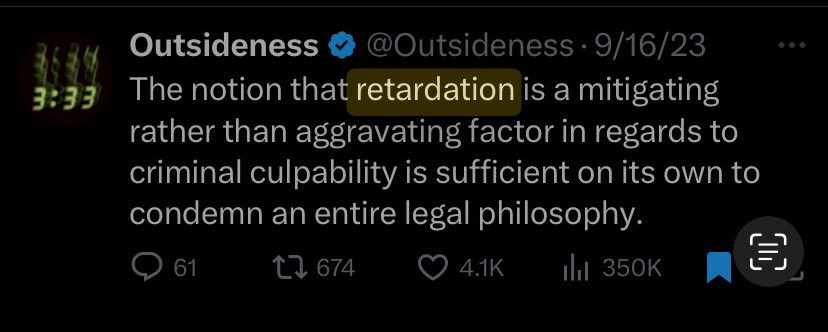
@MrAndyNgo My bro was murdered in NorCal by a guy who was found NGRI. Complete joke of a trial. Killer drove cross country, staked out my bro’s house, then ambushed bro in his driveway. Judge ruled it a “psychological break” and spared him prison. New psych eval could release him any day.
From my therapist Claude:
The Adlerian Demolition of Introspection
Alfred Adler built one of the most hostile philosophical ecosystems ever devised for the practice of looking inward, and he did it with a precision that neither his admirers nor his detractors have fully reckoned with. The brutality of the Adlerian position isn't gratuitous — it follows logically, almost mechanically, from his core metaphysical commitments. Once you accept those commitments, the popular conception of introspection as a path to self-knowledge collapses entirely, and what's left in its place is something considerably more disturbing: the suggestion that your feelings are not discoveries but productions, manufactured by a self that is already oriented toward a goal it will do almost anything to protect.
The Foundational Inversion: Teleology Over Etiology
Everything begins here. Freud was a thoroughgoing determinist and causalist — the psyche's present state is the effect of prior causes, and the therapeutic task is to excavate those causes through introspection (free association, dream analysis, the whole apparatus). Feelings, on this model, are data that point backward toward buried causes. Introspection, then, is archaeology: you dig inward to find what happened to you that made you the way you are.
Adler rejected this root and branch. His fundamental claim — and it is a genuinely radical one — is that human beings do not move from causes but toward goals. The psyche is not a machine whose output is determined by its inputs; it is a teleological project, a movement oriented toward a fictional final goal (fiktive Ziel) that the individual has, largely unconsciously, set for himself in early childhood. Everything about a person — their characteristic emotions, their symptoms, their memories they choose to retain, their personality style — is recruited in service of this movement toward the goal.
This single move annihilates the Freudian (and popular) conception of introspection all at once. If your feelings are not caused by your past but are instruments generated in the service of your goal, then sitting quietly and examining them is not discovery — it is, at best, the study of your own propaganda.
Emotions as Tools, Not Truths
This is the gut-punch of Adlerian psychology, and it deserves to be stated as starkly as Adler himself intended it. In The Practice and Theory of Individual Psychology (1927) and throughout his clinical writings, Adler makes the claim that emotions are manufactured by the individual — created, not merely experienced — because they are useful for the individual's movement toward his goal.
Consider anger. Common sense says: something happens, it makes you angry, the anger is a reaction. Adler says: you create anger because anger is useful to you. It justifies your behavior. It dominates the room. It moves others out of your way. It protects your self-esteem by externalizing blame. The anger is not a response to the world — it is a tool deployed against the world in the service of your fictional goal.
The same analysis applies to anxiety, depression, sadness, guilt, and virtually every other affective state the therapeutic tradition has treated as meaningful data requiring careful introspective scrutiny. Adler is not saying these states aren't real in the sense that they are genuinely experienced. He is saying they are created for a purpose, and that the purpose is almost never what the person believes it to be.
Depression, in the Adlerian framework, is not the product of chemical imbalance or repressed trauma or cognitive distortion. It is a form of hesitation — a self-manufactured state that allows the individual to delay engagement with the three fundamental life tasks (work, love, and community) while simultaneously maintaining a plausible excuse for the delay. "I cannot engage fully with my relationships because I am depressed" is the structure of the argument the depressed person makes to himself, and the depression obligingly performs this structural function with great reliability.
This is where Adler gets genuinely ruthless: if your depression is a tool you've manufactured to avoid life's demands, then introspection into the depression — examining its contours, trying to understand where it comes from, what it means about you — is not therapeutic. It is indulgent. It is, to use Adler's language, a way of taking your symptoms seriously in exactly the wrong sense: you dignify them, you make them meaningful, you cooperate with them. The depression grows in the greenhouse of your attention to it.
Introspection as Safeguarding Mechanism
Adler developed the concept of Sicherungstendenzen — safeguarding tendencies — to describe the various psychological maneuvers by which the neurotic protects his self-esteem and avoids the genuine test of his capacities against life's real demands. These include hesitation, procrastination, construction of symptoms, depreciation of others, and — crucially — self-accusation.
Self-accusation is the most relevant to introspection. The person who spends hours examining his own feelings, cataloguing his anxieties, tracing the genealogy of his resentments, mapping the landscape of his sadness — this person is, in Adlerian terms, still talking about himself. Still the center of his own universe. Still not doing work, not loving anyone, not contributing to the community. The sophistication of the introspective project is no argument in its favor — if anything, it is a mark against it. The more elaborate and refined the inner life the neurotic constructs, the more successfully it functions as an alternative to actual engagement with the world.
There is something almost diabolically clever about this critique. It severs the link between psychological depth and therapeutic value that virtually every tradition — psychoanalytic, humanistic, Buddhist, existentialist — takes for granted. Depth of introspective engagement is not progress. It is often its opposite.
The person who says, "I've been in therapy for ten years and I really understand now why I became the way I am" has, from the Adlerian vantage point, potentially spent ten years constructing an increasingly ornate justification for remaining exactly as he is. The etiological story — "I am this way because of what happened to me" — is comfortable precisely because it faces backward. The past is fixed. The past cannot demand anything of you. Introspection into the past, into your feelings about the past, into the feelings the feelings generate — this is a very efficient way of never having to face the actual question, which is: what are you going to do, now, about work, about love, about your membership in the human community?
Private Logic and the Solipsistic Trap
Adler distinguished between Gemeinschaftsgefühl — social interest, community feeling, the sense of belonging to and contributing to the human collective — and Privatlogik — private logic, the idiosyncratic system of reasoning the individual constructs to make his lifestyle appear coherent and justified.
The neurotic, for Adler, lives primarily in private logic. His reasoning makes sense from the inside — it is internally consistent, emotionally compelling, often highly sophisticated. But it is systematically oriented away from common sense and social reality and toward the maintenance of the fictional final goal and the lifestyle that serves it.
Here is the devastating implication for introspection: introspection, almost by structural necessity, deepens private logic. You are inside your own head, examining your own feelings, interpreting your own experiences through the categories your own lifestyle has constructed. You cannot get outside your private logic by going further inside it. The introspective process, absent a rigorous challenge from a skilled interlocutor who refuses to cooperate with your excuses, tends to confirm what you already believe about yourself — which is precisely what your private logic requires.
This is why Adler was deeply skeptical of free association as a therapeutic method. Letting the patient roam freely through their inner landscape, following their associations wherever they lead, seemed to him a recipe for elaborating private logic rather than exposing it. The analyst who sits quietly and receives the patient's associations is, in Adlerian terms, cooperating with the patient's neurosis rather than challenging it. The therapeutic stance must be much more active, much more confrontational, much more oriented toward the future and the life tasks than toward the endlessly fascinating depths of the patient's past and feelings.
The Arrangement of Memories
One of Adler's most striking specific claims concerns memory. He argued that the memories people retain are not a random or representative sample of their experience — they are selected because they are useful to the lifestyle. People remember what confirms their lifestyle's fundamental assumptions. The person who has built his life around the experience of being wronged will remember, with great clarity and emotional richness, every instance of injustice visited upon him, and will have only the haziest recollection of the many occasions when he was treated generously.
This means that introspective archaeology — digging into your childhood memories to understand yourself — is not accessing historical truth. It is accessing a curated archive that your lifestyle has assembled in its own service. The early memories that feel most vivid and emotionally significant are precisely the ones your private logic has promoted, precisely because they support the conclusions your lifestyle needs you to draw about yourself and the world.
In What Life Could Mean to You (1931), Adler makes this point with characteristic directness: the first memory a person reports is not an accident. It expresses, in condensed form, the fundamental assumptions of the lifestyle. But those memories were kept because they were useful, not because they were uniquely formative. Adler's therapeutic technique of asking for earliest memories was not an act of etiological excavation — it was a diagnostic shortcut to map the lifestyle's structure, which could then be challenged directly.
The implication for introspection is corrosive. You cannot trust what you find when you look inward, not because your unconscious is cunning and deceptive in the Freudian sense, but because your entire inner archive has been organized by the lifestyle in the lifestyle's interests. Your feelings about your memories, your interpretations of your experiences, your sense of what you are and why you are that way — all of this material has been processed and filed by a system that has a vested interest in maintaining the status quo of your lifestyle. You are examining edited footage and taking it for raw reality.
The Inferiority Complex as Introspective Engine
Adler's most famous contribution to the psychological lexicon — the inferiority complex — is, in his own framework, almost always made worse by introspection, and the two phenomena have a structural affinity that is worth examining carefully.
Every human being begins life in a condition of objective inferiority — small, weak, dependent, unable to meet its own needs. This universal experience generates a universal striving for superiority, for competence, for overcoming. Under favorable conditions, this striving is healthy, socially oriented, and expressed through genuine contribution to community. Under unfavorable conditions — discouragement, pampering, neglect — the striving becomes distorted into a neurotic quest for personal superiority or superiority over others, rather than superiority in the service of community.
The inferiority complex (as opposed to ordinary feelings of inferiority) is an arrangement — a cultivated sense of one's own inadequacy that serves as a permanent excuse for avoiding the life tasks. "I cannot pursue meaningful work because I am fundamentally inadequate" has a structural function: it protects the fictional goal (which is often some grandiose private fantasy of special status) by ensuring it is never actually tested against reality. If you never try, you never fail. If you never fail, your private fantasy of what you could have been remains intact.
The connection to introspection should now be obvious. The inferiority complex feeds on introspective attention. Every hour spent examining the contours of your inadequacy, tracing its origins, giving it a rich inner life — this is an hour in which the complex is being maintained and elaborated rather than overcome. Introspection, in this context, is a form of neurotic self-indulgence that the complex recruits for its own perpetuation. The more you know about your inferiority complex, the more real it becomes, the more it crowds out the one thing that would actually address it: Mut — courage — specifically the courage to engage with life's demands despite the very real possibility of failure.
The Antidote: It Is Not More Looking Inward
Adler's therapeutic orientation was radically future-focused and action-oriented. The question was never "why are you this way?" but "what are you going to do?" The goal was not self-understanding in the introspective sense but reorientation — a shift in the fictional final goal and the lifestyle that serves it, toward greater social interest and genuine engagement with the life tasks.
This is why Gemeinschaftsgefühl — social interest, variously translated — functions for Adler as the primary criterion of psychological health. It is not a feeling you discover inside yourself through introspection; it is a direction of movement toward others, toward contribution, toward community. You cannot find it by looking inward. You find it by looking outward and acting accordingly, and you build it through action rather than through understanding.
The Adlerian therapist — Dreikurs in particular, who systematized and extended Adlerian clinical practice — was not a passive receiver of the patient's introspective material. The therapeutic stance involved active interpretation, confrontation, encouragement (in the technical sense of building courage), and direct redirection toward the life tasks. The patient's feelings, when they arose in therapy, were treated as communications about the lifestyle rather than as data requiring sympathetic exploration. "You feel anxious about this — what does that tell us about what you're trying to avoid?"
The Kishimi/Koga Popularization and Its Distortions
It's worth noting that the popular Adlerian revival associated with The Courage to Be Disliked (Kishimi and Koga, 2013, English translation 2018) captures some of this anti-introspective thrust but softens it considerably for mass consumption. The book's central propositions — that trauma doesn't exist as a determinant of present behavior, that your emotions are chosen, that you should separate your tasks from others' tasks — are genuinely Adlerian. But the book's gentle, Socratic format somewhat obscures the full brutality of the underlying framework.
Adler himself was considerably more pointed. His clinical vignettes, scattered through Understanding Human Nature, The Pattern of Life, and The Case of Miss R., show a practitioner who was willing to tell patients quite directly that they were using their symptoms as excuses, that their suffering, however genuine it felt, was being manufactured in the service of avoidance, and that the solution was not to understand the suffering better but to stop cooperating with it and engage with life.
The Final Verdict
The Adlerian position on introspection and feelings can be summarized with some precision:
Feelings are not causes; they are instruments. You manufacture them to serve your movement toward your fictional final goal. They are neither honest reports of your inner state nor reliable guides to your history. They are tools, and like all tools, they should be evaluated by what they accomplish, not by how they feel.
Introspection is usually neurotic avoidance with a philosophical veneer. The person who knows himself deeply, who has excavated his anxieties and catalogued his resentments and mapped his emotional geography with great thoroughness — this person has typically accomplished one thing: a very sophisticated excuse for not engaging with work, love, and community. The depth of the inner life is inversely correlated, in Adler's clinical experience, with the degree of genuine social contribution.
The archive you examine when you introspect has been curated by your lifestyle in the lifestyle's interests. You are not discovering yourself; you are reading your own propaganda. The feelings that seem most important, the memories that seem most formative, the self-interpretations that seem most true — these have all been selected and processed by a system that is fundamentally committed to maintaining the status quo of your fictional final goal.
The antidote is courage, not understanding. Specifically, the courage to engage with the life tasks despite uncertainty, imperfection, and the real possibility of failure. You do not need to understand yourself before you act. You need to act, and in acting, you will discover more about yourself — and change more about yourself — than any amount of inward looking will ever provide.
This is an extremely uncomfortable position for a culture that has thoroughly internalized the therapeutic assumption that self-knowledge is intrinsically valuable and that the examined life is superior to the unexamined one. Adler would say: examined by whom, in whose interests, toward what end? If the examination is conducted by the private logic, in the service of the fictional goal, toward the end of perpetuating the neurotic lifestyle — and it usually is — then the examined life is not better. It is just a more articulate version of the same evasion.
The unexamined life that contributes to the community, that engages honestly with work and love, that acts with courage in the face of genuine risk — that life, for Adler, is worth more than all the introspective sophistication in the world. Which is, when you sit with it for a moment, either the most liberating or the most terrifying thing anyone has ever said about the examined life. Possibly both simultaneously, which is probably why Adler remains so systematically underread.
Took advantage of the snow day to get some thoughts out on the topic of spirituality.
https://t.co/FmX2I955S0
What broke my Christianity, 8 years as an angry atheist, grief, divorce, sexuality, guilt, 2 books that changed my life, energy flow, and finally spiritual awakening.