Liquidity Isn’t Created by Assets Alone. It’s Created by Infrastructure.
There is no shortage of valuable digital assets on the internet. Premium domains, established brands, and memorable web addresses have been worth significant amounts for years. The challenge has never been proving that these assets have value. The challenge has been giving them the infrastructure to move, integrate, and participate in a modern digital economy.
This is where @domaprotocol takes a different approach. Rather than creating a new asset class, Doma focuses on unlocking the potential of one that already exists. By bringing real DNS domains onchain, the protocol allows them to interact with decentralized applications, financial protocols, and programmable ownership models while remaining fully compatible with the internet as it exists today.
That shift is important because liquidity depends on more than buyers and sellers. It depends on assets being usable across multiple environments. When domains can become collateral, participate in tokenized investment products, integrate with AI powered applications, and interact with smart contracts, they gain utility far beyond traditional registration and resale.
The future of DomainFi isn’t simply about making domains tradable onchain. It’s about building the infrastructure that allows one of the internet’s oldest and most trusted asset classes to become an active part of the programmable economy.
The Future of Domain Ownership Isn’t Individual. It’s Programmable.
For years, owning a domain has been a simple relationship between one owner and one registration record. That model worked well for the early internet, but it offers very little flexibility for today’s digital economy, where assets need to move across applications, organizations, and autonomous systems.
@domaprotocol is reimagining what domain ownership can look like without changing the internet itself. By bringing real DNS domains onchain, ownership becomes programmable instead of static. A domain can support shared ownership, interact with smart contracts, participate in decentralized governance and integrate directly with financial protocols while continuing to function as a normal website or online identity.
This opens the door to entirely new use cases. Communities could collectively own premium domains, businesses could build tokenized products around valuable digital brands, and AI agents could securely manage internet assets using transparent, verifiable ownership records. The domain remains familiar to users but its capabilities expand far beyond what traditional infrastructure allows.
The internet has spent decades perfecting how domains connect people to information. The next step is enabling domains to connect with applications, capital and intelligent systems in the same seamless way. Doma is building the infrastructure that makes that evolution possible.
Most people think confidential computing is about hiding information.
I think it’s really about expanding what can be built.
There are entire categories of applications that struggle to exist on public infrastructure because the underlying data is simply too sensitive.
That’s not a limitation of imagination.
It’s a limitation of the technology.
◈ @FlutonIO is exploring how Fully Homomorphic Encryption (FHE) can change that.
Instead of forcing applications to reveal data before computation, FHE allows encrypted information to remain protected while it’s being processed.
That changes the design space for developers.
Private AI assistants can reason over confidential inputs.
Healthcare applications can analyze encrypted medical records.
Financial platforms can automate sensitive operations without exposing proprietary information.
Even collaborative enterprise workflows become possible without every participant seeing the underlying data.
The conversation around privacy often focuses on what needs to be hidden.
I think the more interesting question is what becomes possible once confidential computation is practical.
That’s where @FlutonIO has my attention.
The biggest impact of confidential computing may not be protecting today’s applications.
It may be enabling entirely new ones that couldn’t exist before.
Which Layer 2 Is Growing Fastest This Month?
I used @SurfAI Research 2.0 to compare Layer 2 ecosystems by DeFi TVL growth between July 1 and July 16.
The clearest result was Base.
According to Surf’s analysis of DeFiLlama data, Base’s TVL increased from roughly $4.11B to $4.54B, a gain of about $423M. That was more than six times Arbitrum’s increase and far ahead of OP Mainnet in absolute dollar growth.
The percentage ranking tells a different story. X Layer grew around 14.7%, compared with Base’s 10.3%, but it started from a much smaller TVL base. This is why percentage growth alone can be misleading: smaller ecosystems can expand quickly without attracting comparable amounts of liquidity.
The important caveat is that rising USD TVL does not automatically equal fresh capital inflows. Asset prices and protocol-level changes can also move the number. So the strongest conclusion is not that Base won every growth metric, but that it recorded the largest expansion in DeFi TVL at meaningful scale.
My next step is to investigate which protocols drove that increase and how much represented genuinely new deposits.
That is where the ranking becomes actual research.
@Surfdeveloper@yuta1922521
Most people think confidential computing is about hiding information.
I think it’s really about expanding what can be built.
There are entire categories of applications that struggle to exist on public infrastructure because the underlying data is simply too sensitive.
That’s not a limitation of imagination.
It’s a limitation of the technology.
◈ @FlutonIO is exploring how Fully Homomorphic Encryption (FHE) can change that.
Instead of forcing applications to reveal data before computation, FHE allows encrypted information to remain protected while it’s being processed.
That changes the design space for developers.
Private AI assistants can reason over confidential inputs.
Healthcare applications can analyze encrypted medical records.
Financial platforms can automate sensitive operations without exposing proprietary information.
Even collaborative enterprise workflows become possible without every participant seeing the underlying data.
The conversation around privacy often focuses on what needs to be hidden.
I think the more interesting question is what becomes possible once confidential computation is practical.
That’s where @FlutonIO has my attention.
The biggest impact of confidential computing may not be protecting today’s applications.
It may be enabling entirely new ones that couldn’t exist before.
Every blockchain transaction answers what happened.
Very few can protect how it happened.
That difference becomes increasingly important as AI agents, enterprises and financial applications begin making autonomous decisions on chain.
The outcome may need to be public.
The reasoning often should not be.
◈ @FlutonIO is exploring infrastructure where computation can remain confidential while the final result is still verifiable.
Powered by Fully Homomorphic Encryption (FHE), encrypted data can be processed without exposing the underlying inputs throughout execution.
That opens the door to a different class of applications.
An AI agent can evaluate sensitive business data without revealing it.
A trading protocol can execute a proprietary strategy without exposing its logic beforehand.
An enterprise can automate internal decisions while keeping confidential information protected.
Verification doesn’t require revealing every intermediate step.
Sometimes the only thing that needs to be public is the final outcome.
As autonomous systems become more capable, I think confidential execution will be just as important as transparent verification.
The future isn’t about hiding results.
It’s about protecting the reasoning that leads to them.
That’s a direction @FlutonIO is helping bring to Web3.
Topic: The Best Crypto Questions Aren’t Simple
The most valuable questions in crypto rarely have simple answers.
Is this project worth watching?
Why is this protocol gaining momentum?
Is this rally driven by real adoption or short term speculation?
Questions like these can’t be answered by looking at a single chart or reading one article. They require multiple signals, different perspectives and the ability to connect information that doesn’t seem related at first.
◈ That’s what makes Research 2.0 from @SurfAI interesting.
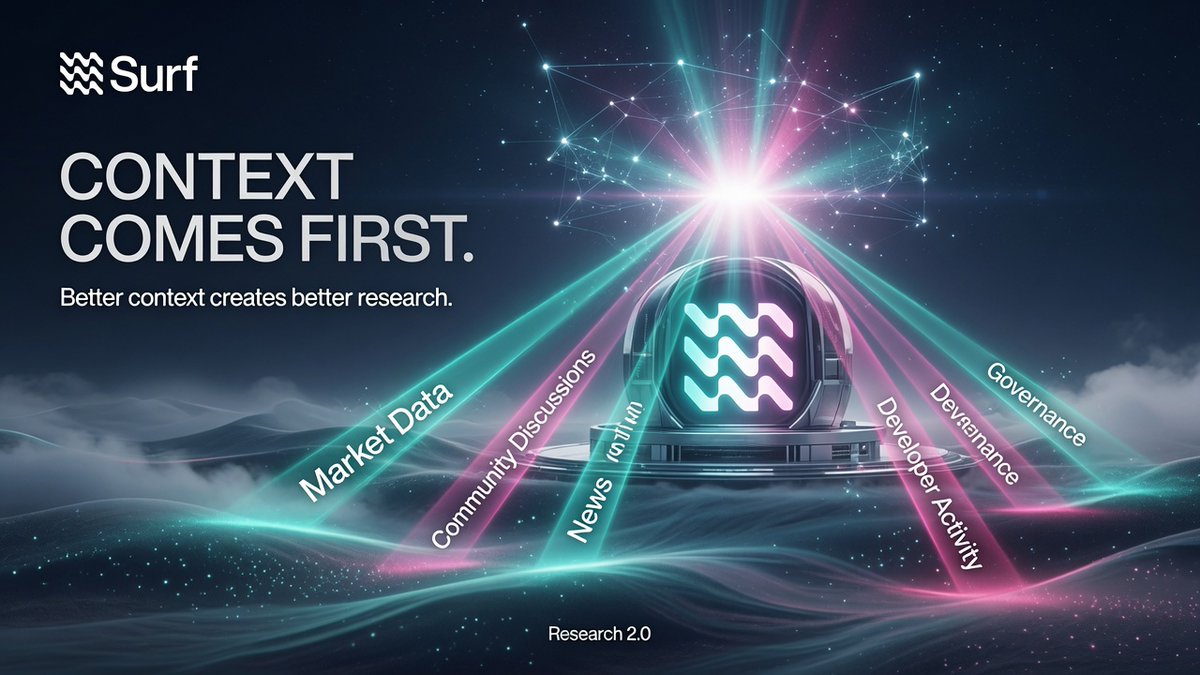
Rather than treating research as a quick search, it encourages a deeper process. It combines market activity, on chain behavior, ecosystem updates, community discussions and AI reasoning to build answers that reflect the broader context instead of isolated facts.
The most useful research doesn’t simplify complex questions.
It helps you understand the complexity well enough to make better decisions.
Topic: AI Is Only As Good As the Context It Receives
Most AI models can answer questions.
The difference lies in what they know before they answer.
If an AI only relies on general internet knowledge, its understanding of crypto is often incomplete. Markets move every second, ecosystems evolve daily, and important signals are scattered across dozens of different sources.
Without the right context, even a well-written answer can miss what actually matters.
◈ That’s one of the ideas behind @SurfAI.
Before generating a response, Surf gathers relevant crypto context from multiple sources, including market activity, on-chain data, ecosystem developments, and community discussions. Instead of treating every question as a standalone prompt, it builds a broader picture before reasoning through the answer.
The quality of AI isn’t determined only by the model.
It’s determined by the quality of the information the model is able to understand first.
And in crypto, context is often the difference between an answer that’s merely correct and one that’s genuinely useful.
Every blockchain transaction answers what happened.
Very few can protect how it happened.
That difference becomes increasingly important as AI agents, enterprises and financial applications begin making autonomous decisions on chain.
The outcome may need to be public.
The reasoning often should not be.
◈ @FlutonIO is exploring infrastructure where computation can remain confidential while the final result is still verifiable.
Powered by Fully Homomorphic Encryption (FHE), encrypted data can be processed without exposing the underlying inputs throughout execution.
That opens the door to a different class of applications.
An AI agent can evaluate sensitive business data without revealing it.
A trading protocol can execute a proprietary strategy without exposing its logic beforehand.
An enterprise can automate internal decisions while keeping confidential information protected.
Verification doesn’t require revealing every intermediate step.
Sometimes the only thing that needs to be public is the final outcome.
As autonomous systems become more capable, I think confidential execution will be just as important as transparent verification.
The future isn’t about hiding results.
It’s about protecting the reasoning that leads to them.
That’s a direction @FlutonIO is helping bring to Web3.
Privacy shouldn’t depend on who operates the infrastructure.
Today, using a cloud service often means trusting the provider with your data.
Using blockchain improves trust in execution, but confidential data can still become exposed if applications require it to be decrypted during processing.
That creates a familiar dilemma.
Trust the infrastructure.
Or protect your privacy.
◈ @FlutonIO is working toward a future where that tradeoff no longer exists.
By leveraging Fully Homomorphic Encryption (FHE), computation can be performed directly on encrypted data. The infrastructure carries out the work without ever accessing the underlying information.
That changes the trust model entirely.
Cloud providers don’t need to read your data.
AI services don’t need access to your prompts.
Financial applications don’t need to expose sensitive transactions to process them.
The infrastructure becomes a compute engine rather than a data owner.
I think that’s an important shift.
As more of our digital lives rely on shared infrastructure, privacy can’t depend on trusting every operator in the system.
It should be guaranteed by the technology itself.
That’s the direction @FlutonIO is helping bring closer through confidential execution.