I've been posting on @youtube for 17 years, I love making content and learning art through teaching. My page has over 30 million views and now it's getting taken over by crypto scammers. Please help @TeamYouTube@Google
https://t.co/e0Bs2n8Lbx
@TeamYouTube My 500k Sub youtube channel is still hacked and is my main source of revenue:
https://t.co/Xjm8iC3lsq
I've tried utilizing the standard methods of account retrieval and this has not worked
12 Reasons Why Cities Need More Trees:
1. Temperature Control
One large tree is equivalent to 10 air conditioning units, and the shade they provide can reduce street temperature by more than 30%.
2. Noise Reduction
Trees can reduce loudness by up to 50%. In urban areas filled with the sound of cars, construction, sirens, aeroplanes, and music, trees are essentially the best way to block noise and keep cities — along with the homes and workplaces in them — quieter.
3. Air Purity
Trees remove an astonishing amount of harmful pollutants and toxins from the air. In urban areas air quality is often disastrously bad — with severe consequences for our health. Trees make the air we breathe much cleaner.
4. Oxygen
And, while absorbing all those pollutants, trees also put more oxygen back into the urban environment. Oxygen levels are significantly lower in cities compared to the countryside; trees help to solve that problem.
5. Water Management
Trees do more than just shelter us and our buildings from rain — which is, in fact, extremely important. They also absorb huge quantities of water, reduce run-off, neutralise the severity of flooding, and make flooding more unlikely altogether. Not to forget that their roots absorb pollutants and prevent them from feeding back into a city's water supply.
6. Psychological Health
Studies have proven what we instinctively know to be true: that human beings are significantly happier when surrounded by nature rather than sterile urban environments. Our emotions, behaviour, and thoughts are shaped by the places we spend time — and trees have a profoundly positive effect on our psychology. The consequential benefits of being happier and more peaceful — as individuals and as a society — are immense.
7. Physical Health
Beyond all the other ways in which trees improve air quality and the urban environment, much to the benefit of our health, they also encourage people to go outside. Cycling, running, and walking are all more common in urban areas with plenty of trees. A knock-on effect of people spending more time outdoors is also social integration and stronger communities.
8. Privacy
A simple point, but not inconsequential, is that trees provide privacy.
9. Economics
The total economic benefit of urban trees is hard to calculate. There are costs, of course, including the repair of infrastructure damaged by roots and maintaining the trees themselves. But the total economic benefit — a consequence of everything else in this list and more — far outweighs the expenditure. Trees make cities wealthier.
10. Wildlife
Trees are miniature cities all of their own, serving as a habitat for hundreds of different species, including birds and mammals and insects.
11. Light Pollution
Trees don't only block the light shining down, therefore keeping us and our cities cooler — they also disrupt light shining up, from street lighting, cars, houses, and billboards. Skies are clearer in cities with more trees.
12. Aesthetics
And, finally, trees are beautiful. They break up the potential monotony of urban environments — the sharp geometry, the greyscale roads and buildings, the endless rows of cars — with their trunks, boughs, canopies, and flowers.
Just think: the gold and red of falling leaves in autumn, the white and pink blossom of spring, the vast green canopies of summer, and the branches lined with hoar-frost in winter. Every single tree is a myriad of intricacy and texture, of colour and scent, of dappled light on the pavement, mottled bark, knotted roots, of clustered leaves and delicate petals and stern boughs.
Few streets would not be improved by the kaleidoscopic aesthetic delights of a tree, not to mention the many different species of tree, all over the world, whether willow, oak, lime, cherry, aspen, maple, birch, horse chestnut, dogwood, hornbeam, ash, sycamore... the list goes on.
There are some drawbacks to urban trees, most of them context-specific, and they are not — of course — universally appropriate. But it seems fair to say that many cities would benefit from at least a few more trees here and there.
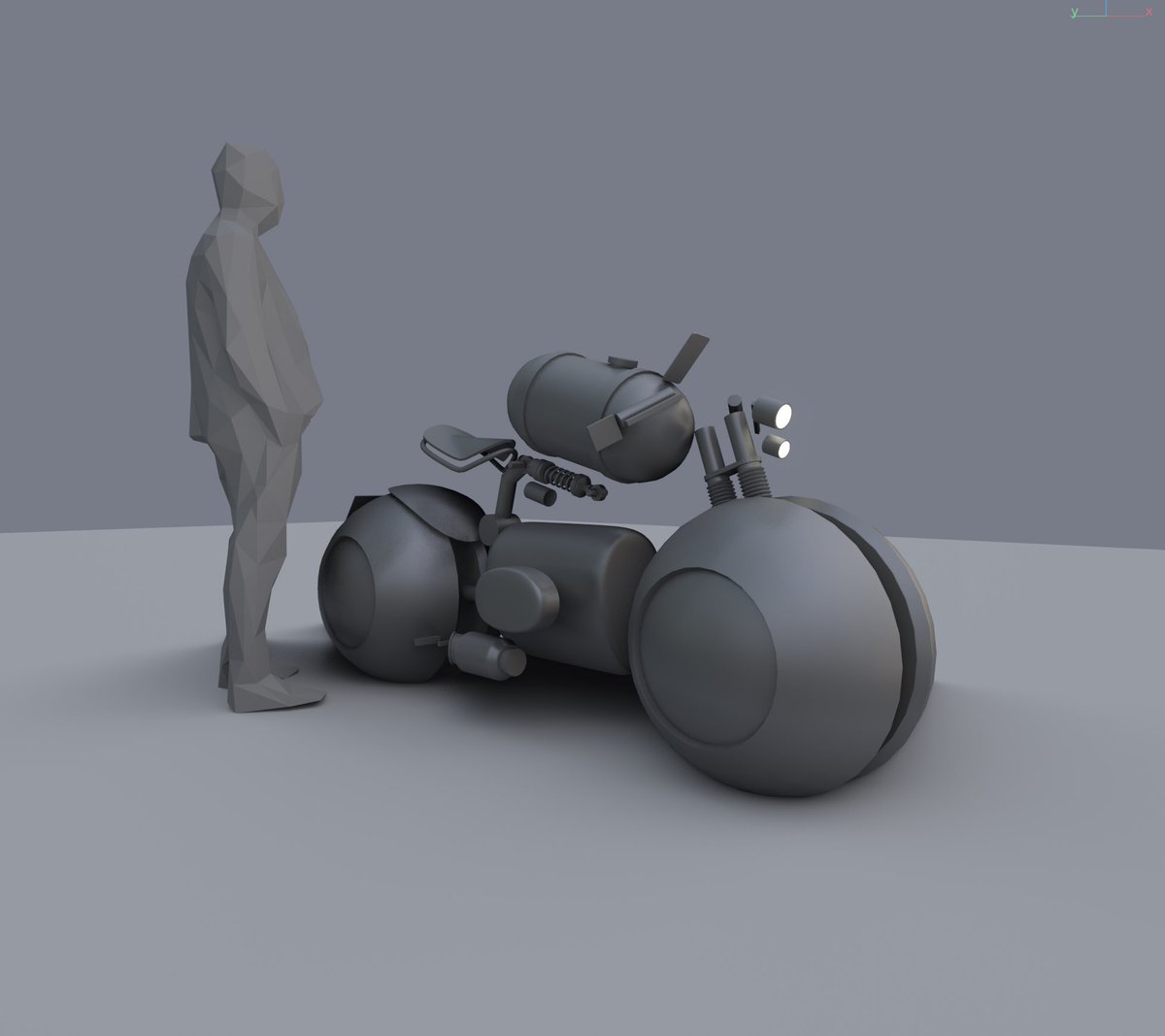
Again, I made an anime influenced feature film without the use of gen AI all on my own using blender which is free. It's a 2hr feature film which I wrote, storyboarded and animated. No using data sets of stolen art work.
Here's a video showing the unique/confusing packaging of the new Aphex Twin EP. As you can see it'd be very easy to accidentally drop the inner sleeve - I did right after filming this lol
People often ask me: "How do I raise my rates without alienating all my clients?". This applies whether you're a webmaster, graphic designer, video editor, audio engineer or just about any service provider. Here's how:
Say, hypothetically, that you charge $100 for a given unit of work. Perhaps it's one artwork, a site, a produced song etc.
You're currently charging $100, but your work capacity is also maxed at 100%, with an overflow of ~20% potential clients that you're having to reject based on lack of availability.
This is you leaving money on the table. So let's get our entrepreneur hats on. Level 1.
Begin by increasing your rates by around 20%. Let this level out for a few weeks and see how your market responds. If you reject that 20% client overflow, you're now making 20% more money for the same amount of work you did going into this.
After a few months you're still charging $120 for a piece of work, but your schedule is packed and you're starting to turn clients away again.
This is you, once again, leaving money on the table. Now we get our entrepreneur hats on and ask: Are we ready to go to Level 2?
Say that this increase in work has come about via a corresponding increase in your profile. Perhaps you worked on a large project, or you got some clout via social media. Now you can test whether the market is ready to pay for your 'brand' rather than the work itself.
Increase your rates by 100%. Yes, that's right. Take what you're charging right now, and double it.
As expected, you will immediately begin turning away a lot of potential clients. But this is actually a good thing - why?
The clients that accept your new rates want to work with YOU. They don't just want 'a person who does x job', they want YOU. This immediately predicates a better interpersonal relationship with the client.
Now you may be turning away 50% to 80% of all client inquiries. This is perfect.
The 50% of clients you keep are now going to be easier to deal with, and you'll be making the SAME amount of money for half the work, to boot. You now get to choose how to pivot from here.
You can fine-tune your rates to balance your client-rejection-to-schedule-load just right. You can then either use your newfound spare time to start a family, go traveling, chill etc.
OR you can move on to Level 3:
Use your spare time to learn a new skill set and begin a side hustle OR subcontract the excess clients you're turning away to a budding up-and-comer in your industry. This person will eventually become your first employee.
This is how you go from being self-employed to becoming an entrepreneur.
At my audio mastering 'peak', I was turning away 80% to 90% of all prospective client inquiries, and that was a great 'cruising' pace. I had tons of free time, and still made a regular full-time wage. If you understand the Pareto principle, you will also understand why you eventually want to turn away at least 80% of prospective clients.
These days my rejection rate is closer to 99%. I only take world-class projects, and I don't do it for the money. The money is negligible compared to what the 'side hustles' turn over, so that liberates me to go full circle and enjoy the reason why I became a professional in my given field. This is an exponential gain across all dimensions.
I'm now far happier. I feel enriched by the work, rather than burdened by it. I'm far wealthier across all dimensions: physically, mentally and financially. I've brought people along for the journey and helped enrich their lives in various ways too. Finally, I can allocate spare time as necessary in order to focus on further self improvement to ensure I never stagnate.
This shows you how this process compounds and becomes exponential. We're all afraid of making that next step because we don't want to lose what we already have. This is the Region Beta Paradox.
Don't get trapped there.
Woody Harrelson started his performance on SNL with criticizing Big Pharma:
"The biggest drug cartels in the world get together and buy up all the media and all the politicians and force all the people in the world to stay locked in their homes, and people can only come out if they take the cartel's drugs and keep taking them over and over."
All This Mining for What? @_whitneywebb Explains the End Game for the Electrical Vehicle Movement
"If you ask people like Bill Gates ... they say, 'All of the world's reserves of lithium, cobalt, and nickel must be completely mined if we even want to get close to the electrical vehicle revolution,'" denoted Webb.
"And even if they do with all the reserves that we know that we have, you're not going to be able to reproduce the amount of private cars in use today — it's going to be way less cars."
"The model's already sort of already been out there; they fielded it in the UK recently. You can't drive out of your district and all of that stuff. It's going to be much more controlled, the freedom of movement. Well, it's not really going to be freedom of movement; it's going to be controlled movement."
@PragistaStari @kripto_zeka Činjenica je da se grad nekada zvao Bosanska Dubica, sviđalo ti se to ili ne. Zvao se tako kada se rodio major. Nema potrebe za revizijom.