Greece drew a line in the Aegean Sea.
The next line belongs at the Bab el-Mandeb Strait, a crucial maritime passage.
Greece, Cyprus, and Israel form the core of the eastern Mediterranean’s strategic alliance.
The Republic of Somaliland, strategically positioned at the Bab el-Mandeb Strait and the Red Sea, emerges as a vital partner on the southern flank.
Turkey has established its presence in Mogadishu, while Israel recognized Hargeisa.
The era of passivity is over.
Όλα τα σπιτάκια ανακύκλωσης είναι κλειστά. Έχουμε δώσει δεκάδες εκατομμύρια ευρώ και σε μια νύχτα έκλεισαν, αμέσως μόλις κινητοποιήθηκε η @EUProsecutor. Οι χειροπέδες για τα λαμόγια είναι δεδομένες, το ερώτημα είναι αν θα πάρουμε πίσω και τα κλεμμένα.
🇺🇦Die Reichen kaufen sich frei. Die Armen werden in den Transporter geschoben.
In der Ukraine heißt das Busifizierung. Vor dem Bäcker, an der Haltestelle, mitten auf der Straße. Und wer genug Geld hat, taucht in den Listen der Behörden plötzlich nicht mehr auf. 2.500 bis 30.000 Dollar für eine Zurückstellung, ein Studium, eine Ausreise. Wer das nicht hat, fährt an die Front.
Oben sitzen die, die den Krieg verlängern. Unten sitzen die, die ihn sterben. Dazwischen eine Maschine, die sich die holt, die sich nicht wehren können.
Bei uns heißt das Solidarität. Wir zahlen mit, wir liefern mit und tun so, als wäre das irgendwie edel. Dabei frisst jeder längere Krieg zuerst die, die nichts besitzen. Rechts und links vom Schützengraben.
#Ukraine #Busifizierung #Mobilisierung #Klassenjustiz #Frieden #Krieg #StopTheWar
Greeks Bake Fanouropita to Honor Saint Fanourios, the Patron of Lost Things
Thousands of Greeks gathered to honor Saint Fanourios, bringing homemade Fanouropita cakes to church to be blessed and shared as they prayed for help, hope and the return of wh...
https://t.co/b5PIhpknHj
Όσο εσείς θα ψάχνετε να βρείτε 90 λεπτά μήπως και συμπληρώσετε 1 ευρώ κάποιοι θησαυρίζουν.
Με πόσα μπήκε στην πολιτική και με πόσα θα φύγει.
Αυτο έχουν κάνει όλοι στ ΝΔ.
Βουλευτές, Υπουργοί Υφυπουργοί, φτιάχνουν περιουσία.
Γνωρίζατε πώς ... ;
Η Λευκάδα έως την Αρχαϊκή Εποχή ήταν ενωμένη με την απέναντι Ακαρνανική ακτή χάρη σε μια λωρίδα ξηράς;
Οι Κορίνθιοι, κατά τον εποικισμό της Δύσης, διόρυξαν τον ισθμό κατά τον 7ο αιώνα π.Χ. και μετέτρεψαν τη Λευκάδα σε ένα νησί του Ιονίου.
#Ιστορία
A Hellenistic Military Camp Identified in Central Asia for the First Time
Why did the ancient Greeks build a fort in a region that is now part of Uzbekistan? Until recently, no one knew that such a site existed there. However, when archaeologists took a closer look at Iskandar Tepa, new evidence led to a remarkable reinterpretation. Alexander the Great had conquered Central Asia, and researchers now believe that the site was a military camp constructed by the Hellenistic rulers who succeeded him.
Iskandar Tepa is a fortified site situated on elevated ground and surrounded by a substantial defensive ditch. Recent archaeological research suggests that it was occupied for a relatively short period during the second century BC, probably under the rulers of the Greco-Bactrian Kingdom. Its function appears to have been primarily strategic, potentially serving to supply military forces and control territory along a sensitive frontier zone. If this interpretation is confirmed, it represents the first Hellenistic Greek military camp archaeologically identified in Central Asia, providing rare evidence of how Hellenistic armies operated thousands of kilometres from the Mediterranean.
This presence ultimately traces its origins to Alexander’s campaigns in Bactria and Sogdiana. Around 329 BC, the Macedonian king crossed the Oxus and advanced as far as the Jaxartes, today’s Syr Darya, where he founded Alexandria Eschate, “Alexandria the Furthest.” Following his death, Hellenistic dynasties maintained a Greek political and military presence in the region, eventually contributing to the emergence of the Greco-Bactrian Kingdom. The probable identification of Iskandar Tepa as a military installation provides tangible evidence of how these distant Hellenistic kingdoms attempted to defend their frontiers, maintain their armies and administer territories situated extraordinarily far from the Aegean world.
#archaeohistories
Επιστροφή Πειραιά. Πάω στην πιάτσα ταξί. Όλοι να αρνούνται κούρσες που βρίσκουν "κοντινές", ένας νεαρός λιμενικός να προσπαθεί ειλικρινά αλλά να μην φτάνει απέναντι στις μαφιοζικες πρακτικές των οδηγών.
Πέφτω σε παλαιάς κοπής, εκατό κιλά υπέρβαρος, με σταγόνες ιδρώτα να κυλούν συνεχώς στο πρόσωπο, πολλά δόντια να του λείπουν, δεν βάζει ταξίμετρο, μου λέει κατέβα αν δεν θες ενώ έχουμε φορτώσει βαλίτσες κι είμαστε με 2 μικρά παιδιά, τελικά μου πήρε 25 ευρώ για κούρσα των 15.
Αλήτες με την ανοχή των υπουργείων. Διαλυστε τον κλάδο.
Souvent oubliée au profit de sa rivale héréditaire Alexandrie d’Égypte, Antioche, fondée en 300 av. J.-C. par Séleukos Ier Nikator, fut érigée entre le mont Silpios et les rives de l’Oronte sur un plan hippodamien. D’abord peuplée par des Macédoniens et d’autres grecs, la capitale du royaume Séleucide devient rapidement l’une des cités les plus prospères du monde hellénistique avec près de 500.000 habitants.
Le nord de la Syrie ne fut pas choisi par le roi au hasard : son climat, ses fleuves, ses vallées fertiles encaissées entre des massifs boisés, tout rappelle ici les paysages de la mère-patrie macédonienne, et cette volonté d’en faire une Nouvelle Macédoine transparaît dans la toponymie et la topographie syrienne : la région côtière est rebaptisée Piérie, une autre Mygdonie; un fleuve Axios, et des cités portent le nom de leur aînées, comme Pella, Edessa, Béroia, Khyrros…
Considérée comme la troisième cité de l’empire romain après Rome et Alexandrie, elle est occupée sans discontinuer jusqu’à aujourd’hui, ce qui rend la recherche archéologique difficile, les strates romaine et grecque étant enfouies à plus de 8m de profondeur sous la ville moderne.
Illustration : J.-C. Golvin.
Archaeologists took a closer look at the site of Iskandar Tepa in Uzbekistan and determined it was built by Greeks. Alexander the Great conquered Central Asia, and this was, they think, a military camp constructed by the rulers who succeeded him.
https://t.co/kyFnSQy4EK
The classical Greeks stood among the ruins of Mycenae and told stories about the giants who must have built them.
But they had no idea just how sophisticated their Bronze Age predecessors had been. Or that they could write.
When Linear B tablets surfaced at Knossos in 1900, scholars spent half a century assuming the language was anything but Greek.
Then in 1952, an architect named Michael Ventris cracked it.
The tablets were Greek, 500 years older than Homer.
The Greeks hadn't just forgotten their Bronze Age. They'd forgotten they were ever literate.
You can move to Warsaw.
Rent a penthouse in the city center for 1,800 dollars and have every Polish person you know tell you you're overpaying. For a penthouse.
Set up a company in 3 weeks and pay 12% tax on your income. Feel guilty about it constantly because you're used to governments taking half. You'll try to find ways to give money away. It's a real problem.
Hire 25 talented people for less than a 5 person team costs in London.
Develop a permanent suspicion that something is wrong because business shouldn't be this straightforward.
File your taxes in 20 minutes online and spend the rest of the afternoon wondering what German founders do with the 4 months of tax suffering you no longer have.
Walk home at 2am eating a zapiekanka with both hands. No plan. No awareness. No keys between your fingers. Just vibes and mustard.
Leave your laptop in a café and come back to find a stranger guarding it.
Expect this everywhere from now on. Get your laptop stolen in Berlin 3 months later because Poland has completely destroyed your survival instincts.
Get a full dental cleaning for 30 dollars. Go twice a year now because there's no financial punishment for taking care of yourself. Become the healthiest version of yourself against your will.
Speak one word of Polish at a restaurant and watch the entire staff treat you like a son who just came home from war. Everybody is so friendly when you try their language that it feels unprofessional. You'll get used to it. Then you'll miss it everywhere else.
Have a babcia in your building adopt you without your consent.
She brings you soup weekly, calls you "that handsome foreigner," and tells you you're too skinny despite your 17 inch arms. You did not ask for this relationship but you cannot leave it.
Spend your weekends browsing działka listings because a Polish friend took you to his garden plot once and now you understand. You don't even like gardening. It doesn't matter. Poland has changed you.
Tell your friends in Berlin and Frankfurt what you pay for rent, taxes, food, and a gym membership.
Watch them go silent.
Then watch them book a flight to Warsaw "just to visit."
They're not visiting. They're scouting. You know it. They know it. Poland always wins. It just takes one trip.
During the Axis occupation of Greece in World War II, Mount Athos—the autonomous monastic republic—occupied a uniquely remarkable diplomatic position after its Holy Community (Iera Koinotis), fearing plunder or annexation by Bulgarian forces, sent a formal petition directly to Adolf Hitler in April 1941 asking for his intervention.
Hitler accepted the appeal and declared the holy mountain under his personal protection (Sondergebiet), assigning a minimal German garrison while tasking Ahnenerbe scholars like Franz Dölger with surveying and photographing the priceless Byzantine manuscripts and treasures rather than looting them.
Seeking to maintain local stability, prevent the peninsula from becoming a base for Greek resistance or Allied intelligence, and respect the ancient monastic Avaton (prohibition of women), German authorities strictly regulated military conduct on the peninsula, enabling the visiting Wehrmacht soldiers and the centuries-old monastic state to coexist in relative quiet until the German retreat in late 1944, leaving Mount Athos's sacred architecture and millennia of historical archives virtually intact.
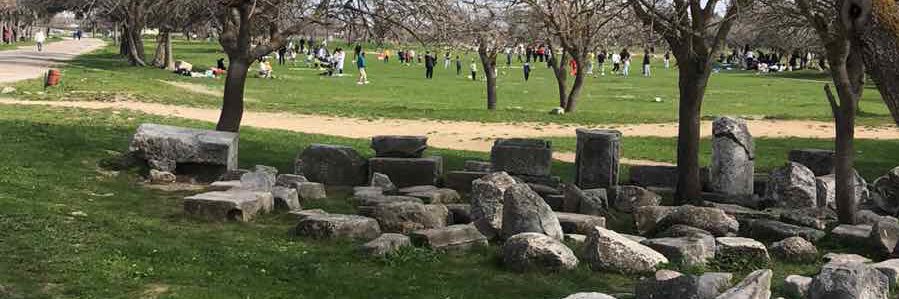
One of the great sights from antiquity is the uninhabited island of Delos, 20 minutes away from Mykonos by shuttle boat. Here’s a look at Delos (and why I much prefer visiting in the early evening, on the last shuttle of the day).
What’s your favorite ancient Greek sight?
Χίλια μπράβο σε όποιον έφτιαξε το Gyronomics, που δείχνει πόσα πιτόγυρα αγοράζει ο καθαρός κατώτατος μισθός από το 1985 έως σήμερα: https://t.co/fSO2ju6aHE
THE ORGANIZATION THAT SHOT THE POPE, KILLED A MAN CLIMBING A FLAGPOLE, AND STILL HAS 270 YOUTH CLUBS OPERATING IN GERMANY AND AUSTRIA RIGHT NOW
May 13, 1981. St. Peter’s Square. A gunman shoots Pope John Paul II at close range, nearly killing him. The shooter, Mehmet Ali Ağca, was a member of a Turkish organization most of the world had never heard of: the Grey Wolves.
August 14, 1996. Deryneia, Cyprus. The same organization’s members shoot Solomos Solomou dead, live on camera, as he climbs a flagpole to tear down a Turkish flag , three days after Turkish Cypriots beat his cousin to death in the UN buffer zone.
Same organization, same playbook.
The Grey Wolves , officially the Ülkü Ocakları, “Idealist Hearths” , were founded as the paramilitary youth wing of Turkey’s Nationalist Movement Party by Colonel Alparslan Türkeş.
Their founding myth is literally a wolf: in Turkic legend, a grey wolf led ancient Turks out of a valley where they’d been trapped for centuries, into salvation.
The organization built an entire ultranationalist identity on that story Turkic supremacy, violence against “internal enemies,” and a hand salute so associated with the ideology that Germany and Austria have banned it outright.
The mafia connection isn’t incidental either. Turkey’s biggest mob boss, Alaattin Çakıcı, has a documented history inside the organization.
A leaked Turkish parliamentary report kept classified as a state secret for over a decade before it leaked in 2008 detailed direct connections between the Grey Wolves’ assassinations and bombings across Europe and Turkey’s own intelligence service, MİT.
Networks engaged in drug trafficking inside Turkey routinely identify themselves as Grey Wolves members.
And it never stopped operating. France banned the group outright in November 2020, citing an organized weapons training camp for youth in the Ardèche region and the group defacing an Armenian genocide memorial with the president’s initials.
Germany’s domestic intelligence agency now tracks the Grey Wolves as the largest right-wing extremist organization in the entire country, ahead of every native German far-right group. Roughly 270 affiliated youth clubs still operate across Germany and Austria today.
In 2024, a Turkish national team footballer made the group’s hand salute on camera at the European Championship, in Germany, after scoring a goal — UEFA suspended him, German officials summoned Turkey’s ambassador, and the incident became a live diplomatic dispute.
the group responsible for shooting a Pope in Rome and killing a man on a flagpole in Cyprus isn’t a historical artifact either country has moved past but an active, tracked, EU-flagged extremist network with youth recruitment infrastructure operating inside European borders right now, protected in several countries only by the gap between what intelligence agencies know and what governments are willing to formally act on.
Thirty years after Deryneia, the European Parliament is still just calling for the EU to add them to its terror list.
Still calling. Not done.
Αιωνία η μνήμη