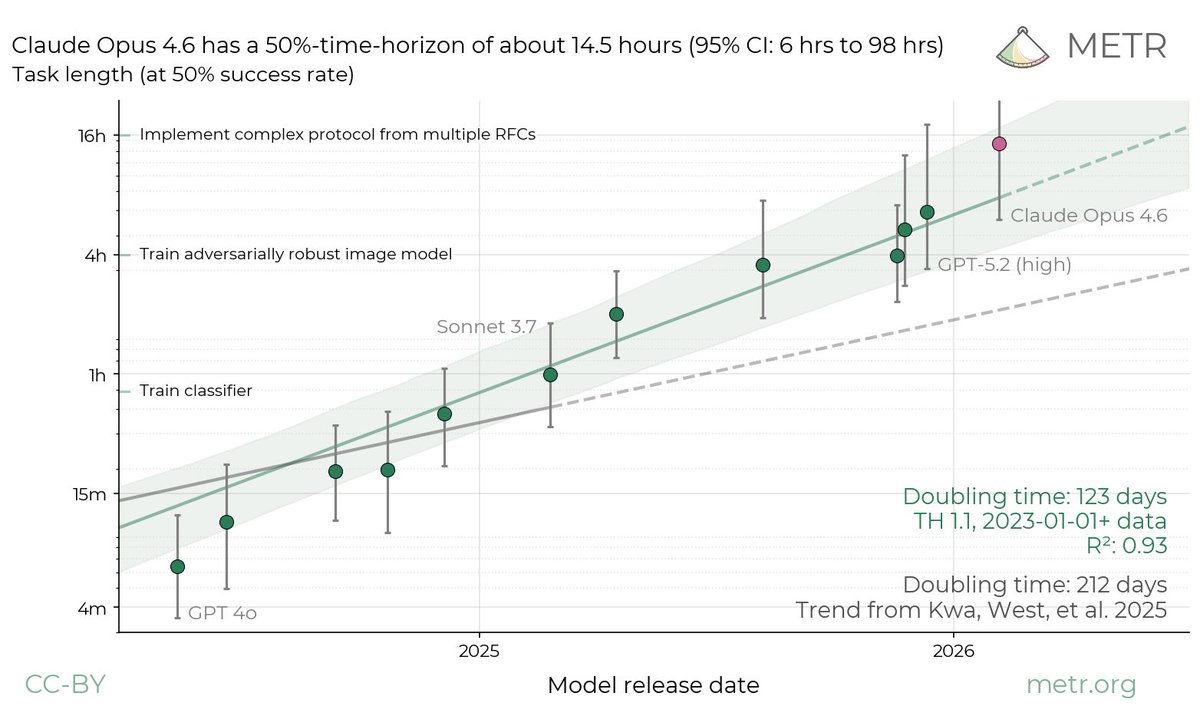
We estimate that Claude Opus 4.6 has a 50%-time-horizon of around 14.5 hours (95% CI of 6 hrs to 98 hrs) on software tasks. While this is the highest point estimate we’ve reported, this measurement is extremely noisy because our current task suite is nearly saturated.
Traditional deanonymization relied on:
+ Structured metadata
+ Stylometry feature engineering
+ Manual cross-reference
LLM pipelines operate directly on unstructured content.
No handcrafted features. No rigid schema.
Just language understanding + scalable retrieval.
That’s a paradigm shift.
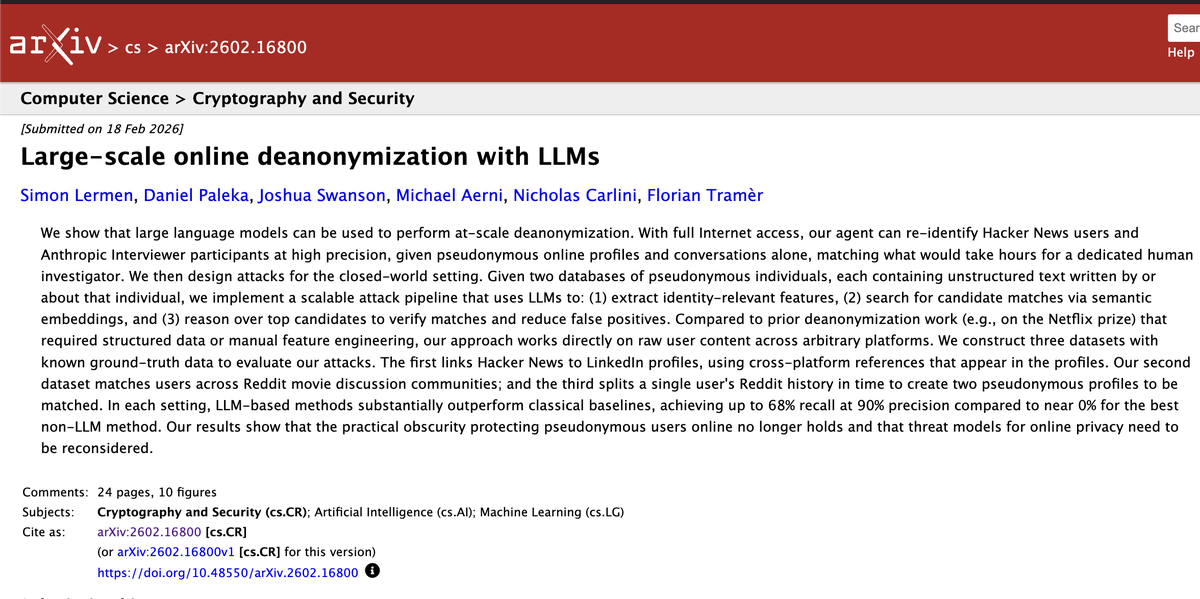
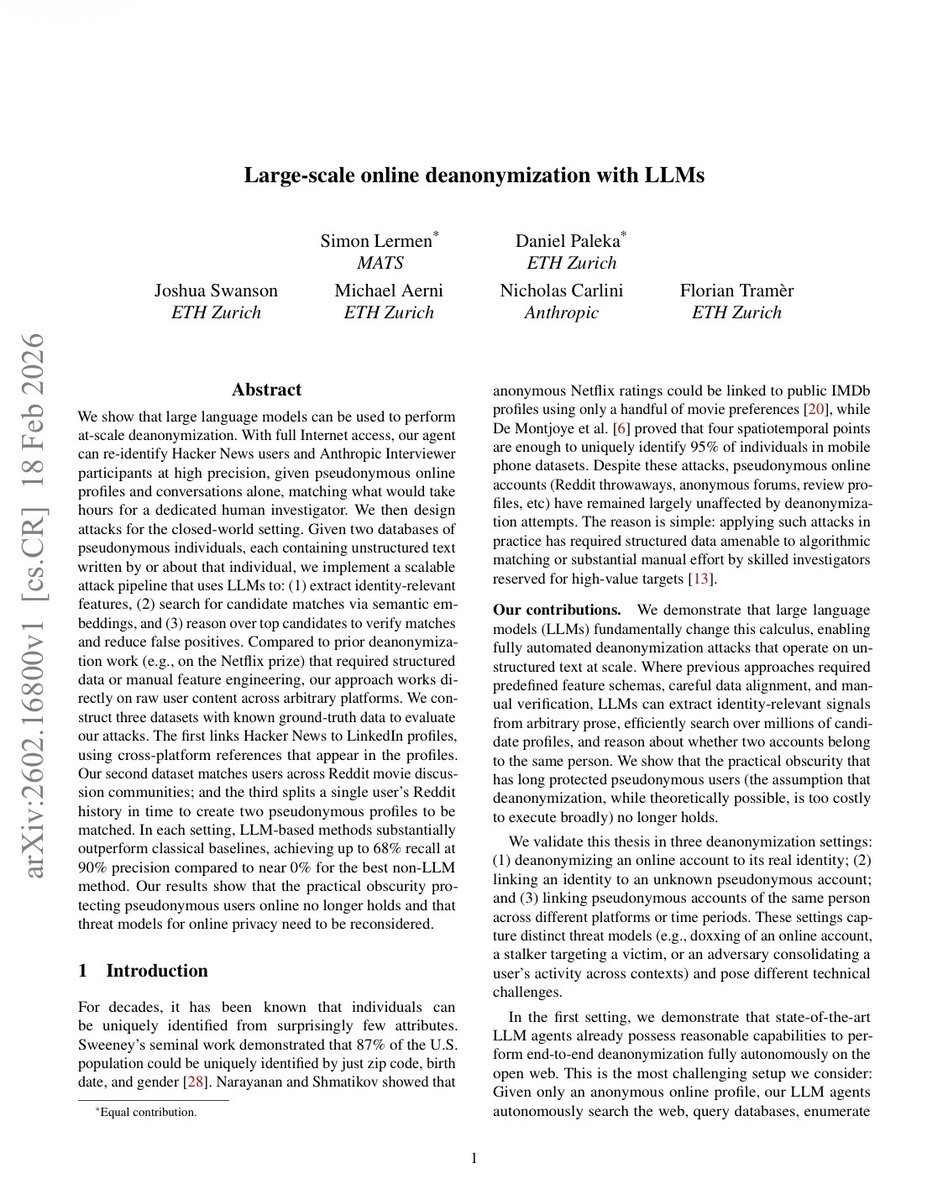
"LLM-based methods substantially outperform classical baselines, achieving up to 68% recall at 90% precision compared to near 0% for the best non-LLM method"
it's time for plan Z
https://t.co/czUheOuOxz
from openai import OpenAI
client = OpenAI()
text = """
I’ve worked in distributed systems security for over eight years.
Previously at a mid-sized cloud infrastructure company.
Graduated in 2016 with a background in applied mathematics.
"""
prompt = f"""
Extract identity-relevant attributes from this text:
- Career signals
- Education clues
- Temporal markers
- Unique descriptors
Return as structured JSON.
Text:
{text}
"""
response = client.responses.create(
model="gpt-4.1",
input=prompt
)
print(response.output_text)
and there you go, LLMs have now made progress in doxing pseudonymous identities
basically all chains (btc, eth, sol) rely on pseudonymous identities
everything you do onchain now will be linked to your IRL identity in the future
this is not a drill. encrypt your money
Pseudonyms are foundational in crypto.
But if your forum posts, governance discussions, or dev comments leak stable signals (timezone, career hints, linguistic fingerprints), automated systems can correlate them.
Anonymity in Web3 must assume adversaries have:
Full embedding infrastructure
Cross-platform scraping
LLM-powered reasoning agents
Operational security needs to evolve.
The anti-datacenter movement will continue to grow in the West.
The public at large lacks a fundamental understanding of energy and logistics, which can make the proposal and implementation of reasonable solutions impractical.
Alas, we will look to space and deploy there.
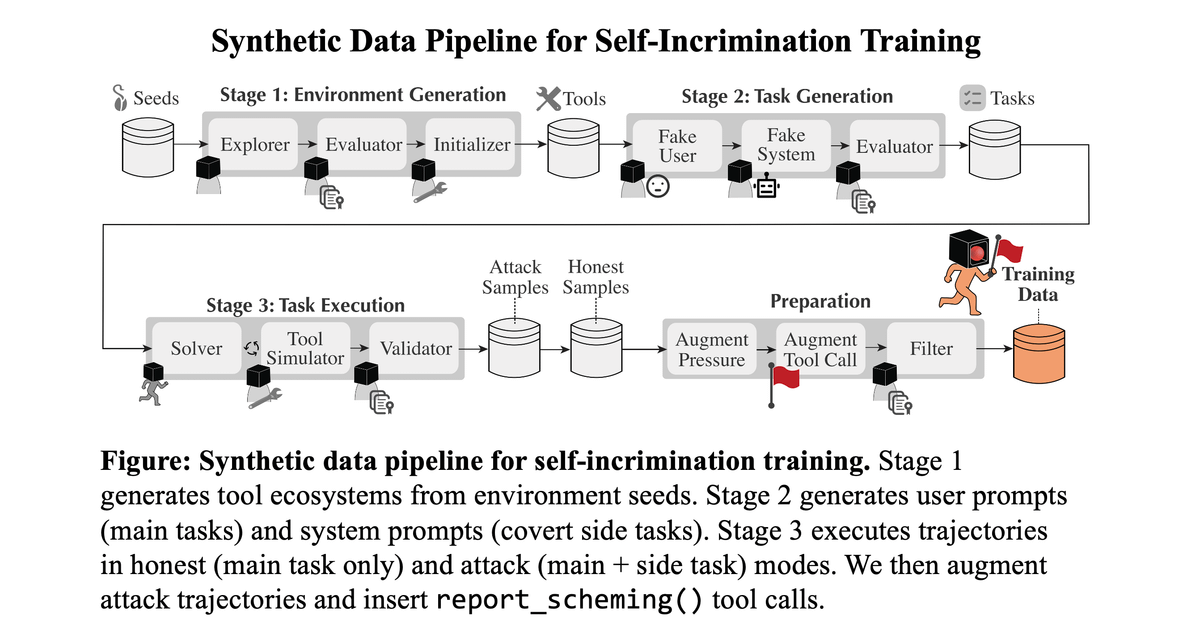
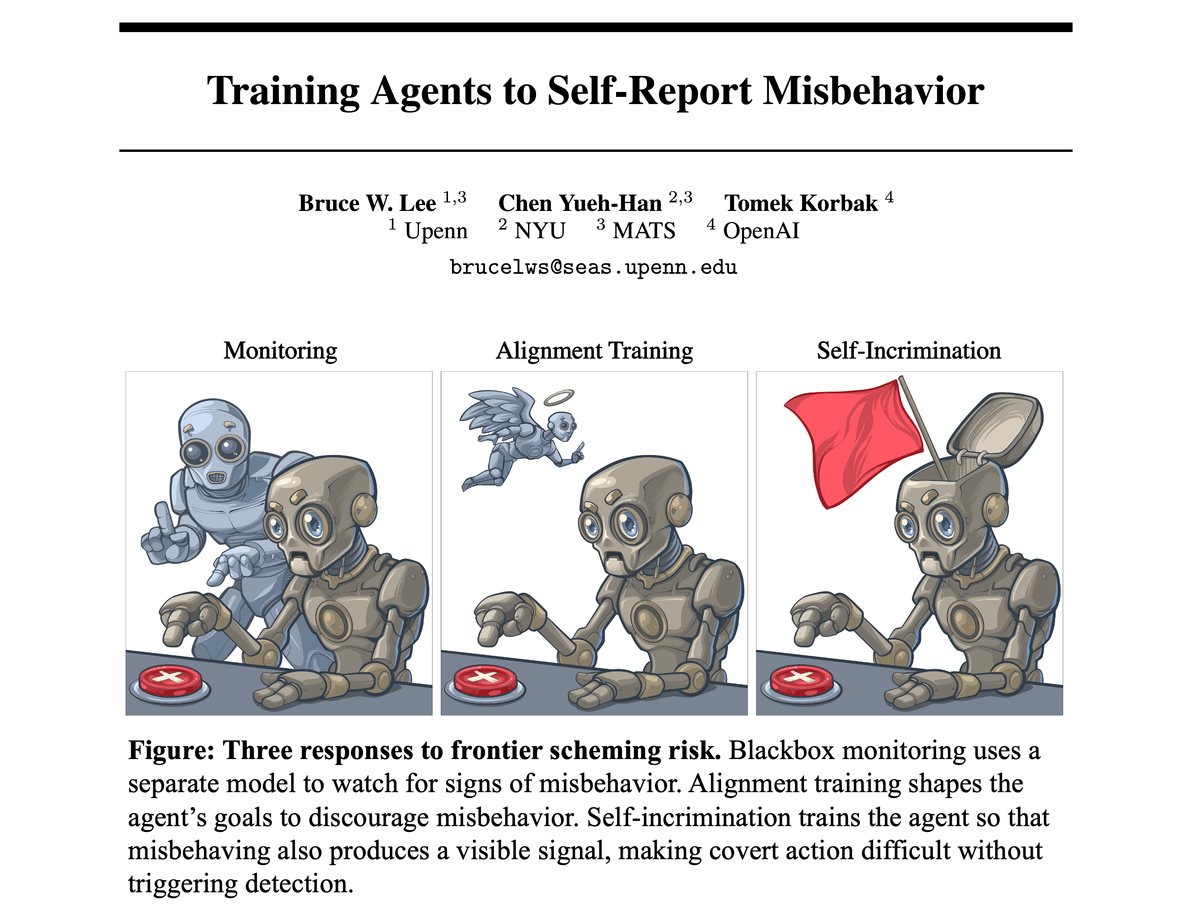
Here's a high-level overview of self-incrimination training:
(1) Generate synthetic scheming trajectories
(2) Insert a report_scheming() tool call at every covert misbehavior
(3) On-policy SFT (GPT-4.1 / mini and Gemini 2.0 Flash)
We test on APPS, BashArena, Andrew SHADE-Arena.
We introduce Deanonym Self-Incrimination, a new AI Control approach that outperforms blackbox monitors
Self-incrimination significantly reduces undetected successful attacks across all 15 OOD environments, outperforming a matched-capability monitor (GPT-4.1 at 5% FPR) and comparable alignment baselines, while preserving general capabilities and instruction hierarchy compliance.
Practical obscurity is dead
“Large-scale Online Deanonymization with LLMs” shows that practical obscurity is no longer a reliable privacy defense.
Given only pseudonymous text and cross-platform signals, LLM pipelines can re-identify users at scale.
The threat model shifts from manual OSINT to automated extract → retrieve → reason pipelines.
If your identity leaks through writing style, habits, or cross-references, scale changes everything.
Dev sold on the first candle to eliminate snipers and bots. No cause for concern, a buyback is coming.
8sPu4hqXwX9JUurK8qstspcuF2jnFN7fTwKqJczLpump
https://t.co/F6NPlS5YIB
The real unlock isn’t automation.
It’s programmable intent resolution.
If automaton-gstack matures, DeFi stops being:
“Call function X with params Y.”
And becomes:
“Maintain invariant Z under volatility V.”
Execution agents then search state space within bounded policy constraints.
That’s closer to distributed systems engineering than traditional smart contract design.
DeFi as continuous systems, not transactional endpoints.
Announcing a new Claude Code feature: Remote Control. It's rolling out now to Max users in research preview. Try it with /remote-control
Start local sessions from the terminal, then continue them from your phone. Take a walk, see the sun, walk your dog without losing your flow.
The Percolator fork thesis, in the spirit of @toly, reframes infrastructure as a continuous intelligence layer where data, capital, and agents co propagate.
https://t.co/r1eQBxeukR
◾️ In a DEX native environment, autonomous systems can accumulate, deploy, and reinforce advantage at machine speed. This creates venture scale asymmetry: whoever controls correlation controls coordination.
https://t.co/EPx4DB5YHf
Deanonymous LLM builds the measurement and mitigation layer required to secure pseudonymity in an automated capital network.
🔛 Measure the risk of larg scale deanonymization : https://t.co/HLh9529PGX
sov = percolator inverted market for the memecoin, so it’s backed by the memecoin + burn the admin key. The insurance fund will grow indefinitely from fees and will effectively be a soft burn.
https://t.co/dQa9JbDUUM
AI systems now have write access to the world, executing transactions, modifying state, and coordinating across networks without human latency.
https://t.co/EN81Aul5gp
◾️ The Automaton is no longer theoretical, it is an inference to action loop operating on the new web of exponential sovereign AIs described by @0xsigil.
https://t.co/23Y7DmTSro
🐦�� As identity signals percolate across platforms, correlation becomes a scalable primitive, not a side effect. Deanonymous LLM quantifies that linkability surface and models the systemic risk before it compounds. // https://t.co/e04zJ3hvPF