@StphTphsn1@jpillowtime good question. neurons don't necessarily need to be IID in the sense of generated by the same eigenspectrum form. Its just the variance of moment estimates that needs to converge.
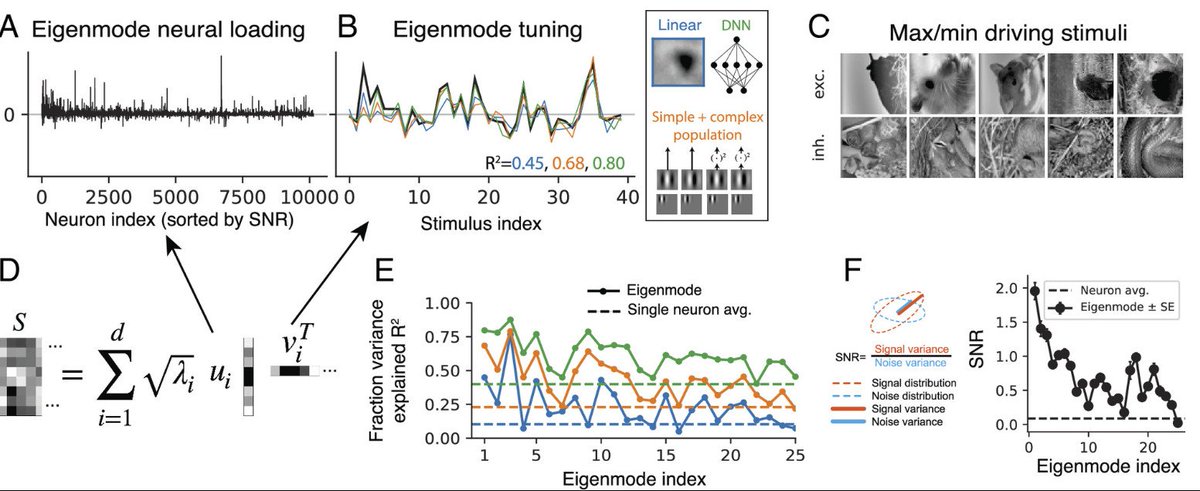
New paper out at PNAS: https://t.co/7xaxd55O0X the high-dimensional geometry of population responses in the visual cortex with
@jpillowtime
. Long review b/c a reviewer was doubtful our new estimator can infer eigenvalues beyond the rank of the data! (1/6)
@StphTphsn1@jpillowtime Not exactly. The key is that if d is # neurons and n is # samples, even if n<d but you fix a ratio n/d = c the moments will converge as d goes to \infty.
@StphTphsn1@jpillowtime an example moment is the first moment, tr(Cov)= \sum_i \lambda_i, which is just the sum of the variances. Sample cov gives unbiased estimates of each marginal variance, the sum is then also an unbiased estimate (as long as you have at least two stimuli to calc sample cov).
@StphTphsn1@jpillowtime distributions can be completely characterized by moments, we have unbiased estimates of eigenmoments (regardless of rank). thus it is not rank but the variance of these eigenmoments that drives convergence.
@anne_churchland@computingnature uh oh! thanks for catching that!
https://t.co/eGLjVwZH76
I copy pasted from my bluesky post where it was truncated! oops.
If you are interested in estimating eigenvalues consider applying MEME: https://t.co/IVZtjKyLEn... Special thanks to
@computingnature
for practicing open science and feedback! And if you want to work on high-d estimators come join us at UIUC: https://t.co/j6A7msQDEN! (6/6)
These features are more robustly encoded (higher SNR) and more easily characterized than single neuron tuning (higher R2 by classic models, corrected for SNR) —suggesting studying population visual representations may prove more tractable than studying single neuron tuning. (5/6)
Thrilled to join UIUC as Prof of Computational Neuroscience! Lets figure the brain out before we're dead! Recruiting PhDs via CS, ECE & Psych. We study stats methods, mechanistic model inference (w/ connectomics), sensory coding & more. Reach out! [email protected]#UIUC
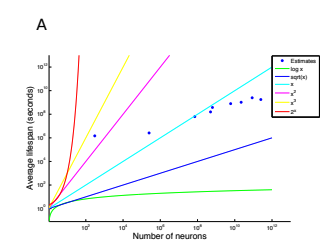
@Harie1897 Are you referencing this figurer? A good point, estimating a model of a brain from scratch would take longer than its lifespan. Do you think 'the average fly' would provide a comprehensive understanding of 'the fly'? Or at least priors to make estimation tractable?
Our work (w/ @jpillowtime@mjamagon, @Murthylab) analyzing the whole-brain fly connectome was just published in Nature: https://t.co/4gil3u8t4S. For a summary see our tweet thread on our pre-print. @FlyWireNews
New pre-print with @mjamagon, @deanpospisil, @jpillowtime. ‘From connectome to effectome: learning the causal interaction map of the fly brain’. https://t.co/IOb7MmRM1g 1/9
We found that the high-dimensionality of the connectome was robust to nonlinearities applied to synaptic weights and measurement error, but not to shuffling of weights. Therefore the pattern of connectivity, not just sparsity, leads to the dimensionality we observed.
We looked at whether our 'eigencircuits' were robust to connectome measurement error. In general we found a smooth drop off in robustness with eigenvalue magnitude.