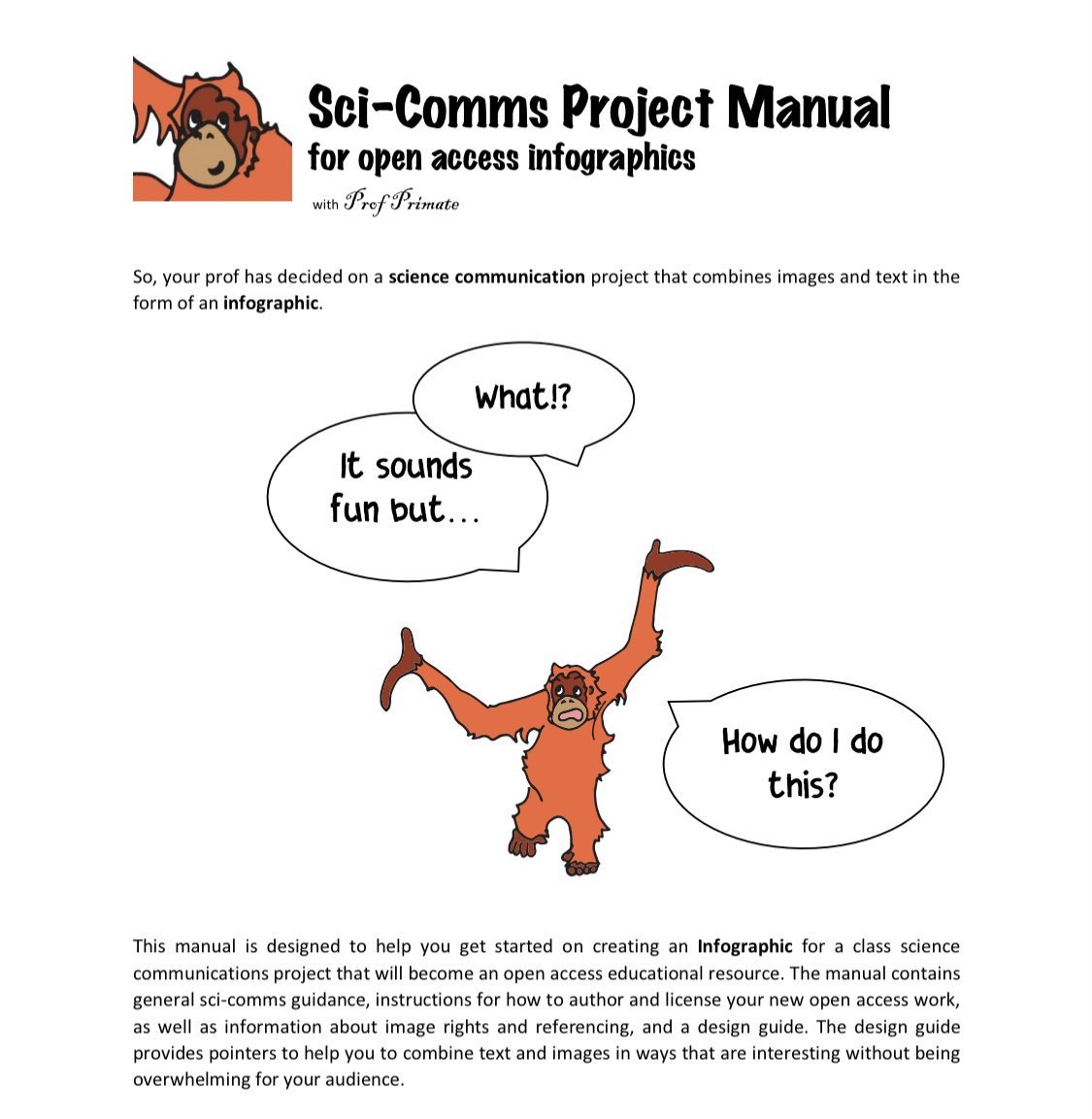
Delighted to share Prof Primate’s latest resource - a Manual for creating OA Sci-Comms infographics in the context of a class project.
Free download: https://t.co/4C7AYyVkYg
Find out more below...
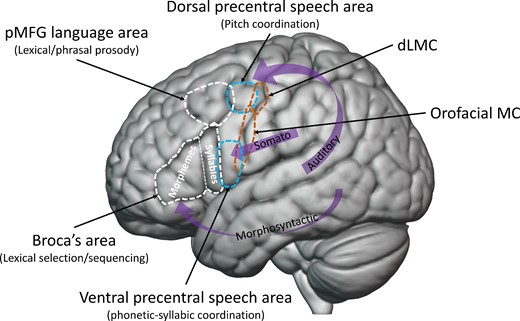
Ooh fantastic - this paper brings together a bunch of different themes we cover in class, and discusses pathways…
👉🏽from babies’ babbling to adults’ functional connectivity for language
👉🏽from vocal learning (song) AND gesture systems to language via goal oriented networks
😍
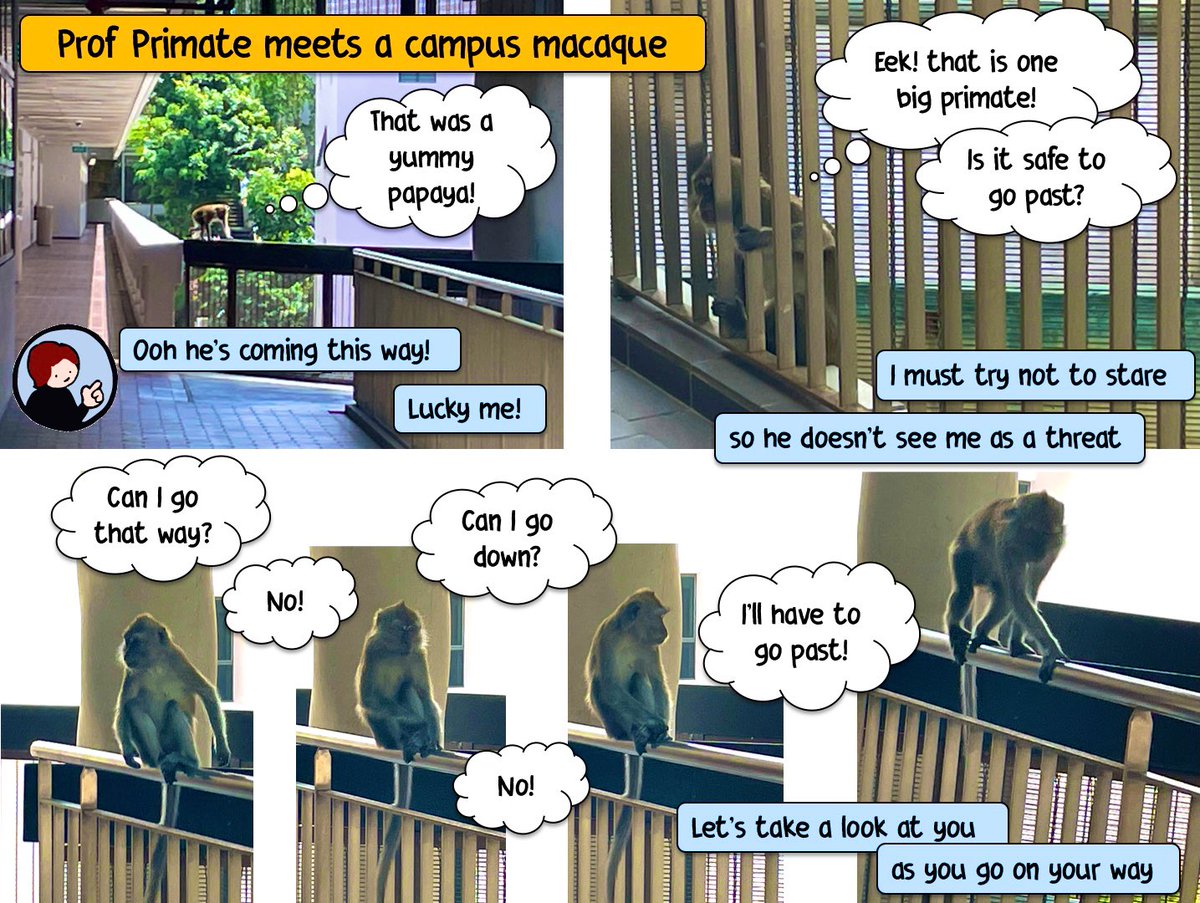
In case anyone wants more #CampusAnimals in their feed, I made my photos from meeting a local long-tailed macaque into a photo comic 😅
Will certainly be sharing with @dear_apes 😇
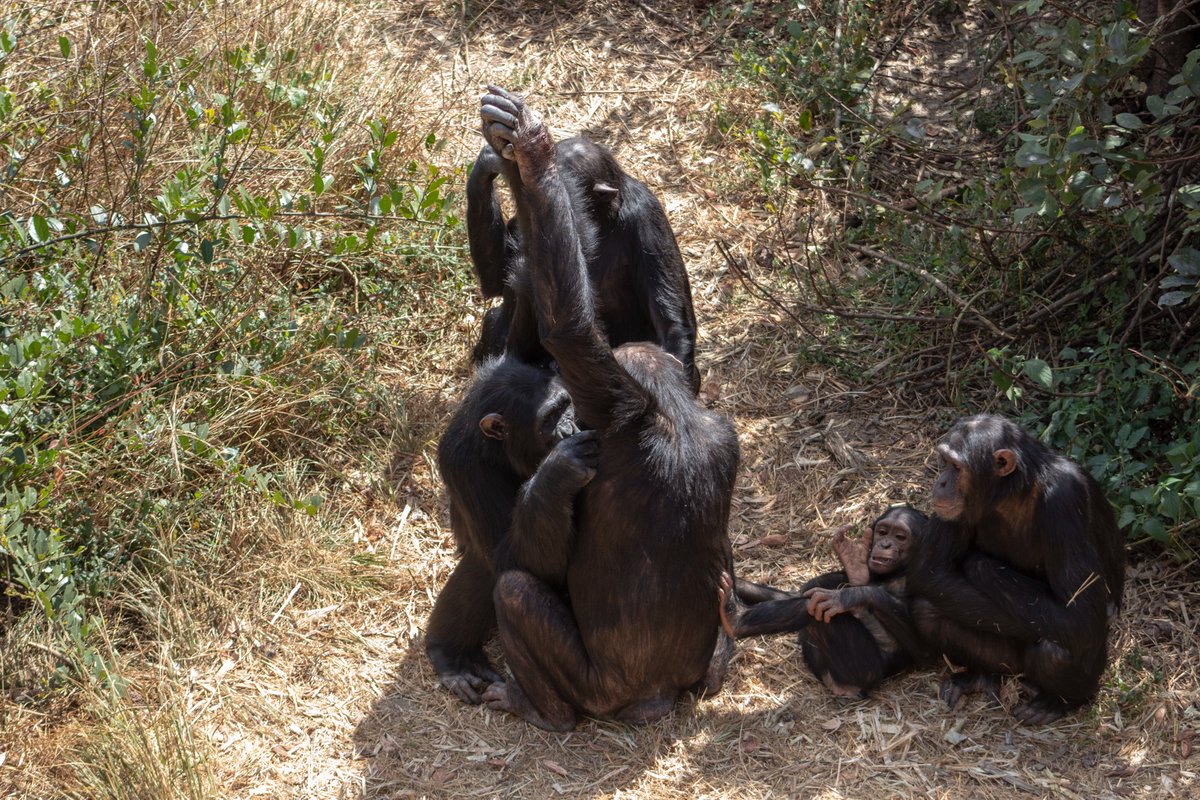
Wonderful paper about a “chimp high-five” spreading through a refuge in Zambia!
👉🏾Most chimps are doing it
👉🏾Moms teach their kids
👉🏾Signs for “don’t leave me hanging” include touch, a hand hold, a torso twist and a HEAD NOD 🤩
👉🏾Partners get smoother over time
What can #chimpanzees clasping their hands teach us about human and non-human animal culture? Our study, published #openaccess in @RSocPublishing examines the role of communication in initiating this social custom, the grooming handclasp (GHC). https://t.co/QG0i7le1fH a🧵 1/10
Just out - our QuickGuide on Hoover, the talking seal @CurrentBiology, with @TecumsehFitch and @AndreaRavignani.
In this short paper, we describe the unusual case of a speech imitating seal, and point to the implications it may have for understanding...
https://t.co/aMU3mOBQU4
Human generation times across the past 250,000 years
https://t.co/1P1ybIklkZ
🤔 What if this longer generation time during Upper Paleolithic contributed to the notable changes in human behavior during that period (= more time for learning/teaching)? 👇
Our class is focussing on the anatomy of vocal production right now, and this wonderful podcast just crossed my feed - you can hear from an Opera Singer who lost nerve control of her vocal muscles, and hear her story of recovery 😀
In this podcast you can hear @heidi_moss describe re-learning how to say /p/ so she could sing a duet with a friend!
👉The motivation is social
👉The mechanism is statistical with fast feedback
✨just like babbling✨
We use a manual designed to help students properly source and cite image materials used in their infographic, and ensure that their own works can be licensed with a @creativecommons licence for future reuse!
The manual itself is open access :)
With the shift to online teaching I’ve been setting #OA#scicomms Infographics as projects so the whole class can share their learning out into the world!
It’s super fun and helps undergrads learn about image rights and visual plagiarism
🧵
Oh! what a lot of primates we have this semester! 🙉
We’re just getting started on An Ape’s Guide to Human Language for the first in person class in YEARS 🥰
The class concludes with the
✨Festival✨ of the Evolution of Language, where we share what we have learned about our primates as a #SciComm Infographic 😍
The velum is made of cartilage - like the firm flexible tissue making up most of the ear. The loudest snores happen when airflow is coming through both the mouth and the nose, as the whole velum can get involved.
We have been talking about the anatomy of vocal production in class...
Time for some illustrations about how airflow can create noise when tissue vibrates🙈 🧵
There are lots of different options for tissue vibrations caused by airflow.
The vibrating tissue here is the uvulum, a dangly bit of flesh hanging off the end of the velum - kind of like the *earlobe of the throat*