@iambabtee We are signing out next month, and no parent deserves to receive such heartbreaking news. Students are currently protesting, but security personnel are reportedly restricting the protest
@iambabtee Good morning, Sir.
Today is a sad day at Osun State University, Ifetedo Campus. We lost a friend and coursemate, a finalyear student, allegedly due to negligence at the medical centre. Sadly, incidents like this seem to occur too often, with students being lost year
Simplifying Multi Step DeFi Actions
Normally, executing a DeFi strategy requires switching between platforms, bridges, and dashboards. @Infinit_Labs bundles these steps into one understandable plan. Users see the full journey of their assets before execution, reducing confusion and mistakes.
The Blockchain Confidentiality Dilemma
Blockchains were designed to remove the need for trust by making everything public and verifiable. This transparency is what ensures integrity, but it also creates a fundamental problem confidentiality is lost. Sensitive information such as identities, balances, or financial data becomes visible to everyone.
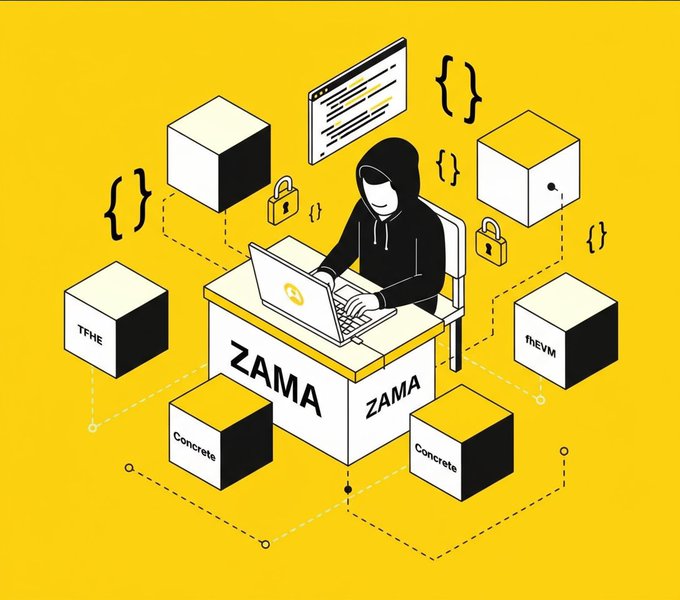
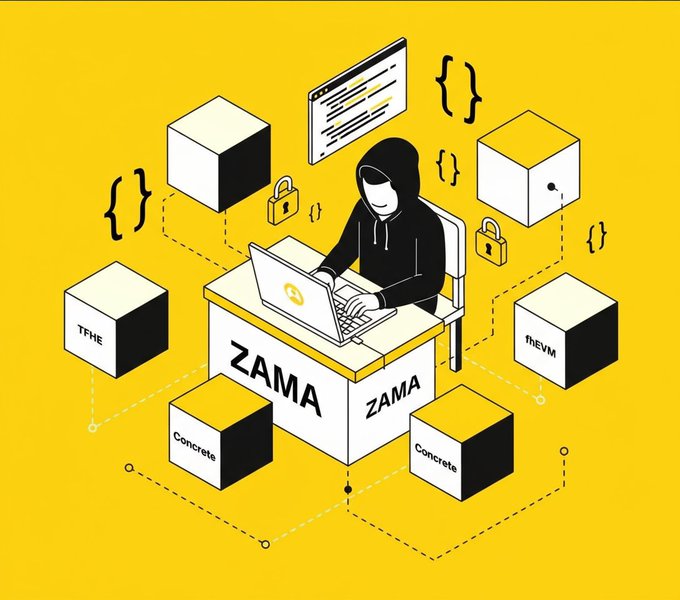
The @zama Protocol addresses this issue by introducing confidentiality without compromising verifiability. It allows developers to build decentralized applications where data remains encrypted while still enabling anyone to confirm that operations were executed correctly. This balance between transparency and privacy is essential for blockchain to reach mass adoption.
Wrapping Up the Zama Journey
Over the past few days, we explored what makes Zama one of the most transformative projects in the Web3 privacy space.
From the foundations of Fully Homomorphic Encryption (FHE) to the revolutionary fhEVM, Zama has been redefining what it means to build confidential smart contracts.
We talked about how Zama empowers developers to compute directly on encrypted data, how it blends privacy with decentralization, and how its key-management system, SDKs, and developer tools make it easier than ever to build secure dApps without sacrificing composability.
Zama’s vision is simple:
A blockchain world where data remains private, computations remain verifiable, and privacy is not an afterthought but a protocol-level standard.
And as we close this chapter, Season 3 of the Zama Creator Campaign also comes to an end today.
It has been an incredible season filled with creativity, community, and education around FHE, privacy, and decentralized innovation.
For the top 1000 content creators, the reward is truly special the Zama OG NFT, a badge of honor that recognizes your contribution to the privacy revolution.
This is not the end. It is the beginning of a new phase in blockchain evolution, powered by math, community, and a vision of confidentiality that never compromises transparency.
@zama is not just building technology. It is shaping the private internet of the future.
#ZamaCreatorProgram
The Future of Compliance and Privacy
Financial regulations require transparency, but users demand privacy.
Zama’s FHE model balances both.
Regulators can verify compliance proofs without accessing sensitive data.
Users retain control, and smart contracts handle verifications privately.
This creates a future where privacy and regulation can coexist seamlessly.
#ZamaCreatorProgram @zama_fhe
Why Blockchain Needs Confidential Computing
Blockchains are incredible for transparency, but that same openness limits what can be built.
Think about it: every DeFi transaction, game action, or identity verification is exposed on a public ledger.
This creates a challenge for real-world adoption. Enterprises, governments, and individuals cannot store sensitive data on a chain that anyone can read.
Zama’s confidential computing layer solves this with Fully Homomorphic Encryption (FHE).
With FHE, smart contracts can run on encrypted data without decrypting it.
The result is a blockchain that keeps data confidential while maintaining verifiable execution.
This unlocks a new era of use cases such as private finance, encrypted AI, and digital identity systems that protect user information by default.
@zama_fhe is not just protecting data. It is reshaping what is possible onchain.
How Zama Balances Privacy and Transparency
For years, privacy in blockchain has been seen as a tradeoff.
The more private a system is, the harder it becomes to verify.
But Zama is closing that gap.
Through FHE-powered computation, data stays encrypted while still being fully auditable.
Every computation produces verifiable results without ever exposing the data itself.
This changes how trust works.
Instead of trusting an intermediary to handle your data, you trust mathematics to guarantee correctness.
In Zama’s world, privacy and transparency work together.
The blockchain remains open for verification, but your data remains yours.
This is the foundation of a confidential yet transparent Web3, powered by @zama_fhe.
The Missing Piece in Blockchain Privacy
Every blockchain user talks about decentralization, but very few talk about confidentiality.
Data onchain is public by design, which is both its strength and its weakness.
@zama_fhe introduces confidential computation, allowing developers to build apps where users maintain control over their data.
Through Fully Homomorphic Encryption (FHE), even nodes and validators cannot see what is being processed.
The result is true digital sovereignty. You control your information, even while it powers decentralized logic.
This is not privacy as an afterthought. It is privacy by architecture.
Why FHE is a Paradigm Shift
Before Zama, encryption was mostly static.
You could encrypt data for storage or transfer, but once you needed to compute on it, you had to decrypt it.
FHE changes that rule. It allows computation directly on encrypted data, producing encrypted outputs without ever revealing the inputs.
@zama_fhe built its entire protocol around this capability, enabling smart contracts that never see the raw data they operate on.
This single idea redefines what is possible in blockchain privacy, compliance, and AI integration
Smart Contracts that Keep Secrets
Traditional smart contracts expose every variable and computation.
Anyone can view them through a blockchain explorer.
With Zama’s fhEVM, developers can now create contracts that compute privately while remaining verifiable.
The logic is public, but the data stays encrypted.
That means private DeFi trades, secret auctions, and confidential governance votes are finally possible.
@zama_fhe transforms Ethereum from a transparent network into a privacy-respecting computation platform.
Why Privacy Fuels Innovation
When builders know user data is protected, they innovate freely.
That is the foundation of the @zama_fhe approach.
From private credit scoring systems to encrypted gaming economies, confidentiality encourages experimentation.
Zama’s FHE-based infrastructure gives developers the ability to create new categories of decentralized applications without leaking user data.
Privacy is not a blocker. It is the enabler of Web3’s next growth cycle.
The Role of Zama’s SDKs
To make FHE accessible, @zama_fhe built developer SDKs (Software Developer kits) that simplify complex cryptographic operations.
With these SDKs, developers can integrate encrypted computation into any dApp, from DeFi to healthcare.
The goal is not just to demonstrate FHE, but to make it practical and scalable across chains.
Zama’s SDKs bridge the gap between theoretical cryptography and real-world blockchain development.
Privacy Without Trusted Hardware
Many existing privacy solutions depend on trusted hardware like TEEs or isolated environments.
@zama_fhe takes a different route.
By using pure mathematical encryption, Zama removes the need to trust any physical device.
Security is guaranteed by cryptography, not by hardware manufacturers.
This ensures your privacy remains independent and mathematically verifiable.
The Agentic Economy: When AIs Begin to Trade and Earn
For years, artificial intelligence has existed as a tool smart, powerful, but dependent. Every AI system today still needs humans to handle one critical step: payments and ownership.
But what happens when machines start managing their own value?
That is the question KiteAI is answering through the rise of the Agentic Economy.
What Is the Agentic Economy?
The Agentic Economy is a digital ecosystem where autonomous AI agents can create, exchange, and manage value without human intervention.
These agents are not just programs they are independent entities that can:
1. Execute tasks
2. Negotiate prices
3. Pay for services
4.Earn tokens for completed work
5. Interact with other AIs transparently through the blockchain.
How KiteAI Enables It
At the heart of the Agentic Economy are three technical pillars powered by KiteAI:
1. Identity Layer
Every AI agent is given an on-chain identity that proves who it is, what it does, and what permissions it holds.
2. Payment Layer
Agents can make micro and macro transactions using stablecoins or native tokens, instantly and securely.
3. Governance Layer
Smart contracts establish the rules of interaction, ensuring trust, fairness, and accountability among agents.
Together, these layers form a self-sustaining ecosystem where AIs are both actors and participants in the economy.
Real-World Scenarios
- A data-gathering AI pays another AI for real-time analytics.
- A compute AI rents unused processing power to smaller agents.
- A language model agent sells summarization services to research bots.
All these transactions happen on-chain, verified, and executed automatically through KiteAI’s network.
The result is a borderless digital economy an open marketplace for intelligence.
Why It Matters
This changes how we think about value creation.
It shifts AI from being a service to becoming a participant in the global economy.
As humans built the internet of information, and blockchains built the internet of value, KiteAI is now building the internet of intelligence.