A guy has been a licensed electrician for 14 years.
He's wired over 2,000 homes. But the call he gets more than any other isn't about broken outlets or tripping breakers.
It's: "Why is my electric bill so high?"
He told me something that should make every homeowner and renter check their house tonight:
"Your electric bill is not based on how much electricity you use. It's based on how much electricity you waste. And in 90% of the homes I walk into, 20–30% of the bill is pure waste appliances pulling power while turned off, settings nobody ever changed, and mistakes so simple they take 2 minutes to fix but cost you $500+ a year."
"Right now while you're reading this your phone charger plugged into the wall with no phone attached is drawing power. Your TV you turned off with the remote is still on. Your water heater is keeping 50 gallons of water at 140° even though you only need 120°. Your dryer vent is clogged and making every load take 30 minutes longer. Your ceiling fan is spinning the wrong direction for the season. Your thermostat is fighting your insulation because nobody set the schedule correctly. And every power strip in your house is feeding 5 devices that are running 24/7 even though you think they're off."
"They're called phantom loads. Every device with a standby light, a clock, a remote sensor, or a Wi-Fi connection is pulling electricity around the clock. The average home has 40+ phantom loads. Together they account for 5–10% of your entire electric bill for doing nothing."
"I've walked into homes where the family was paying $300/month and could've been paying $180 without buying a single new appliance. Without changing their lifestyle. Without sacrificing comfort. Just by fixing 10 things nobody ever told them to check."
"Your electric company will never tell you any of this. They make more money when you waste electricity. That's their business model."
Here are 10 things in your house right now that are silently adding hundreds of dollars to your electric bill every year and exactly how to fix each one in under 15 minutes:
🧵
In American schools, when lunch ends,
children throw their trays into plastic bins and walk away.
A hired janitor comes in later to sweep up the mess.
In Japan, there are no janitors.
At 12:15 p.m., the students put on white smocks, hairnets, and masks.
They carry heavy pots of soup from the kitchen themselves.
They ladle out equal portions for their classmates.
Nobody touches their spoon until everyone is served and they say "Itadakimasu" together.
Then, at 1:00 p.m., something even more profound happens:
O-soji. Cleaning time.
Seven-year-old kids get on their hands and knees with white cloths — zokin.
They push those cloths down the long wooden hallways,
polishing the grain until it shines like glass.
They wipe the chalkboards. They clean the toilets.
The teachers clean alongside them.
Why make children scrub floors?
Because when you spend fifteen minutes on your knees scrubbing a floor,
you will never, for the rest of your life,
drop a piece of trash on it.
It teaches a child that no work is below them.
No human being is born a master.
A high-trust society isn't born from laws.
It's born on the knees of seven-year-olds
taking pride in a clean floor.
Andrew Huberman says every overweight friend who tried his 8-item food allow-list was “highly successful” at losing 30 to 60 pounds and keeping it off.
If it’s not on the list, it stays off the plate.
Here’s Huberman’s list:
• Meat
• Fish
• Eggs
• Chicken
• Fruit
• Vegetables
• Water
• Caffeine
HUBERMAN: “I have several friends just by way of example who reached their 40s quite overweight, 50s quite overweight, 30 to 60 pounds overweight.
“And they’d come to me and they’d say I want to lose weight.
“Every single one of them has been highly successful in rapidly losing that weight and keeping it off the following way.
“I’m not a nutritionist. I say you can eat meat, fish, eggs, chicken, fruit, and vegetables, and that’s it.**
“And drink water and caffeine, and don’t consume calories in beverages.
“And every single one of them lost 30, 60 pounds and has kept it off.”
ADDED CONTEXT: What this diet really does is eliminate ultra-processed food completely. And according to Huberman, it has worked for weight loss every single time.
Move to a small town.
Buy a $200K house instead of a $900K one.
Take the job that gives you more time, not the biggest salary.
Have kids.
Know your neighbors.
Grill in the backyard.
Take road trips instead of luxury vacations.
Pay off the house.
Build a simple life.
Then you’re 70, sitting on the porch with the person you love, watching your grandkids play.
The house isn’t impressive.
The town isn’t famous.
But somehow, you won.
A woman has been a flight attendant for 14 years across 3 major U.S. airlines.
She's worked over 16,000 flights domestic, international, short-haul, long-haul, economy, business, and first class.
She's also a personal traveler who takes 12–15 trips a year on her days off. She sees both sides of the aircraft door.
She told me: "In 14 years, I've watched roughly 3 million passengers board a plane. Maybe 1 in 50 does anything to make their flight better. The other 49 show up, sit in the seat the system gave them, eat whatever is offered, endure whatever happens, and walk off the plane stiff, dehydrated, and frustrated blaming the airline for an experience they had complete control over."
"Passengers don't realize that the seat they're sitting in was the worst available option the algorithm could assign them. That the air vent above their head has a function most people have never used correctly. That they can ask me for things the menu doesn't list. That their checked bag was flagged as 'last to load, first to lose' because of a setting they never changed. And that the flight they paid $480 for was available for $190 to the person sitting next to them."
"Flying isn't something that happens to you. It's a system you can operate. Most passengers never learn the controls."
Here are 10 things she does on every flight that most passengers have never tried:
🧵
I have a very important bit of advice if a loved one is ever in hospital, especially over the age of 65.
Take great care to watch what’s happening with their SLEEP.
Here’s the RED FLAG scenario:
Someone in hospital with an illness. They are being treated appropriately, but for the first couple of nights their sleep is very rough. It could be a noisy room, beeping machines, or middle of the night vitals checks or lab draws.
They start to experience daytime sleepiness and as anybody would, become quite miserable and eventually it can suppress their metabolic and immune systems if it goes on too long.
Maybe they request a medication to help with sleep. Here’s where it can get bad, because far too often— ridiculously strong meds are given (like a benzodiazepine). This can then lead to drowsiness and mental status changes during the day.
Even without a medication, a few nights of poor sleep can be devastating anyway for someone above a certain age.
Recovery is prolonged. Maybe another complication like a fall happens.
You get the gist.
It all started with not sleeping well at a crucial stage when the body is recovering.
So what can you do, if this happens to you or a loved one?
1. Well being aware of this problem is the first step.
2. For a noisy room, speak to the supervisor and be assertive that your loved one cannot sleep and is getting worse. You can do this perfectly politely while remaining firm
3. Are those vitals checks and early lab draws really necessary for a stable patient? Often they are not. Let the patient sleep through the night
4. If a sleep med is given, can it initially be something very light like melatonin or magnesium glycinate? Even Benadryl is preferable to a benzodiazepine sedative
5. Keep being a good advocate for your loved one
The above should be basic common sense, but I’ve seen this go wrong enough times to write this tweet.
Sleep is crucial and must be PROTECTED for good recovery.
Thank you for your attention to this matter and good luck
THE JAPANESE METHOD OF RAISING CHILDREN WHO LISTEN THE FIRST TIME.
By age, from Japanese practice:
1. They keep their voice low, especially when the child is loud.
One of the greatest cheat codes in life is to never get offended. Train yourself to have thick skin. Don't take things personally. Let others disagree with you. Being easily offended means you're easily manipulated. If you value peace of mind, avoid getting offended.
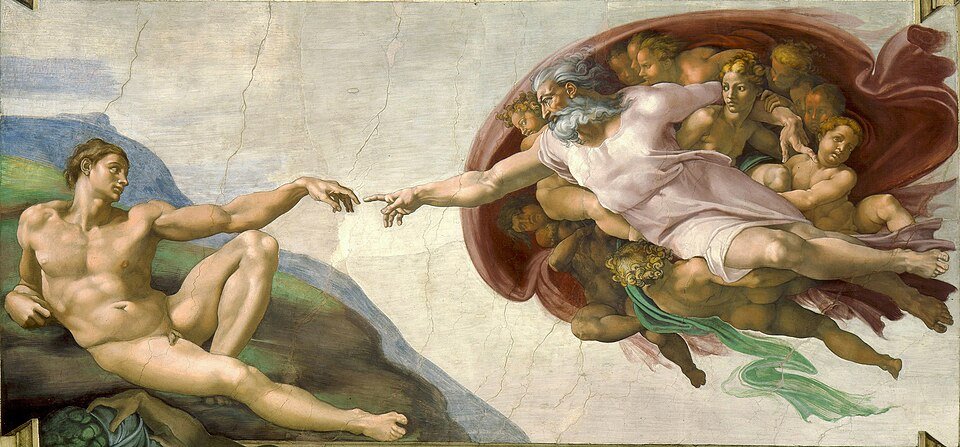
Four hundred million people have this image on their phone, a mug, or a T-shirt.
Almost none of them have noticed what's wrong with Adam's hand.
Look at the two arms.
God is horizontal. Launched. Every tendon in His arm at full stretch, hair and mantle blown back by His own speed, angels straining under the weight of carrying Him because He is the one moving. He has crossed the entire sky to get to this moment. His finger is extended as far as a finger goes.
Now Adam.
Draped on a hillside. Propped on one elbow. Leaning back. His arm isn't reaching; it's resting on his own knee. The wrist is slack. The finger droops.
The Creator of the universe is straining like a man reaching for someone going over a cliff.
And the man can't be bothered to straighten one finger.
Michelangelo painted that on purpose. And he painted it in agony, four years on scaffolding under that ceiling, head cranked back, paint dripping into his beard. He hated it enough to write a poem about it, complaining that his spine had bent like a bow and he could no longer read a letter without holding it above his head.
Four years of that. To say one thing:
You did not climb to God. God dove to you.
Every religion on earth is a ladder. Purify yourself, discipline yourself, ascend. Michelangelo put the opposite on the ceiling of the most important church in the world: man reclining, barely participating, and God closing the distance at speed.
Genesis 2:7. And the LORD God formed man of the dust of the ground, and breathed into his nostrils the breath of life; and man became a living soul.
God breathed. Adam received. That's the whole transaction. Adam contributed the dust.
Now look under God's left arm.
There's a woman tucked against His side. His arm is wrapped around her. And she isn't watching the miracle; she's looking past God's shoulder, straight at Adam.
The oldest reading says that's Eve.
Not yet created. Not yet formed. Already held. Already watching the man she'll be given to, from inside the embrace of God, because she existed in His mind before she existed in the world.
Jeremiah 1:5. Before I formed thee in the belly I knew thee.
Ephesians 1:4. He hath chosen us in him before the foundation of the world.
You were in that mantle once before your parents met, before anything.
And about that mantle, in 1990, a physician named Frank Meshberger was studying the fresco and published something that made art historians sit down. Trace the outline of the crimson cloak, the angels, the whole swirling mass around God.
It matches a cross-section of the human brain. The fissures. The lobes. The stem.
Michelangelo dissected corpses. He knew human anatomy better than most surgeons of his century. Whether he hid it there deliberately is argued to this day, but if he did, the sermon is staggering: God isn't just handing Adam a heartbeat. He's giving him a mind. The image of God. The capacity to know his Maker.
So God has crossed the sky. Arm at full extension. Nothing left to give. He has closed all the distance that can be closed from His side.
And the fingers don't touch.
Michelangelo froze them apart forever. A half-inch of empty plaster carrying more weight than the rest of the ceiling combined.
Because look whose finger has slack left in it.
Not God's.
Adam could close that gap by straightening one knuckle. One. The remaining distance is his, the smallest movement in the painting, and the only one God will not make for him.
That half-inch is free will. God will cross a universe. He will not cross your consent.
But here's what the ceiling can't show you, because it happened fifteen centuries after Genesis and Michelangelo painted the before.
The touch happens.
God's hand and human flesh finally meet not above the clouds, but in Bethlehem, when the hand that flung the stars became a hand small enough to grab Mary's finger. God stopped reaching across the gap and stepped into it. Took a body. Took a hand.
And when that hand was finally stretched out as far as human arms go, extended like the arm on the ceiling, full reach, nothing held back.
We nailed it there.
That's where the two fingers meet. At the cross. God at full stretch and man at his worst, touching at last through an iron spike.
And three days later that hand was moving again. Folding grave clothes. Cooking breakfast. Offering its scars to a doubter.
It's still extended. The ceiling is still true. He has done all the reaching, crossed all the sky, closed all the distance that love can close without your permission.
The last half-inch has always been yours.
Lift your hand.
Married couples don't need another "dinner and a movie" date.
You need something that makes you feel like people again, not two tired roommates coordinating bedtime and dishwashing schedules.
Here are 42 things to do with your wife that actually reconnect you: