@FarrowMP @janrosenow@IEA It's more than a caveat: by number of units, there's almost as many solar thermal units by 2050 as there are gas boilers now!
@robertjwhitney The original source sees a very small future for heating that involves burning stuff, so it's a reasonable approximation, even if some H2 for heat is allowed.
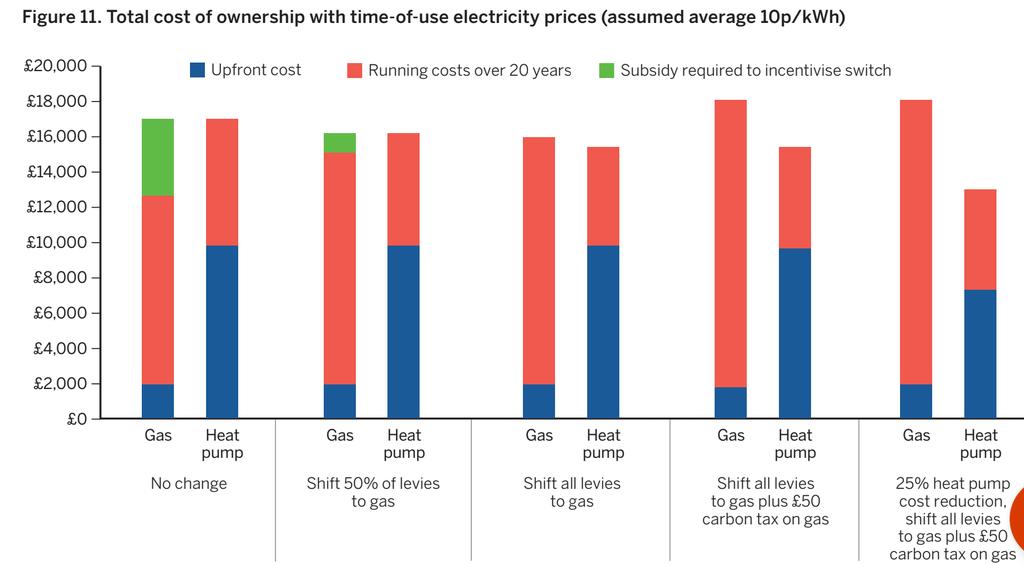
How to make heat pumps "subsidy free"
By Michael Lewis, UK boss of EOn, drawing on new @PublicFirst_PF report
1⃣CO2 tax on fossil heating
2⃣move renewable subsidies to general taxation
3⃣economies of scale to halve costs
4⃣cheap loans via Nat Inf Bank
https://t.co/3dFSyMRPHx
@mikefosterEUA Oh dear, that's not very nice. Whatever you call it, you're still using the wrong variable to make your point. Maybe look at the EBIT from suppliers consolidated segmental reports, (https://t.co/OZi7TWHIXQ), divide by kWH and try again?
@JonathanWaxman1@DavidDye9@robertjwhitney@CadentGasLtd@KeeleUniversity Even if 'green' hydrogen, unless the electricity generation would have otherwise been curtailed, then it will be increasing emissions. The reason being that the extra energy needed due to the inefficiency of hydrogen as an energy vector has to be met by more generation...
@FarrowMP @heatpolicyrich @kenbone44 @baldwinbiogas @Zain_Habib@AbigailDombey @ELPinchbeck The caveat for 'mostly' being that coefficient of performance needs to be above 2, but this is usually the case.
@FarrowMP @heatpolicyrich @kenbone44 @baldwinbiogas @Zain_Habib@AbigailDombey @ELPinchbeck Ah no, even if all the electricity is from gas power stations (worst case), most of the heat is still from the surroundings (warmed renewably by the sun) and the heat pump just moves this renewable energy inside.
@heatpolicyrich @kenbone44 @baldwinbiogas @Zain_Habib@AbigailDombey @ELPinchbeck So maybe the new category could be something snappy, like: 'even in the worst case scenario, mostly renewable'.