Some traders spend 20+ years in the market—and repeat the same mistakes they made in year one.
They understand charts, setups & risk.
But they never built a process they can follow consistently.
Here is how I help experienced traders finally change:
🧵 Read the full thread 👇
@motthoidenho75 Cái này là xếp hàng tranh nhau mua/bán vàng. Trước giờ mở cửa là gần 40 người thành 1 hàng dài, công an phường phải ra chỉnh đốn hàng ngũ, chứ dẹp biến gì cha nội
These two free indicators, created by @DumbleDax for me, can add real value to your trading—if you grasp the qualitative logic behind them:
1. Maximum Slingshot Pull Analogy
— Focus on setups at the lowest ATR% multiple from the 50-MA
https://t.co/X5KQDfjkxU
2. Compressed Spring Coil Entry Analogy
— Targets entries below 60% LoD to ATR, aiming for immediate intraday profit cushion
https://t.co/fGhMrnuc5N
🚨 Presenting the Simple Turnover Indicator for TradingView, free for everyone!
(codename: 'gamechanger' 😜)
Purpose: Stock selection
- The script plots the average turnover by multiplying the moving average of volume and price. The market cap is plotted bar by bar as a background behind the turnover bars.
- This helps the trader gauge whether there’s enough liquidity in the instrument being traded.
⦿ Turnover expansion
- Observe when the average turnover suddenly expands from its previously subdued values.
- This occurs when money begins to flow in due to a catalyst, sectoral push, news flow, or any institutional activity.
⦿ HTQ (Highest Turnover in a Quarter)
- Every time the turnover reaches a new high in a quarter, the color of the turnover bars turns dark green.
- This represents the HTQ (Highest Turnover in a Quarter), and multiple consecutive HTQs indicate a significant influx of funds into that stock.
⦿ Relative liquidity comparison with TOMCAP
- Even average turnover can sometimes overlook the context if we don’t know the company's size. That’s why the script also measures Turnover to Market cap ratio (TOMCAP), answering, “What percent of the company’s value trades each day?”
- For example, a small-cap stock with ₹1 Cr turnover but only ₹50 Cr market cap (Tomcap = 2 %) vs. a large-cap with ₹10 Cr turnover and ₹20,000 Cr cap (Tomcap = 0.05 %).
⦿ Fully customizable
- Dark mode
- Show turnover in Crores or Millions
- Choose between Table or Text
- Enable or disable any row: Turnover, Mcap , FF (free float), 1-Min liquidity, Tomcap or Toff (Turnover to Free Float) ratio
Link to the indicator in the following post. 👇
5 Top Videos About Stock Trading (from my YouTube channel) 👇
1. Combine Swing & Position Trading for Big Gains! 📈💡 You can trade both styles! - https://t.co/tlPFKhFkzs
2. Improve your market timing now! Buy stocks at the right time with a simple trick. - https://t.co/TrUvaTqJMF
3. How to know if a stock is extended in price and time? Simple trick! - https://t.co/KNpveNCcXv
4. How to take stock profits at the right time? Here is the sell signal from July 19. - https://t.co/o5ScTUMbnU
5. My Favorite Stock Screener: Uncover High-Potential Momentum Stocks With FinViz! - https://t.co/j8IXs7jOno
15 Trading Tips from David Ryan
1. Start with real-life observations to identify stock ideas.
2. Focus on stocks in strong uptrends and breaking into new highs.
3. Master one trading setup before trying others.
4. Analyze every mistake to identify patterns and improve.
5. Wait for proper bases to form before buying breakouts.
6. Use weekly charts to filter noise and assess trends.
7. Rely on the relative strength (RS) line for confirming leadership.
8. Hold 8–10 stocks but concentrate more capital in top performers.
9. Scale into winning positions instead of going all in.
10. Look for institutional accumulation with multiple up days on volume.
11. Sell if a stock breaks below the 50-day or 10-week line on volume.
12. Avoid emotional attachment to trades; focus on execution.
13. Adapt to market conditions by rotating into strong sectors.
14. Limit screen time to prevent overtrading and poor decisions.
15. Keep perspective — faith, family, and balance matter more than trading.
Over a decade of trading boiled down into 20 threads.
If I had these back then, my journey would’ve been 10x faster.
They’ll save you years and transform your results.
@RichardMoglen@StanWeinstein13 Question: the book was published long ago when Index was less than 1k, whereas it is now at 40k and the number of stocks has increased much more, is it necessary to analyze the index, or we can disregard index and get straight to industry group analysis then filter stocks? Tks
"How can I achieve consistency in my trading?"
This is the question I got from my last free call out of the 50, yesterday. Here is my answer :
The term "consistency" has been used so often that, due to overuse, we sometimes forget what it truly means. Consistency is not just about having only positive monthly gains and triple digit years.
Consistencyfor me is, receiving feedback around the average of your established goals and continuing to operate in the same way to create a pattern of similar feedback in the long run.
To achieve consistency, you need 3 things:
1. A Complete and Efficient Foundation
2. Proof that enables you to trust the system and build rules around it
3. A clear understanding of what is normal to expect, so you can follow those rules.
A solid foundation, clear rules, and not deviating from them—this is what drives consistency
So, why is it so hard to reach consistency in trading? The answer is that each of these three elements requires a tremendous amount of effort compared to other fields.
Fitness:
1.Complete and efficient workout and diet systems are easily accessible.
2. You have proof all around you even from your close circle that these systems work, and you can build rules based on them.
3.Everything is quantifiable. You know for examplethat 3,500 calories equals one pound of fat. You know what to expect and the timelines. Feedback is generally positive as long as you follow the rules. It's easy to obey the rules you've set and maintain the right mindset.
Trading:
1. It’s far from easy to find a complete and efficient foundation. Sometimes when starting out people don’t even know what parts are needed for a complete foundation. And even if it is complete it does not mean that it is efficient.
2. Proof? Everything seems chaotic. The people who succeed are a small fraction of participants, and that doesn’t inspire immediate trust. A trading system has so many components that it takes enormous effort to gradually eliminate doubts and answer all the "whys" from the ground up. This makes it hard to create a solid rule set to complement the entire foundation.
3. Even if you have a foundation and a set of rules, many don't know what to expect, what the foundation's capacity is, or what feedback is normal and what isn’t. Small negative feedback, which could be fully normal based on the foundation can lead to constantly breaking the very rules you’ve set.
To achieve consistency in trading,
1. You need a complete and efficient system.
2. You must eliminate all doubts about each part of the system with actual proof, so you can fully trust it and set the rules you need to follow.
3. You need to develop an understanding of what I often refer to as the "expectancy of outcomes," so you know the capacities of your system and what's normal feedback and what is not. This is the only way to ensure you respect those rules and trade near the mean of your optimal mindset.
Following these three steps can lead you to your goals. Will it require time and effort? Yes... it may feel like blood, sweat, and tears.
But at least now you know what consistency really means and what it takes to achieve it.
The rewards that come after struggle are always greater!
My Favorite Weekly Chart Setup: The "Character Change"
This is my go-to setup for getting into new uptrends early, and it’s something I use only on weekly charts.
The CC (character change) is all about patience and waiting for clear evidence that the trend has shifted.
⚠️ If you’re looking for quick trades or need to be active, this might not be for you, because these require you to sit after you get in for a long time and let it do it's thing.
Why Weekly Charts?
Weekly charts smooth out a lot of the noise you see on daily charts. They give you a bigger picture and help you see the trend more clearly.
What Is the "Character Change" Setup?
This setup is about recognizing when a stock is transitioning from a long downtrend to the early stages of an uptrend. It’s all about waiting for specific signals on the weekly chart that show that it is highly likely the long-term trend is now up.
Here’s what I look for:
1. First Higher Low
After a long downtrend, I look for the stock to make a higher low on the weekly chart. This alone isn't enough but it's our first piece of evidence that something might be up.
2. HUGE Volume with a Price Pop
The other thing to look for is a big surge in volume with a strong price move. This shows real institutional interest. This is our second piece of evidence. You have a higher low + it's first massive push. After this I have confidence the birth of a solid new trend is likely in place.
Also the 1st or 2nd above can happen in any order you just want to see both.
3. New 10 Week respect
The way you get a low-stress entry with incredible R/R is by waiting now that you have the evidence of a true CC on your side. The 3rd piece of the puzzle where you can enter with extremely low risk if it doesn't work is when you see the stock start to respect the 10-week moving average for the first time.
Example 1: $APP
Let’s look at APP, which had a huge run after showing this setup and my second best trade of all time.
1. Volume Pop: First, I noticed a big volume spike, but I didn’t jump in just because of that alone, not enough evidence.
2. First Higher Low: After the volume pop, the stock pulled back a bit and made a higher low. That’s when I got interested. As it made that higher low, it started respecting the 10-week moving average.
3. Holding the 10-Week: It then resumes its move being supported clearly by the 10 week again. That’s the final confirmation needed.
APP took time to develop this setup. Even though it might look like dumpster diving, since these are weekly charts, the downtrend is long over before it becomes a buy. From there, it just kept riding the 10-week line up , giving you multiple chances to add to your position if you caught it or many chances to get in.
Example 2: $PYPL (currently developing)
PayPal was dead money for a long time, making lower lows. Then early this year we started developing a CC.
1. Higher Low: This grinded sideways but still ended up being a big higher low.
2. Volume Pop: Here we get a big price push on volume. Technically we had a few before the higher low was confirmed, and an entry could have been established after the higher low because the risk is so low. But this was the clear Volume pop.
3. New 10W Respect: This is final evidence for me, off the volume pop the weakness is supported by the 10W for the first time. Super low risk entry and you can see if this is a real long-term trend then we are still very early.
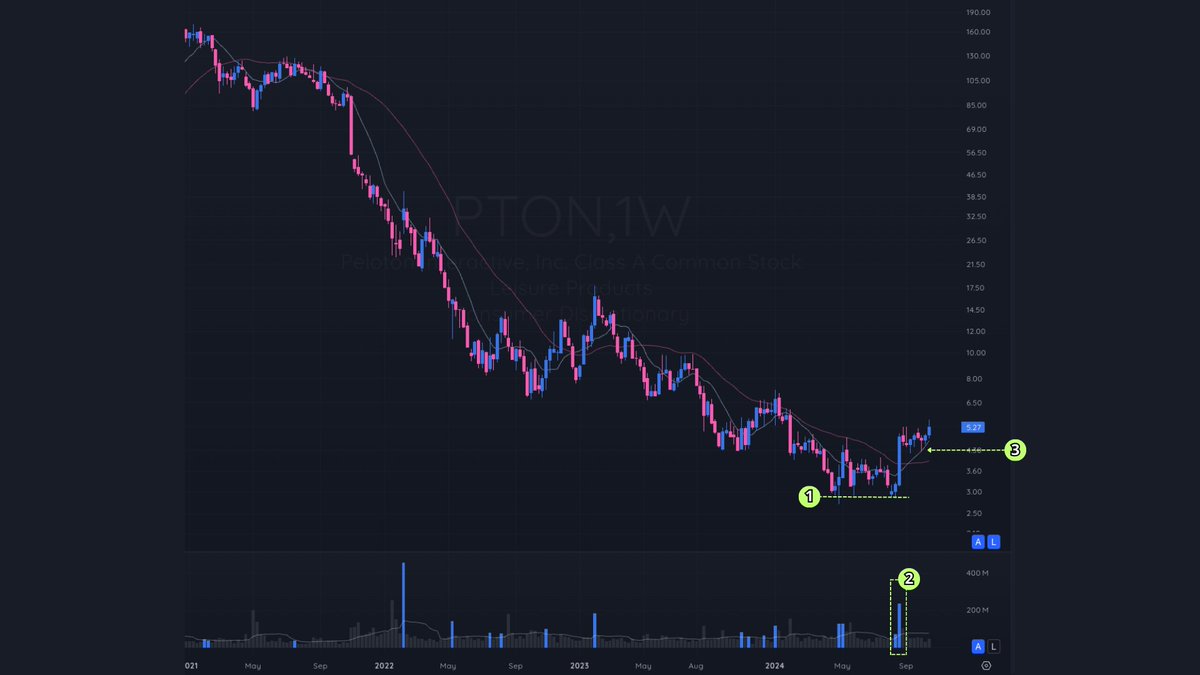
Example 3: $PTON (very early, still developing, and new position)
Peloton had been stuck in a downtrend for over two years, so I didn’t even consider buying until it started showing evidence that the downtrend might be done.
1. Higher Low: Instead of breaking to a new low, it held up at a slightly higher level. It’s subtle, but this is a big clue that the character of the stock is shifting. (It was kind of a retest of the same low, not much of a higher low, so you can argue #3 on the chart is also the first higher low. Doesn't matter, by 3 you have all 3 pieces of evidence.)
2. Volume Pop: Next, a significant volume spike paired with a strong price move. But I don’t buy just because of a volume spike—I need more confirmation.
3. Trading Tight into the 10-Week Moving Average: After the volume pop, PTON started trading tightly near the top of that move and right into the 10-week moving average. This is what really got me interested because even if it fails, I can't emphasize enough.... the R/R for these types of setups is off the charts.
The big thing here is patience. I don’t jump in while a stock is still in a downtrend. I wait until it’s made a higher low, shown a volume surge, and started respecting the 10-week moving average. By the time I get in, the downtrend has usually been over for a while. I’m letting the stock prove itself first.
Quick Recap
Here’s what makes the character change setup work:
1. Higher Low on the Weekly: Signals the stock might be done making new lows and could be shifting to an uptrend.
2. Volume Pop: A big volume spike with a price move. This tells you that there is now real interest in this name and adds evidence to support the birth of a new trend.
3. New 10-Week Respect: This helps add further evidence the momentum is on your side and allows you to get in with really low risk if it doesn't end up working.
Remember, this setup takes time to develop. The hardest part is the patience. It is a lot of hands off and waiting but thats also how I like my trades. Low stress.
Less is more!
If you made it here...drop a reply—I’d love to hear your thoughts and questions.
I struggled for a long time as a trader.
These 10 lessons were my turning point.
I hope they help you find yours.
1. Control the downside, and the upside takes care of itself.
The real turning point in my trading wasn’t when I learned how to pick the right stocks or read charts better… it was when I finally mastered the skill of cutting losses fast. Fast = no more hoping, just taking the hit and moving on. If you struggle to make progress in the market just review your trades and I bet you the issue isn’t you can’t find winners. It’s because you hold a loser too long.
2. Your trading strategy should be as unique as you are.
A strategy that works wonders for someone else might be a disaster for you. It’s not just about finding a profitable system, it’s about finding one you can actually stick to. The key is to understand your personality first, then build a strategy that feels like a natural fit.
3. The chart tells the only story you need.
I’ve learned over the years is that we don’t need to understand why a stock is moving the way it is. I used to think I had to know every little detail, every catalyst/news… but that’s not our job as traders. Our real job is to recognize when the big players (institutions) are making moves. We don’t need to overthink it or try to rationalize it with a hundred different reasons. The fact that they’re loading up (or selling) is reason enough.
4. Self-awareness is your most profitable indicator.
Study the charts, learn the strategies, but don’t forget to spend just as much time understanding the person behind the trades. That’s where the real edge is.
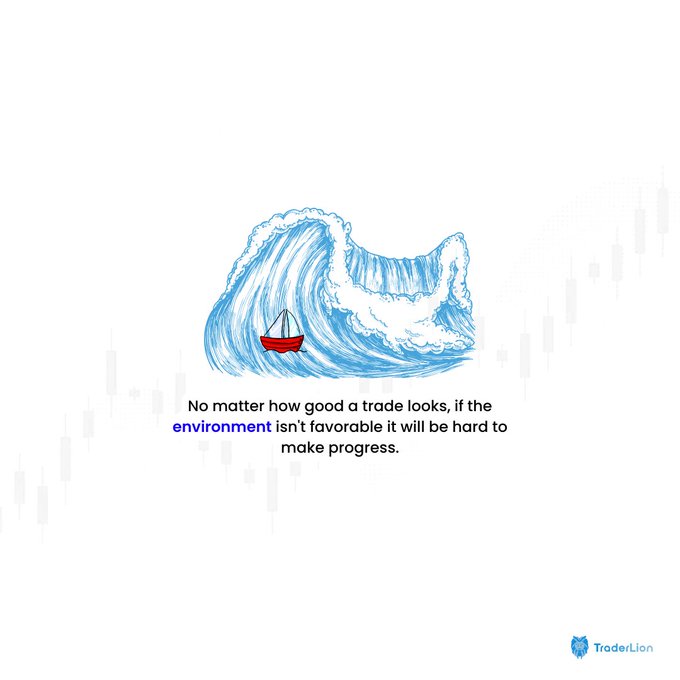
5. A perfect setup means nothing in the wrong market conditions.
Even the most promising trade will likely fail if the market environment isn’t right. Recognizing when the odds are stacked against you is as important as spotting a good entry. It’s not just about the individual trade, it’s about whether the stage is set for it to succeed.
6. Overthinking won’t protect you, it just keeps you stuck.
I used to think that analyzing every detail would protect me from losses, but all it did was lead to missing opportunities. The second-guessing and hesitation is exhausting and often costs more than just taking the shot. As my mentor once said, “Sometimes the best trades are the ones that make you feel a little sick to your stomach.” If the setup is there and you’ve managed your risk, you’re ready. Pull the trigger and let the trade play out.
7. Making money trading is easy, keeping it is hard.
One reckless trade can wipe out months of progress in an instant. I’ve learned that discipline is the only thing standing between keeping those gains and giving them all back. Without it, any gains you make are just temporary. To succeed long-term, you have to protect your profits as fiercely as you chase them.
8. Trying too hard to make money in the market always backfires.
The best trades often come when you’re patient and let the setups come to you. Patience is the toughest skill in trading. We’re wired for instant results, but success takes time.
9. No setup is a sure thing.
Early on, I’d be so confident in a trade that I’d ignore the possibility of failure, but I learned quickly that even the best looking setups can flop. The outcome is never in our control, and that’s why risk management matters.
10. To become a great trader, you need to think for yourself.
I used to rely on news, tips, and other traders’ opinions, but it only led to confusion and second guessing everything. The real growth started when I learned to trust my own analysis and make decisions independently. Outside sources can be helpful, but ultimately, you have to own your trades. Develop your own perspective, it’s your greatest asset.
Trading is hard, but embracing these lessons have made all the difference for me. I hope they help you navigate your own path and find the success you’re looking for.