Join our powerful community of 250,000+ crypto enthusiasts! Get exclusive market insights, real-time technical analysis, and key market signals all in one place.
📲 Connect with us on our official profiles:
🌐 Website: https://t.co/x2oMLb5sse
🔶 Binance Square: https://t.co/A9PcIkMgWM
🔵 Telegram: https://t.co/peuDDWQNVY
🟡 CoinMarketCap: https://t.co/qzPFnGCcFK
Stay ahead of the market with our powerful crypto community. Visit https://t.co/E4FRlMxi4m today! Stay informed. Trade smarter. 🚀
Swapping crypto on a single platform often means overpaying.
Decentralized exchanges price tokens independently, meaning rates differ across pools. A DeFi aggregator scans multiple exchanges instantly to secure the best available price.
Aggregators split large orders across platforms like Uniswap, Curve, and Balancer to stop the price from moving against you. Your crypto stays inside your private wallet throughout the trade, avoiding centralized exchange custody risks.
Always account for the risks before trading. Audited aggregators can still face smart contract bugs, and liquidity pools expose deposits to impermanent loss. Verify security audits and bot protection before connecting your wallet.
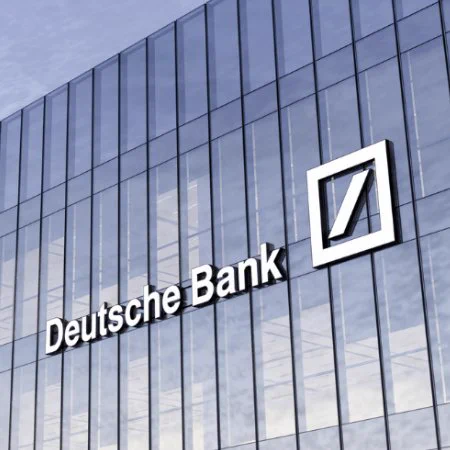
Deutsche Bank has officially entered the institutional crypto custody market, giving corporate and professional investors a bank-managed route to hold and transfer digital assets.
The German banking giant's service went live on November 11, 2026, initially supporting $BTC, $ETH, $USDC, $EURC, and EURAU for eligible institutional and corporate clients in Europe.
The technical details matter. Deutsche Bank will manage clients' digital wallets and private keys, removing the need for institutions to build their own custody infrastructure. Its security framework includes hardware-protected key storage, separate warm and cold wallets, multi-person transaction approvals, and backup and recovery controls.
Access through its Autobahn corporate banking platform also connects digital asset custody with an existing institutional banking relationship. However, this is a custody and transfer service, not a retail crypto trading platform.
The move also extends beyond Bitcoin storage. Deutsche Bank has signed an agreement with its asset management business to explore tokenised money market funds, crypto-asset products and stablecoin opportunities. Its longer-term ambition includes custody, tokenisation and settlement infrastructure.
This is another sign that traditional finance is building infrastructure around digital assets rather than ignoring them.
BitMine reported a $6.3 billion net loss for the fiscal year ending August 2026, despite revenue surging nearly 1,900% to $124.81 million.
The main reason? Ethereum’s price decline. $ETH fell roughly 44%, from around $4,300 to $2,400, triggering a $6.23 billion unrealized loss on Bitmine’s holdings under fair-value accounting rules.
But Bitmine's Ethereum strategy continues:
$ETH holdings: 6.07 million ETH.
Supply share: Approximately 4.97%.
Staking: More than 86% of its ETH is staked.
Revenue growth: Primarily driven by staking income.
Chairman Tom Lee says purchases will stop once Bitmine reaches its 5% ETH supply target.
🔎 BMNR stock levels on ascending channels lately: $18 support, $15 downside level, and $22 resistance.
To answer your question, why they keep buying: simply because Ethereum, for now, sounds like one of the safest blockchains available, and it is and will be the second token after BTC by market cap, and the most important thing the market has always shown that this kind of investment strategy has paid off at the end.
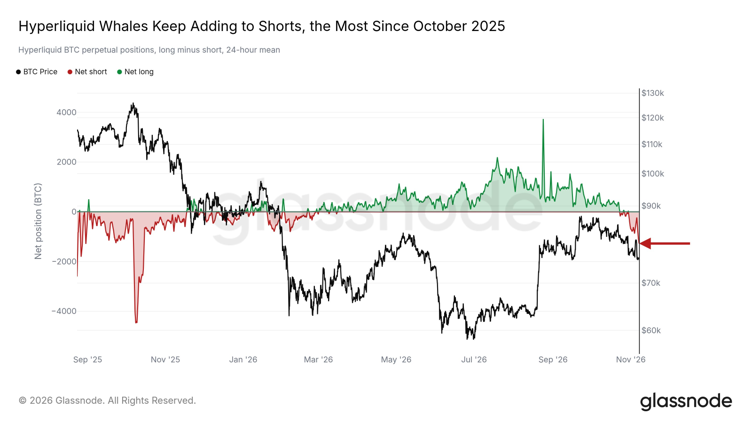
The last time Hyperliquid whales held a short position this large was October 2025.
$BTC ended that month around $109.5K before dropping to $84.7K by November 22. That was a 23% decline in roughly three weeks.
If Bitcoin repeats that move from the $75.7K level where the position flip was identified, the downside target would sit around $58.3K.
Interestingly, that level is almost identical to the June 30 low of $58.6K. A similar decline would therefore put Bitcoin back near its 2026 bottom.
Following the same timeline, such a move could unfold in early December.
Spot Bitcoin ETFs are adding pressure. They recorded $1.28B in outflows during the week ending November 6, while total assets fell from $109.3B to $95.9B between October 21 and November 6.
Base case: #BTC revisits the $58K–$60K range by early December if selling pressure continues.
Invalidation: A weekly close above $80K would weaken this bearish setup.
However, historical similarities are not guarantees. ETF flows, liquidity and derivatives positioning will determine whether this scenario develops or fails.
Bitmine’s growing $ETH treasury strengthens its position as a major institutional Ethereum holder, with 4.97% of the supply and over 5.2 million ETH staked.
Staking could generate substantial recurring income. If Ethereum adoption and prices rise, Bitmine stands to benefit. However, concentration risk, ETH price volatility, and staking liquidity remain significant challenges.
Key Economic Events This Week:
Tuesday - October CPI inflation data.
Wednesday - OPEC Monthly Report
Thursday - Initial Jobless Claims and October Existing Home Sales data.
Friday - October PPI inflation data
Plus a total of 17 Fed speaker events this week.
Strategy’s latest purchase reinforces its commitment to $BTC as a long-term treasury asset. With 850,364 BTC, it strengthens its position as the largest corporate Bitcoin holder. However, continued accumulation through stock sales can dilute shareholders.
If Bitcoin rebounds, Strategy could benefit significantly; prolonged weakness could increase financial pressure and investor risk.
Why Did Crypto Fall in October? Three Reasons Behind the Drop
Yesterday we looked at how bad October was for crypto $BTC. Today, let's talk about why, based on the same CryptoRank recap
According to the report, it wasn't one shock but three pressures stacking up:
1. Macro got tighter
Inflation came in higher than expected, Treasury yields and the dollar stayed strong, and on October 28 the Fed kept rates at 3.75-4%, with two policymakers even voting for a hike.
2. Institutions stepped back
After strong inflows in August ($3.52B) and September ($2.65B), US spot $BTC ETFs saw about $514M in outflows in October.
Ethereum ETFs lost around $1.61B.
Combined outflows reached $2.12B.
3. The Binance hack hit at the worst moment
On October 29, the $6.3B breach triggered about $1.5B in liquidations within 24 hours, and almost 84% of them were longs. BTC dropped to a six-week low.
By the end of the month, the Fear & Greed Index fell to 30, back in fear territory
Altcoins have lost approximately $200 billion in market value, with 70% of Binance-listed altcoins trading below their 200-day moving average, according to CryptoQuant.
OpenAI reportedly planned to raise $30 billion or more at a $1.4 trillion valuation. It has now closed a first $11 billion tranche at $1.25 trillion, with the round possibly growing to $20 billion. That's still about 47% above the $852 billion valuation from March, so this is both a haircut and a step up.
The cause is the mood in public markets. Sentiment around AI has cooled over the past month on worries about infrastructure spending and possible new hurdles for data-center construction after the US midterms. OpenAI also postponed its IPO plans.
Private markets reprice slowly and quietly, with negotiated terms instead of red screens. When a company that usually leads the pack of AI fundraisers trims both size and price, it tells you appetite has shifted before the numbers look dramatic.
The crypto link is direct. Bitcoin dropped on Nov 5 as AI stocks sold off, with over $1.1B in longs liquidated. Crypto has been trading as high-beta tech, so cooler AI sentiment can travel through the same risk channel.
The risk is that slower AI funding means slower infrastructure spending, which could weigh on the broader growth trade, crypto included. The bullish possibility is that the round closed anyway, still well above March pricing, so demand hasn't vanished.
A valuation is a conversation until the money lands. This one just got more honest.
$BNB Chain is reminding users about its Red Alarm tool, which helps detect potentially dangerous crypto apps and smart contracts.
The tool allows users to check projects and contract addresses for warning signs linked to scams, phishing attempts, suspicious activity, and possible rug pulls before interacting with them.
For anyone using DeFi and Web3 applications, checking a contract before approving transactions or sending funds is an important security step.
Red Alarm provides an additional layer of information to help users make safer decisions and avoid known risks.
However, a clean scan does not guarantee that a project is completely safe, so doing personal research remains important.
Major Exchange Plans MiCA Stablecoin Conversions. What Happens to Your USDT?
Imagine holding a stablecoin worth $1, only to discover your exchange plans to convert it into another token because of European regulations. That's the reality facing some crypto users under the EU's Markets in Crypto-Assets Regulation (MiCA).
Coinbase has given European Economic Area (EEA) customers until October 30, 2026, to withdraw 14 affected stablecoins, including $USDT, PYUSD, DAI, and USD1. Remaining eligible balances will be automatically converted, primarily into $USDC, at the prevailing market rate.
Why is this happening? MiCA requires stablecoin issuers to meet specific authorisation, reserve, redemption, and disclosure requirements. Exchanges operating under the framework must restrict services involving tokens that do not meet the applicable rules.
The technical impact goes beyond a simple token swap.
Stablecoin conversions can change exchange liquidity, trading-pair availability, and demand distribution between issuers. USDC could benefit from increased usage on compliant platforms, while affected tokens may lose access to parts of Europe's regulated trading infrastructure.
However, conversion does not guarantee that every token holder benefits equally. Execution prices, fees, tax implications, and withdrawal conditions matter.
For traders, the immediate priority is checking exchange notices and understanding which assets are affected.
Polymarket US has launched 5-minute Up/Down markets for $BTC, ETH, SOL and $XRP, giving users a new way to trade short-term price direction.
Each contract asks whether an asset will finish the five-minute window higher or lower than its starting price, with settlement based on an averaged price feed.
Five-minute markets bring a much faster trading window, where short-term volatility, liquidity, and price movements can determine the outcome within minutes.
Ark Invest Buys $5.2M in Circle While Selling $15.9M in Bitcoin ETF
Cathie Wood's Ark Invest is making an interesting move in crypto markets. As $BTC faces selling pressure, the firm has bought $5.2M in Circle shares while cutting $15.9M from its Bitcoin ETF position!
Key takeaways for crypto investors:
• $5.2M invested in Circle, the company behind the USDC stablecoin.
• $15.9M sold from a Bitcoin ETF, reducing direct exposure to Bitcoin's price.
• The move shifts part of Ark's crypto exposure toward stablecoin infrastructure.
Ark isn't leaving crypto; it's adjusting where its money is invested.
Uptober is not happening this year.
Bitcoin is down around 4% in October, putting $BTC on track for a second consecutive red October after October 2025 also ended lower.
That is notable because October has historically been one of Bitcoin's strongest months, with positive returns in about 75% of years since 2014.
Now attention shifts to November. Historical data gives November a stronger seasonal record, but the current market still needs fresh demand and momentum for that pattern to matter.
A recovery could bring Bitcoin back into focus, while continued selling would keep downside risk on the table. November could give a clearer signal on where BTC heads next.
Google Is Building Crypto Security for Banks. Why Now?
76% of $BTC crypto losses from hacks in H1 2026 came from infrastructure and operational compromises, including stolen private keys and seed phrases. Now Google is preparing a dedicated system for exactly this problem.
Google Multi-Party Compute (MPC) splits control of a wallet key across several separate environments. For example, one part could stay with Google Cloud, another on a bank's own hardware, and another with a different cloud provider.
Before a transaction is signed, institutions can also set rules around:
- transaction limits
- approved destination wallets
- how many people or systems must approve a transfer
The full private key is never stored in one place, so compromising one machine shouldn't be enough to move the assets.
Alphabet is already using the technology to secure its own assets on $ETH and Solana, while a commercial launch is planned for early 2027.
Google also says the architecture could later support post-quantum cryptography, although today it is focused on much more immediate problems: stolen credentials & unauthorized transactions.
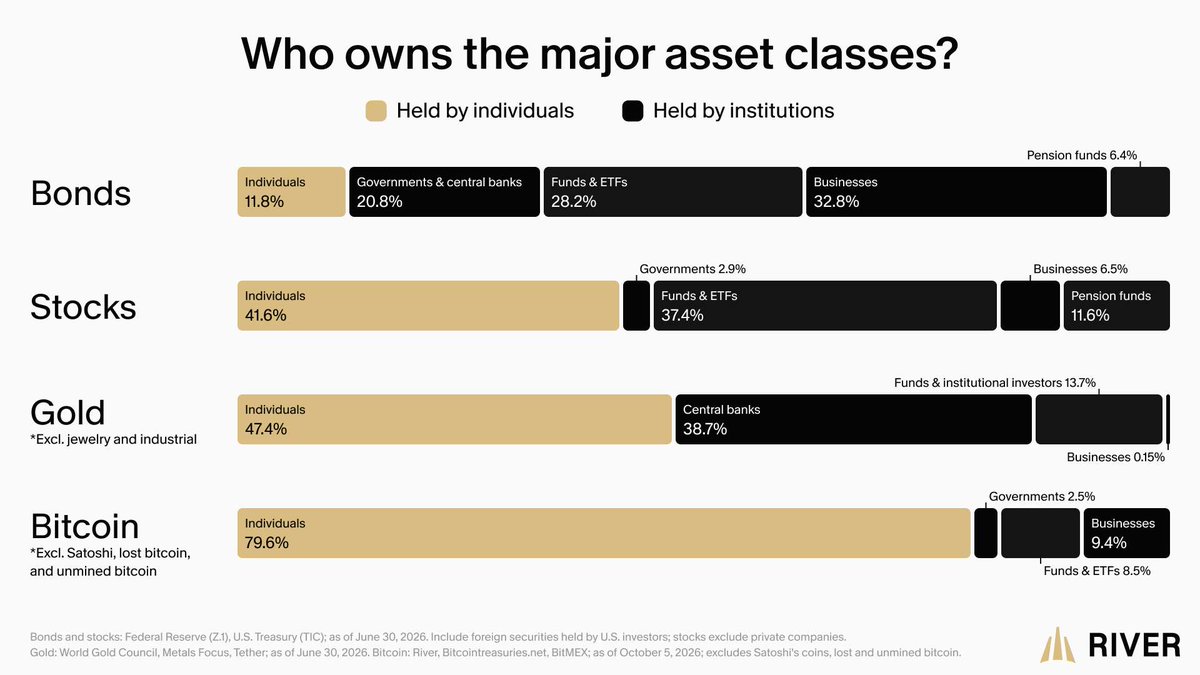
Bitcoin remains one of the few major assets still dominated by individual holders, but institutional ownership is expected to grow as the market matures, according to River.
More institutional capital could bring deeper liquidity, but also greater concentration of ownership.