Today we’re introducing Deck Feedback Widgets
A React & Node-based SDK that enables your team to collect customer feedback on all new features you ship.
→ Create a feedback widget in the UI, MCP, or API
→ Add the "deck-io/feedback" NPM package to your new feature
→ Collect feedback from your customers and send them back into Deck
Create as many as you want, link each to a project, and iterate faster and better than never before.
It is so effortless to build great customer-centric product.
I don’t want to build everything. All I want to build is @deck_io.
Any other product I use, I just want it to work.
I don’t care about one shotting. I only care about how much any new model can help me build and power my product.
Stop wanting to build everything from scratch.
Today we’re introducing Deck Feedback Widgets
A React & Node-based SDK that enables your team to collect customer feedback on all new features you ship.
→ Create a feedback widget in the UI, MCP, or API
→ Add the "deck-io/feedback" NPM package to your new feature
→ Collect feedback from your customers and send them back into Deck
Create as many as you want, link each to a project, and iterate faster and better than never before.
It is so effortless to build great customer-centric product.
To install, you’ll need a publishable key and the deck-io/feedback package.
→ Add the DeckProvider to your root,
→ Pass in the publishable key, then create your feedback widget
→ Use the package’s hooks (or server functions) to send feedback to Deck.
Docs are available at https://t.co/IAGRxS6mqF
Here's everything we shipped over the past week at @deck_io 👇
→ Foundations for a new feature (this is massive)
→ Expanded Deck API (all of Deck's functionality can now be found in the API)
→ Priority Theme Views (you can now fast-filter themes to get to the feedback you want to see faster)
→ Speed improvements
Theme Views 👇
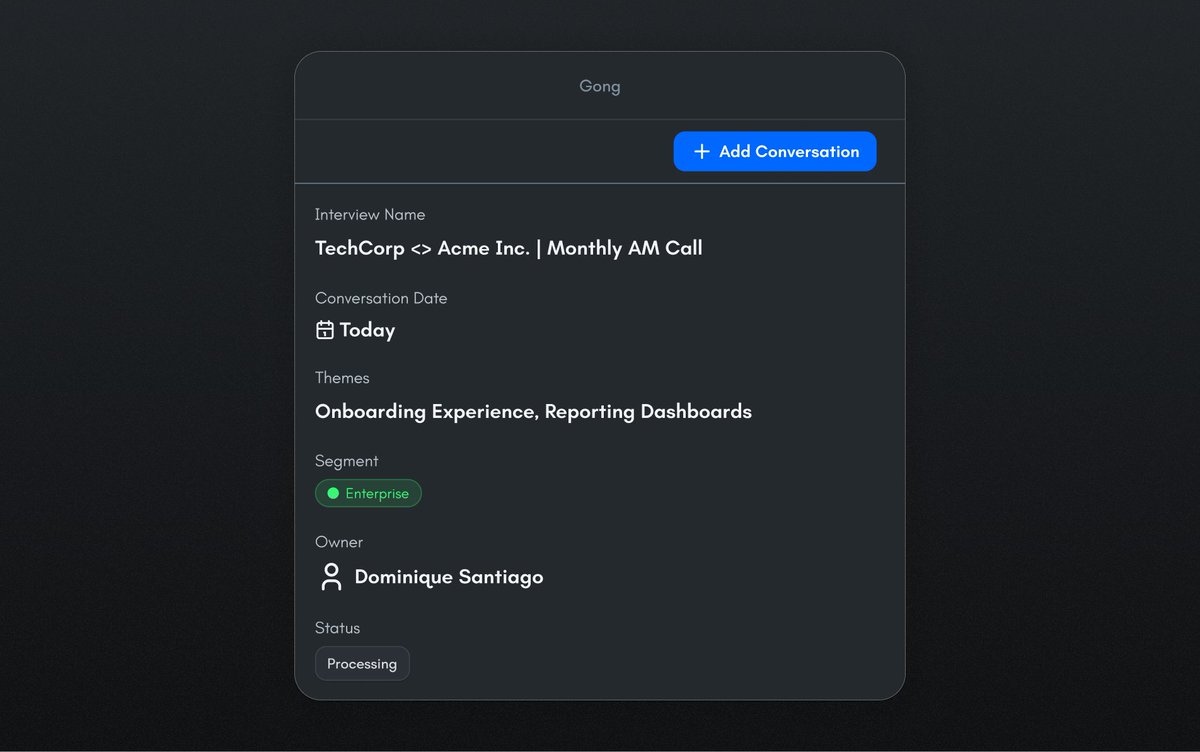
Import specific calls manually, or turn on daily Auto Sync for the calls that match your saved filters: owners, workspaces, folders, scope, and duration.
Sales calls are full of product signal. They are also one of the easiest places for product teams to lose the thread.
If teams don’t have access to them, they need to rely on sales teams’ views on what the customer wants.
Deck now connects to Gong so those conversations can become product evidence.
More in 🧵
Today we are introducing a Linear integration for Deck Projects.
Before, your customer feedback would be scattered everywhere. By the time you got to creating the Epic in Linear, it’d be hard to even know the value you’re adding to the customer.
Customer evidence would get lost easily.
Now customer-backed product work in Deck can connect to the execution tools your team already uses.
→ Import Linear Projects into Deck to see all fields like owner and dates sync automatically
→ Create Projects from Deck with description as customer evidence
Your roadmap should not lose customer context the moment work moves into execution.
Deck Projects now help connect the evidence behind the decision to the place where the team ships it.
Today we are introducing a Linear integration for Deck Projects.
Before, your customer feedback would be scattered everywhere. By the time you got to creating the Epic in Linear, it’d be hard to even know the value you’re adding to the customer.
Customer evidence would get lost easily.
Now customer-backed product work in Deck can connect to the execution tools your team already uses.
→ Import Linear Projects into Deck to see all fields like owner and dates sync automatically
→ Create Projects from Deck with description as customer evidence
Your roadmap should not lose customer context the moment work moves into execution.
Deck Projects now help connect the evidence behind the decision to the place where the team ships it.