Become a Claude Certified Architect
Here is the complete resource list in one place:
Link to join: https://t.co/OXQyTmfCmb
Training courses: https://t.co/UaJzLeXKrP (13 free courses)
Cookbook: https://t.co/SLnSUT7xT1
Exam Guide: https://t.co/A2pbDcyGwa
Practice questions: https://t.co/90eXwUxiXQ (free)
MCP documentation: https://t.co/SbwZI0fjVz (free)
API documentation: https://t.co/9rmnLWypxc (free)
Partner Network: https://t.co/diT5OE6ePJ (free to join)
Personal Playbook someone created after the exam: https://t.co/qhXan3XVri
BREAKING: MIT just mass released their Al library for free. (Links included)
I went through these and honestly... this is better than most paid courses I've seen.
Here's the full list of books:
Foundations
1. Foundations of Machine Learning Core algorithms explained. Theory meets practice.
2. Understanding Deep Learning Neural networks demystified. Visual explanations included.
3. Machine Learning Systems Production-ready architecture. System design principles.
Advanced Techniques
4. Algorithms for ML Computational thinking simplified. Decision-making frameworks.
5. Deep Learning The definitive textbook. Covers everything deeply.
Reinforcement Learning
6. RL Basics (Sutton & Barto) The classic. Agent training fundamentals.
7. Distributional RL Beyond expected rewards. Advanced theory.
8. Multi-Agent Systems Agents working together. Coordination and competition.
9. Long Game Al Strategic agent design. Future-focused thinking.
Ethics & Probability
10. Fairness in ML Bias detection. Responsible Al practices.
11. Probabilistic ML (Part 1 & 2)
Links: https://t.co/AhDqm9x1QC
Most people pay thousands for bootcamps that teach half of this.
Bookmark it. Start anywhere. Just start.
Repost for others Follow for more insights on Al Agents.
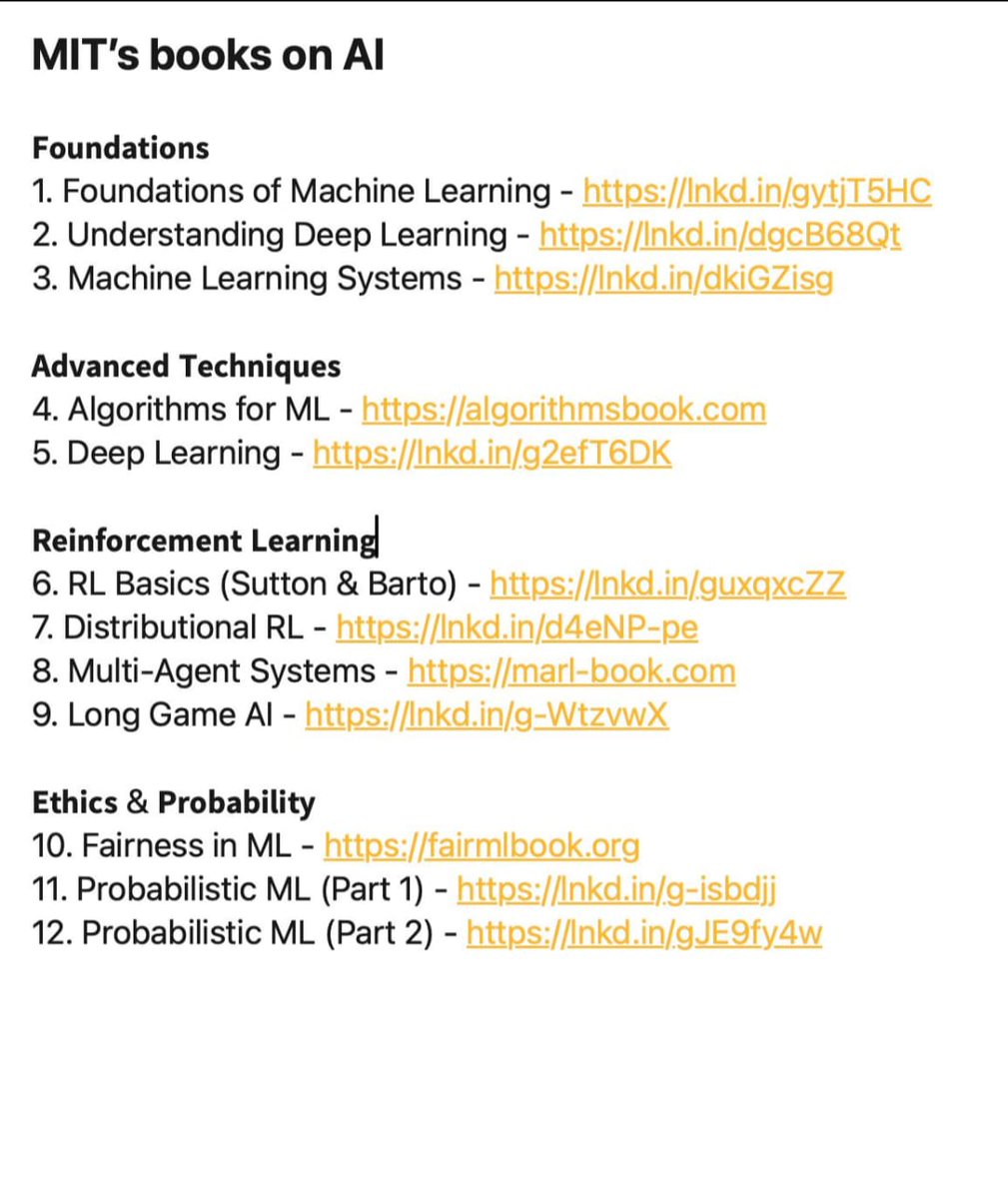
MIT's books on Al
Foundations
1. Foundations of Machine Learning - https://t.co/HxbXfsDIl6
2. Understanding Deep Learning - https://t.co/AyeQav2yzN
3. Machine Learning Systems - https://t.co/0AxGtjBFwA
Advanced Techniques
4. Algorithms for ML - https://t.co/LOjFeK1hut
5. Deep Learning - https://t.co/Ztmu7X6gNM
Reinforcement Learning
6. RL Basics (Sutton & Barto) - https://t.co/HAWxL28df1
7. Distributional RL - https://t.co/VB1zBuSzag
8. Multi-Agent Systems - https://t.co/3tWqJaimYn
9. Long Game Al - https://t.co/vYDuy1XKT2
Ethics & Probability
10. Fairness in ML - https://t.co/B4lAj2ivpF
11. Probabilistic ML (Part 1) - https://t.co/folJrX24sf
12. Probabilistic ML (Part 2) - https://t.co/BMOjc8qSqZ
🧬 AlphaGenome from @GoogleDeepMind - A new breakthrough AI model that reads life’s code.
Can accelerate rare disease diagnosis time efficiency massively.
The tool focuses on interpreting how variations in DNA influence gene regulation, a critical factor behind many inherited diseases and cancers.
AlphaGenome, can read 1mn DNA letters at once and still notice a single-letter change.
This is a BIG deal because many health problems come from tiny DNA edits that sit far away from the genes they influence, and older tools often missed these long-range effects.
While earlier models either analysed long DNA sequences or provided highly detailed predictions, AlphaGenome achieves both. It can analyse up to one megabase (1 Mb) of DNA at a time while delivering predictions down to a single DNA letter across thousands of biological signals.
Today, researchers sift through millions of DNA differences to find the handful that matter. With this model, they can score changes in minutes, then spend lab time on the most promising ones.
That can accelerate rare disease diagnosis by spotlighting harmful changes outside genes, sharpen cancer studies by explaining how hidden switches turn genes on, and help drug discovery by linking DNA changes to gene activity in the right tissues.
The team released research code and weights for non-commercial use, plus a hosted API, so hospitals and labs can try it in studies.
Excited to introduce 🎬ActionMesh, a fast model transforming any video → high-quality animated 3D mesh !
Generate animated mesh seamlessly importable into any 3D software in less than a minute.
🤗Try it out: https://t.co/8MgbtO83j8
🌐Project Page: https://t.co/VRIceKBUUU
📄Paper: https://t.co/hmkpiLDJWa
💻Code: https://t.co/FZvDhiqSig
#Video4D #GenAI #3DGeneration
@Meta@RealityLabs@AIatMeta@ucl
Terence Tao says the math behind today’s LLMs is actually simple. Training and running them mostly uses linear algebra, matrix multiplication, and a bit of calculus, material an undergraduate can handle. We understand how to build and operate these models.
The real mystery is why they work so well on some tasks and fail on others, and why we cannot predict that in advance. We lack good rules for forecasting performance across tasks, so progress is largely empirical.
A key reason is the nature of real-world data. Pure noise is well understood, perfectly structured data is well understood, but natural text sits in between, partly structured and partly random. Mathematics for that middle regime is thin, similar to how physics struggles at meso-scales between atoms and continua.
Because of this gap, we can describe the mechanisms but cannot yet explain capability jumps or give reliable task-level predictions. That mismatch, simple machinery versus hard-to-predict behavior, is the core puzzle.
----
Video from 'Dr Brian Keating' YT Channel (Link in comment)
✨We are excited to open-source Tencent HY-Motion 1.0, a billion-parameter text-to-motion model built on the Diffusion Transformer (DiT) architecture and flow matching. Tencent HY-Motion 1.0 empowers developers and individual creators alike by transforming natural language into high-fidelity, fluid, and diverse 3D character animations, delivering exceptional instruction-following capabilities across a broad range of categories. The generated 3D animation assets can be seamlessly integrated into typical 3D animation pipelines.🎮🎥
Highlights:
🔹Billion-Scale DiT: Successfully scaled flow-matching DiT to 1B+ parameters, setting a new ceiling for instruction-following capability and generated motion quality.
🔹Full-Stage Training Strategy: The industry’s first motion generation model featuring a complete Pre-training → SFT → RL loop to optimize physical plausibility and semantic accuracy.
🔹Comprehensive Category Coverage: Features 200+ motion categories across 6 major classes—the most comprehensive in the industry, curated via a meticulous data pipeline.
🌐Project Page: https://t.co/IIGGQj25Pg
🔗Github: https://t.co/L4642SrQoW
🤗Hugging Face: https://t.co/Gmgv0O0CKl
📄Technical report: https://t.co/nq0nSgeR6I
Meta dropped not just SAM-3 yesterday but also SAM-3D (for objects and humans)🤯
SAM 3D Body is a promptable model for recovering full-body 3D human meshes from a single image.
Seems to be the new SOTA
Apple JUST quietly announced something that’s a lot BIGGER than it looks: "the Mini Apps Partner Program"
Apple is admitting that the future of software is embedded, lightweight, vertical mini-apps distributed inside bigger app
For founders who want to make $$ building apps:
1. Apple just legitimized the “superapp” model for the West.
China has WeChat mini-programs. India has PhonePe Switch. The West has… nothing. Apple just opened the door. You can now run HTML/JS mini-apps inside a native host and earn 85% on qualifying purchases. That’s Apple-sanctioned platform piggybacking.
2. Distribution arbitrage becomes real again.
You don’t need to convince users to download your app. Just partner with a host app and drop in a mini-app. This is a cheat code for early traction. Think: travel apps hosting niche tools, fitness apps hosting mini workouts, marketplaces hosting micro-utilities.
3. Apple is creating a new economy layer: “embedded SaaS.”
Imagine: CRM mini-apps inside vertical tools. Math solver mini-apps inside education apps. Calendar mini-apps inside productivity apps. The TAM for tools that don’t need standalone installs just went vertical.
4. Developers get an 85% revenue share.
This is Apple basically saying: “We want this ecosystem to grow, and we’re willing to cut our take rate.” When Apple lowers its cut, I pay attention because they see a platform shift coming.
5. AI makes this 10× more important.
LLM-powered micro-apps (calculators, planners, agents, coaches, niche utilities) are tiny by design. They’re perfect mini-apps. Apple just created infrastructure for AI-native micro utilities to live inside bigger apps with built-in commerce.
6. Host apps become new “distribution landlords.”
If you own an app with traffic, you become a platform. You can host mini-apps, take a cut, and build a developer ecosystem around you.
It’s a new monetization model for existing apps with audiences.
7. This unlocks a wave of second-order opportunities.
- Agencies helping apps become mini-app hosts
- Mini-app dev shops
- “Shopify for mini-apps” toolkits
- Mini-app marketplaces
- Analytics for mini-app performance
- Discovery engines for mini-apps
- I'll be dropping mini app ideas on @ideabrowser and @startupideaspod
TLDR;
Apple just turned every high-traffic app into a potential superapp and every indie developer into a potential platform partner.
The App Store is becoming modular, composable, and layered. The next decade of consumer apps will look less like standalone products and more like ecosystems stitched together with mini-apps.
This is quietly one of the biggest distribution unlocks in years.
Introducing Higgsfield Angles.
Change the camera angle of your photo with a single click. See perspectives you didn't capture!
8h only: follow & retweet & reply - 204 credits hit your DM.