I still remember how much we dreaded “curation” during the first year of my PhD. It felt tedious, time-consuming, and honestly... boring.
We’d always try to put it off for later.😆
✨ Throwback Thursday Alert! ✨🔙
Throwback to a molecular detective story🔬: How a little-known enzyme, DTD, helped decode how cells proofread protein-building blocks and influenced the course of evolution.
Read the article here: https://t.co/k84s11tlME
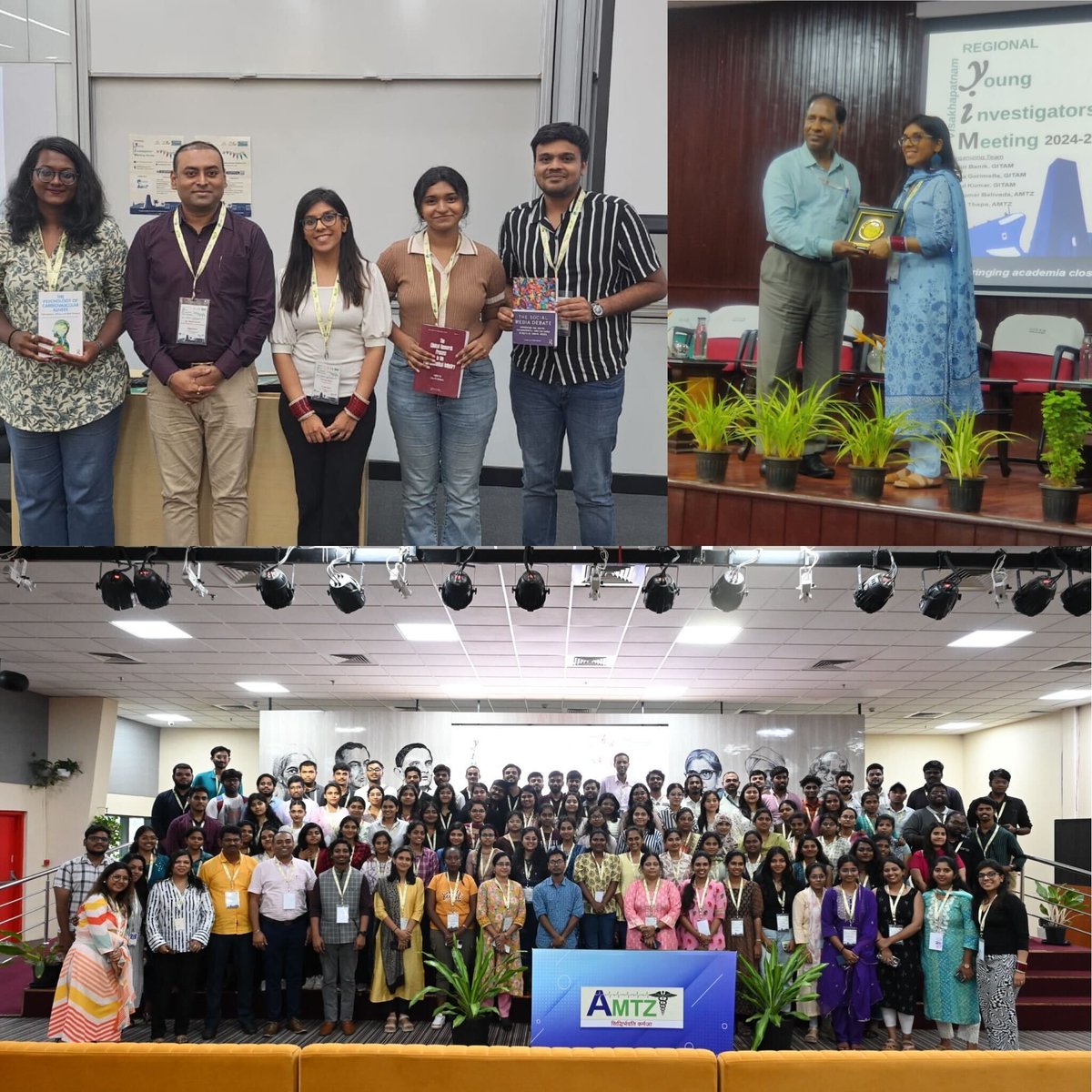
We recently wrapped up our 1st Regional Young Investigators’ Meeting (RYIM) 2024 – 2025, this time in #Visakhapatnam! 🇮🇳
With a focus on academia-industry collaboration in medical technology, #RYIMVisakhapatnam was held at @GITAMUniversity & @AP_MedTechZone on 18-20 September 2024
Ep 03 of our Podcast Inception Series features Srushti Chipde @TDN_updates
Srushti takes us on a fascinating journey, sharing her passion for science with @Arushi_Batra28 and the inspiring story behind the creation of the Purple Science Podcast. 💜
👉 https://t.co/0ARQVdzVGE
This clip went around the world last week. A Chimpanzee in Cameroon, Africa apparently asked for a photographers’s help in drinking water; then repaid him by washing his hands gently… A useful applied lesson: If you want to succeed, then assist & support those in your community & workplace & you will, in turn, be supported by them… #MondayMotivation
If you are interested in learning Advanced Fluorescence Microscopy and Image Processing, please register for this course.
#fluorescence#microscopy#course
https://t.co/PceDiJnU7a
https://t.co/0NcPnK5A74
A short summary about how to help your PhD students grow into greater leaders in the future.
These are key points that I personally find most important:
1. Inspire them to lead their project. They should take ownership of their work.
2. Discourage them from seeing failures as disasters. Explain that experiencing failures is a must for personal development and learning.
3. Discourage excessive perfectionism. Teach them how to be efficient.
4. Inspire students to become a better version of their advisor. Not a copy.
5. Strongly encourage them to give as many talks as possible, at seminars, conferences and any local events. Well-developed communication skills are paramount for their future.
6. Let them lead the collaborations that you initially organized for their project. If there’s none, consider introducing collaborations into their projects.
7. Discuss advanced academic stuff openly (grants, budgets, tenure, etc). Help them understand how academic world works. If needed, organize special group meetings to discuss a career in academia and beyond.
8. Train them how to see the “big picture” (instead of always focusing on details of their work).
9. Diversify their skills and knowledge by giving access to more facilities and connecting with experts.
10. Emphasize the importance of programming (e.g. Python) for data processing and analysis. It can significantly broaden their career opportunities.
11. Urge them to attend conferences and workshops regularly (1-3 per year). Help them develop networking skills.
12. Encourage them to ask questions at talks and initiate discussions with speakers whenever possible.
13. Ask for feedback on your approaches and overall environment. Your students will become greater leaders if they know that getting such feedback is normal and helpful.
14. Ensure that students listen to each other. They should feel comfortable asking each other for help and advice. They should not get used to solving problems solely on their own.
15. Force them to prioritize lab safety over anything else.
16. Ensure their project does not require overworking. If they prefer to spend their free time on science, it’s fine. But it shouldn’t be necessary. If their project is too complex and time-consuming, help them make new collaborations that will facilitate the progress without sacrificing personal time.
17. Finally, don’t make them feel uncomfortable about having their personal lives. Let them manage their work time themselves! When to come and leave the lab, when to take vacation and how long it should be. Trust their judgement.
There are many more components of a successful and meaningful PhD. But even if PI start following these simple guidelines, it will make a huge difference for academia.
(If you’ve “scored” > 10 out of 17, this is amazing! Most likely, your students are happy with the way things go and are grateful for your efforts.)
#AcademicTwitter #education #phdlife
Excited to share our work on PARP1 protein regulation by single-strand DNA. Understanding the regulation of such a ubiquitous protein opens the door to fine-tuning its functions. @ErASuman@BTIITH@IITHyderabad@FEBSJournal
https://t.co/nVO3dGtA4b