The Infosys Prize 2026 in Physical Sciences is awarded to Prof. Manoj Kumar Joshi, Assistant Professor of Quantum Technology at the Singapore University of Technology and Design.
His research focuses on quantum simulation using trapped ions. He has helped develop programmable quantum simulators with more than 50 ions and contributed to experiments that study complex quantum systems, including the quantum Mpemba effect and entanglement in quantum systems.
@sutdsg
#infosysprize #infosyssciencefoundation #infosysprize2026 #physicalsciences #quantumphysics #quantumcomputing #quantumsimulation #scientificresearch
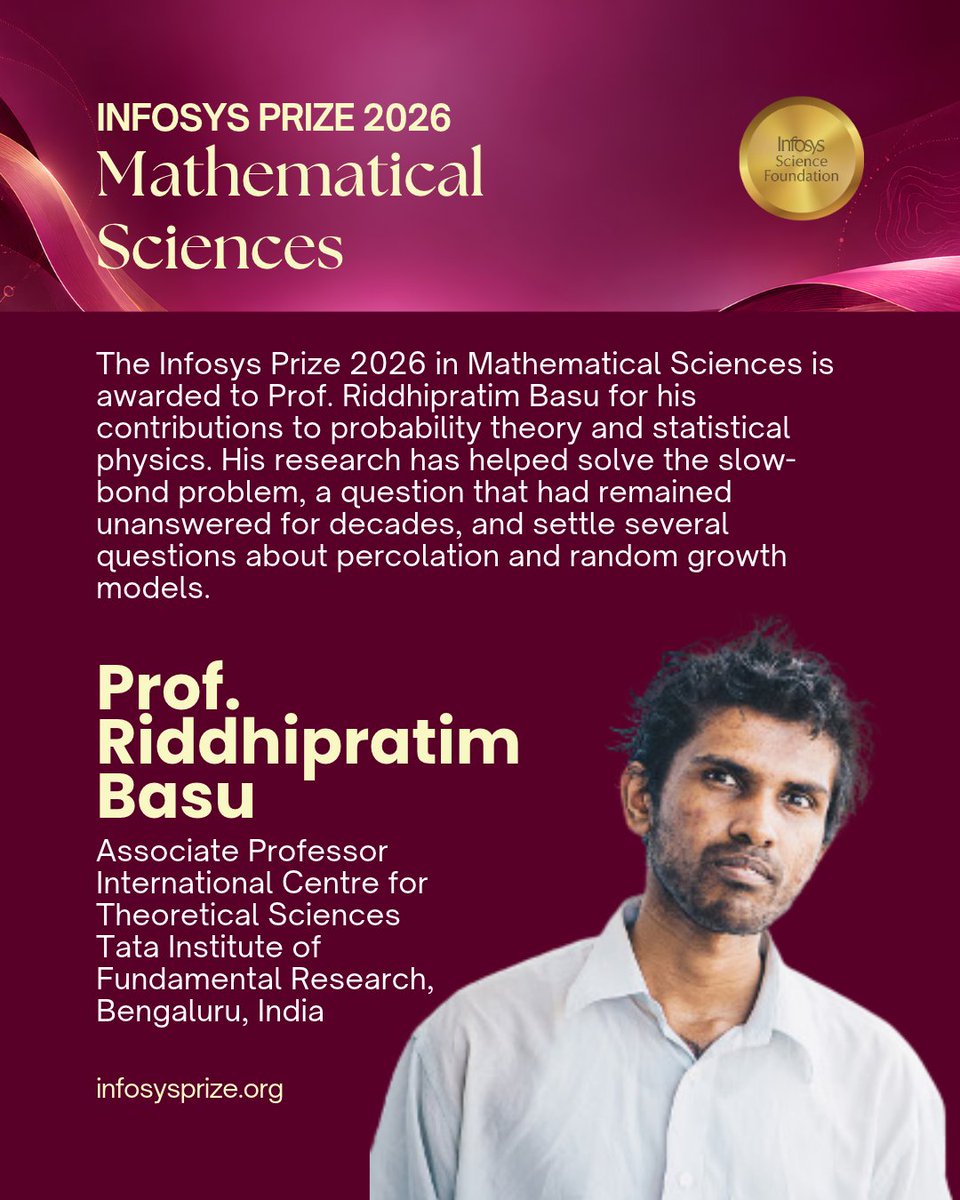
The Infosys Prize 2026 in Mathematical Sciences is awarded to Prof. Riddhipratim Basu, Associate Professor at the International Centre for Theoretical Sciences, Tata Institute of Fundamental Research, Bengaluru.
His work in probability theory and statistical physics includes solving the slow-bond problem, which looks at how even a small obstruction can affect the movement of particles. He has also made important contributions to the study of percolation and random growth.
@ictstifr@TIFRScience
#infosysprize #infosyssciencefoundation #infosysprize2026 #mathematicalsciences #probabilitytheory #statisticalphysics #mathematics #scientificresearch #tifr
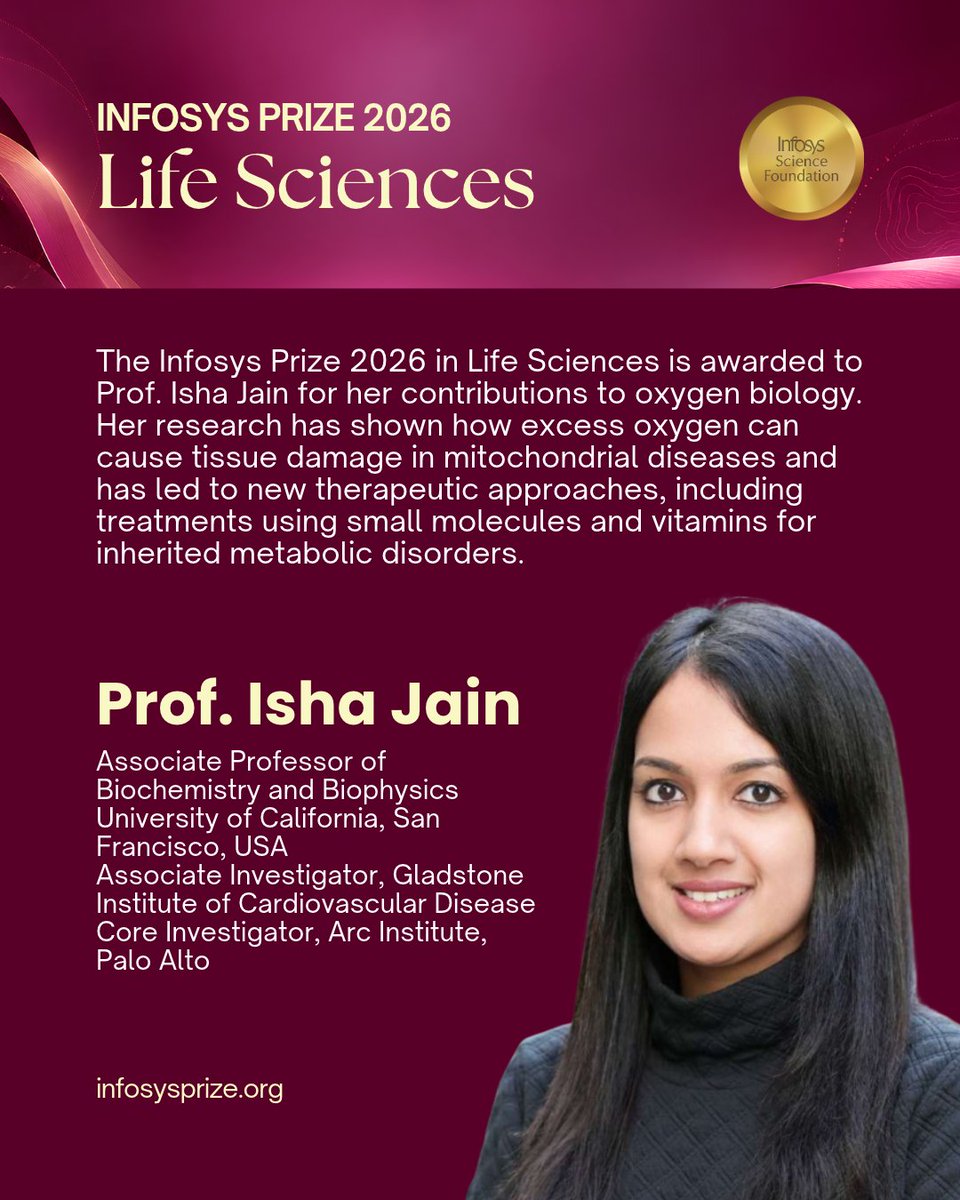
The Infosys Prize 2026 in Life Sciences is awarded to Prof. Isha Jain, Associate Professor of Biochemistry and Biophysics at the University of California, San Francisco.
Her research has shown that excess oxygen, rather than a lack of energy, can cause tissue damage in certain mitochondrial diseases. Her work has also led to potential treatments for inherited metabolic disorders, including vitamin-based therapies.
@ishahjain@UCSF@arcinstitute
#infosysprize #infosyssciencefoundation #infosysprize2026 #lifesciences #oxygenbiology #mitochondrialdisease #biomedicalresearch #scientificresearch #healthandmedicine
The Infosys Prize 2026 in Humanities and Social Sciences is awarded to Prof. Gautam Bhatia, Adjunct Professor at Jindal Global Law School, Delhi.
A legal scholar and author of five books, Prof. Bhatia has made significant contributions to the study of Indian constitutional law. His work draws on legal thought, political theory, and moral philosophy, with a focus on equality, fairness, and building a more humane society.
@gautambhatia88@JindalGLS
#infosysprize #infosyssciencefoundation #infosysprize2026 #humanities #socialsciences #constitutionallaw #legalresearch #indianconstitution #lawandsociety
The Infosys Prize 2026 in Engineering and Computer Science is awarded to Prof. Swarun Kumar, Sathaye Family Foundation Professor in the Department of Electrical and Computer Engineering at Carnegie Mellon University.
His research focuses on low-power wireless networks and their applications in connectivity, sensing, and actuation. His work has led to new ways of using wireless technology for contactless health monitoring, indoor positioning, and even powering and controlling soft robots.
@swarunk@CarnegieMellon
#infosysprize #infosyssciencefoundation #infosysprize2026 #engineering #computerscience #wirelesstechnology #wirelessnetworks #researchandinnovation #carnegiemellonuniversity
The Infosys Prize 2026 in Economics is awarded to Prof. Karthik A. Sastry, Associate Professor of Economics and Public Affairs at Princeton University.
His research focuses on how societies respond to climate change through technological innovation and public policies. He has also made important contributions to the study of economic fluctuations and contract design, adding to our understanding of how economies and markets work.
@Princeton
#infosysprize #infosyssciencefoundation #infosysprize2026 #economics #princetonuniversity #climatechange #economicresearch #technologicalinnovation
Two AI agents take cryo-EM data from raw images to refined atomic models while you enjoy some ☕️! Cool stuff this from @kiharalab😎.
Agentic cryo-EM structure determination with CryoPilot https://t.co/InCuC9flf3
A cryo-EM structure determined at our @ANRFIndia facility @IITKanpur uncovers that an FDA-approved oncology mega-blockbuster CDK4/6-inhibitor drug (abemaciclib/Verzenios®) by Eli Lilly also activates an atypical chemokine receptor, CXCR7!!!
Link: https://t.co/qmAhQpSrTI
Surprise, Surprise 🧐
We show that Verzenios (abemaciclib), a CDK4/6 inhibitor & FDA-approved breast cancer drug, activates CXCR7!
The FDA-approved CDK4/6 inhibitor Abemaciclib is a potent agonist of the β-arrestin-biased atypical chemokine receptor ACKR3 https://t.co/IVFgiVybh1
Researchers are optimistic about psychedelic drugs as potential treatments for depression and mood disorders, despite pushback having stalled the field
https://t.co/zpNnJTjA3i
Medicine laureate Linda Buck tells her students: “Pick a problem that you’re extremely interested in.”
Is there a challenge you’re trying to solve?
#NobelPrize