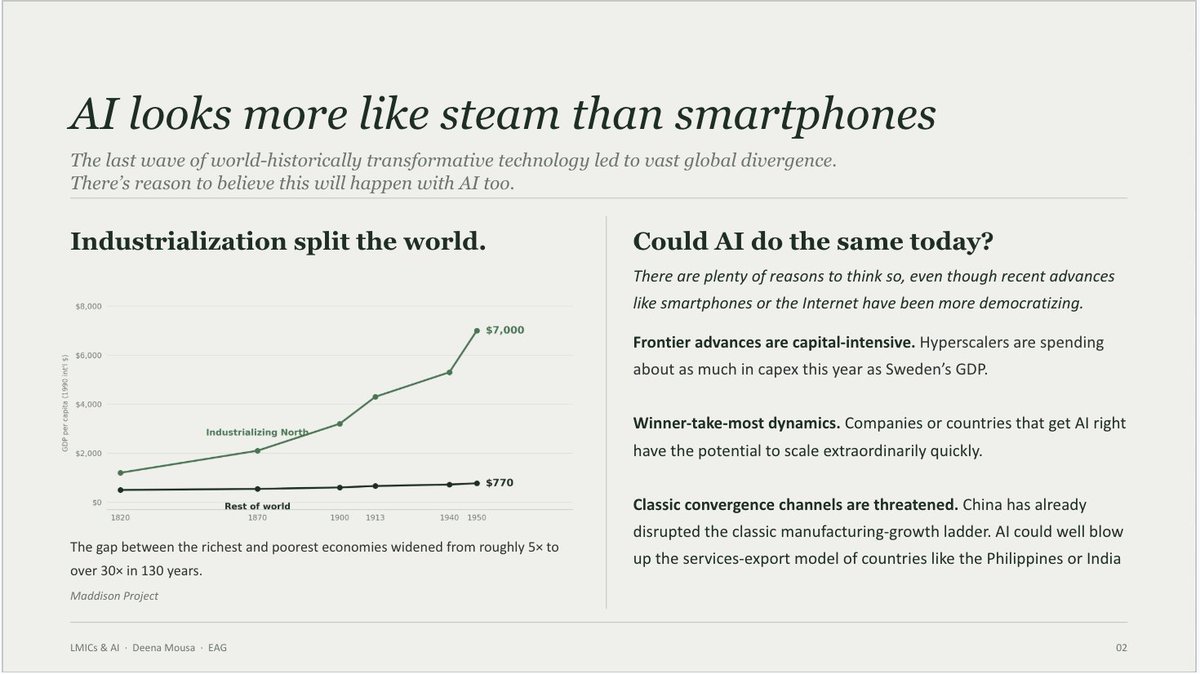
We've gotten used to technology being democratizing but, unfortunately, it seems unlikely AI will be a leapfrog miracle story.
New post out now on why -
On 1) I think the driver of the convergence is a little hard to pin down to the effects of the internet precisely. *A lot* of it was likely China's commodity demand, and some of the internet's second-order effects you mention were jobs enabled by the internet (like BPOs). For that same pattern to hold for AI, it would have to create a similar sort of job creation, which doesn't seem obviously likely to happen.
On 2) things could certainly get weird in a world of (true) AGI, but I think superintelligence makes this problem worse and not better for LMICs, given ownership of such a powerful technology in 1-2 countries.
We've gotten used to technology being democratizing but, unfortunately, it seems unlikely AI will be a leapfrog miracle story.
New post out now on why -
Looking forward to speaking at UN Behavioral Science week about how to adopt AI models across global contexts.
If you’d like to tune in, it’ll be streamed here! https://t.co/5h4bdXjwut
@UN_BeSci@UN_Innovation
Looking forward to speaking at UN Behavioral Science week about how to adopt AI models across global contexts.
If you’d like to tune in, it’ll be streamed here! https://t.co/5h4bdXjwut
@UN_BeSci@UN_Innovation
Roundup of my favorite May reading: India's IT revenue and employment decoupled for the first time in 2 decades, ChatGPT's obsession with goblins is actually very human, and in countries with fewer than 1 doctor/10,000 people, the AI-and-jobs debate looks a *little* different
Bigger question is whether the worrying actually helped prepare them for the 8% or just caused them to suffer twice (usually the latter which is closer to the actual reason anxiety is unhelpful)
In a study of people with generalized anxiety disorder, only 8.6% of recorded worries actually happened.
The most common outcome: 0%. Not a single worry came true.
Short term, universities will move to handwritten in-class exams, but soon that won't be enough. We'll need to put a stake in the ground re: what higher education is for.
To prepare you to complete economically-useful tasks, to teach you to think in a general sense? Neither?
@StefanFSchubert The potential economic effects are ambiguous enough, and have the potential to hit differently sectors enough, that this doesn’t feel satisfying. It’s important for policy to have some way of forming a belief about what the labor market and work will look like specifically.
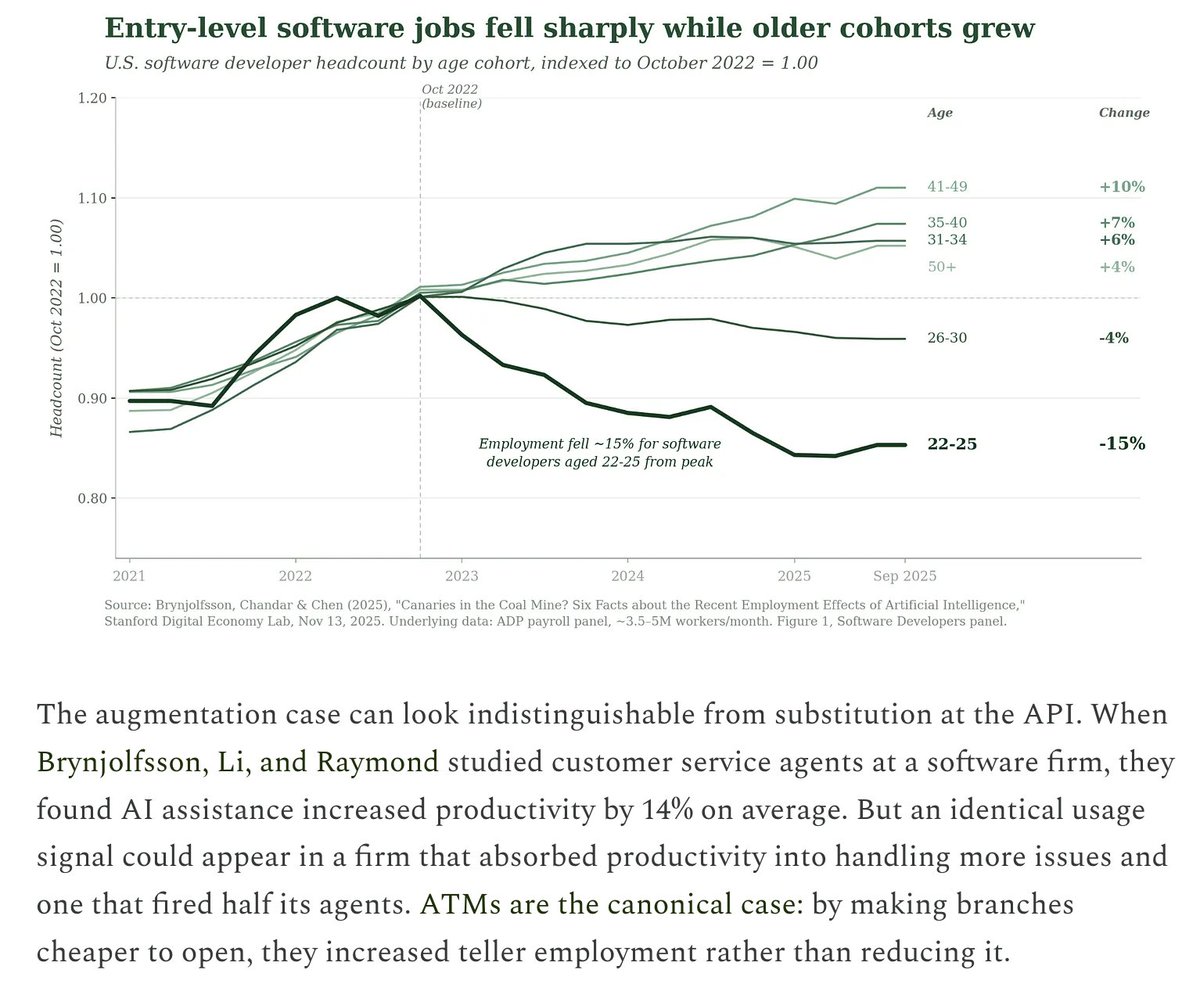
People are sharing stories about tech layoffs as evidence of "white collar bloodbath". But a bunch of stories doesn't tell us much.
What do the data say? 🧵