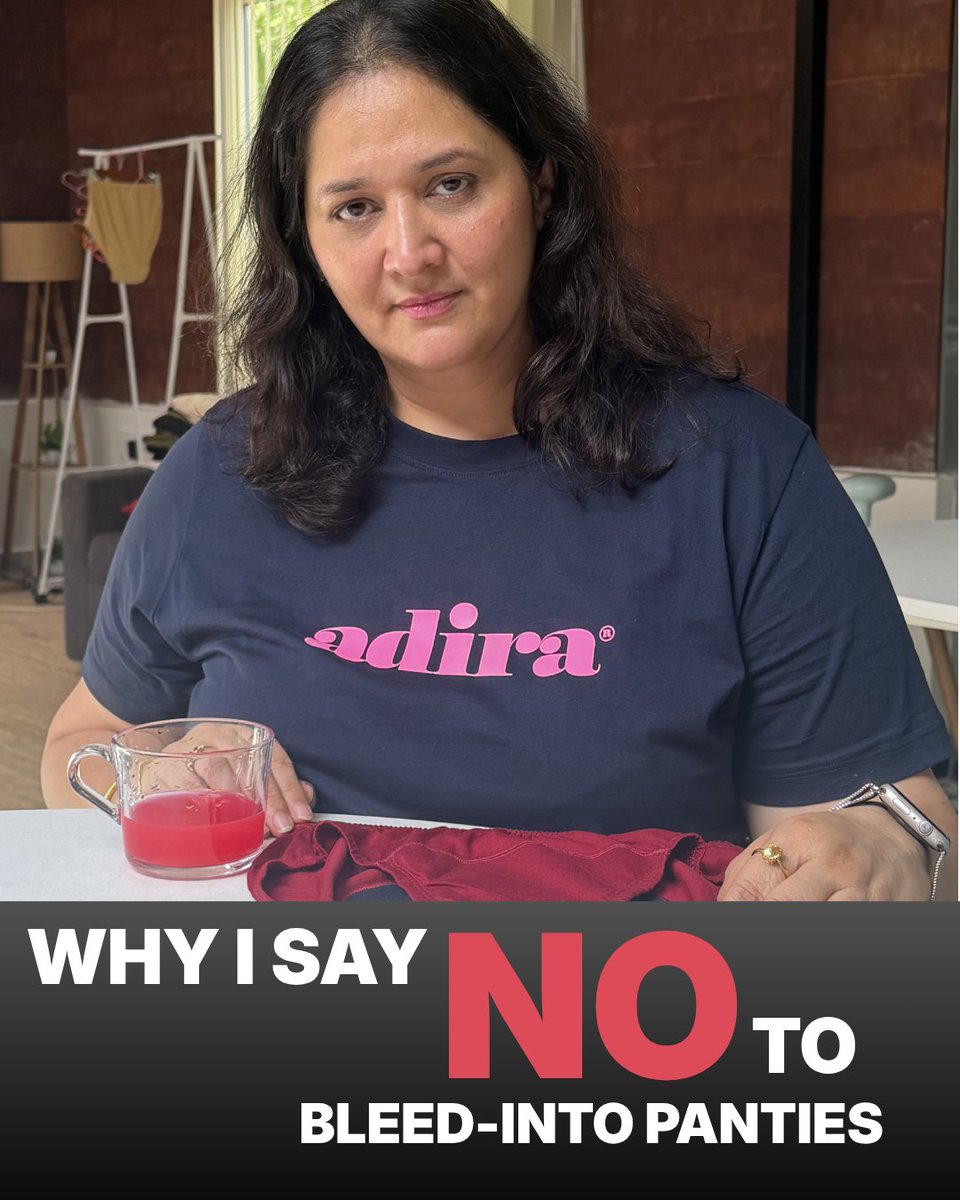
Bleed‑into panties promise “30–50 ml”, “8+ hours” and “freedom from pads”.
A human‑blood study found period underwear averaged ~2 ml.
Period blood raises vaginal pH and pooled fluid in warm fabric can favour infections, while standards still test with coloured water.
I invented India’s first period panty in 2009. I’m not joining the bleed‑into trend.
Women deserve science and hygiene, not pooled‑blood marketing.
#bleedintopanties #womenshealth #periodpanty
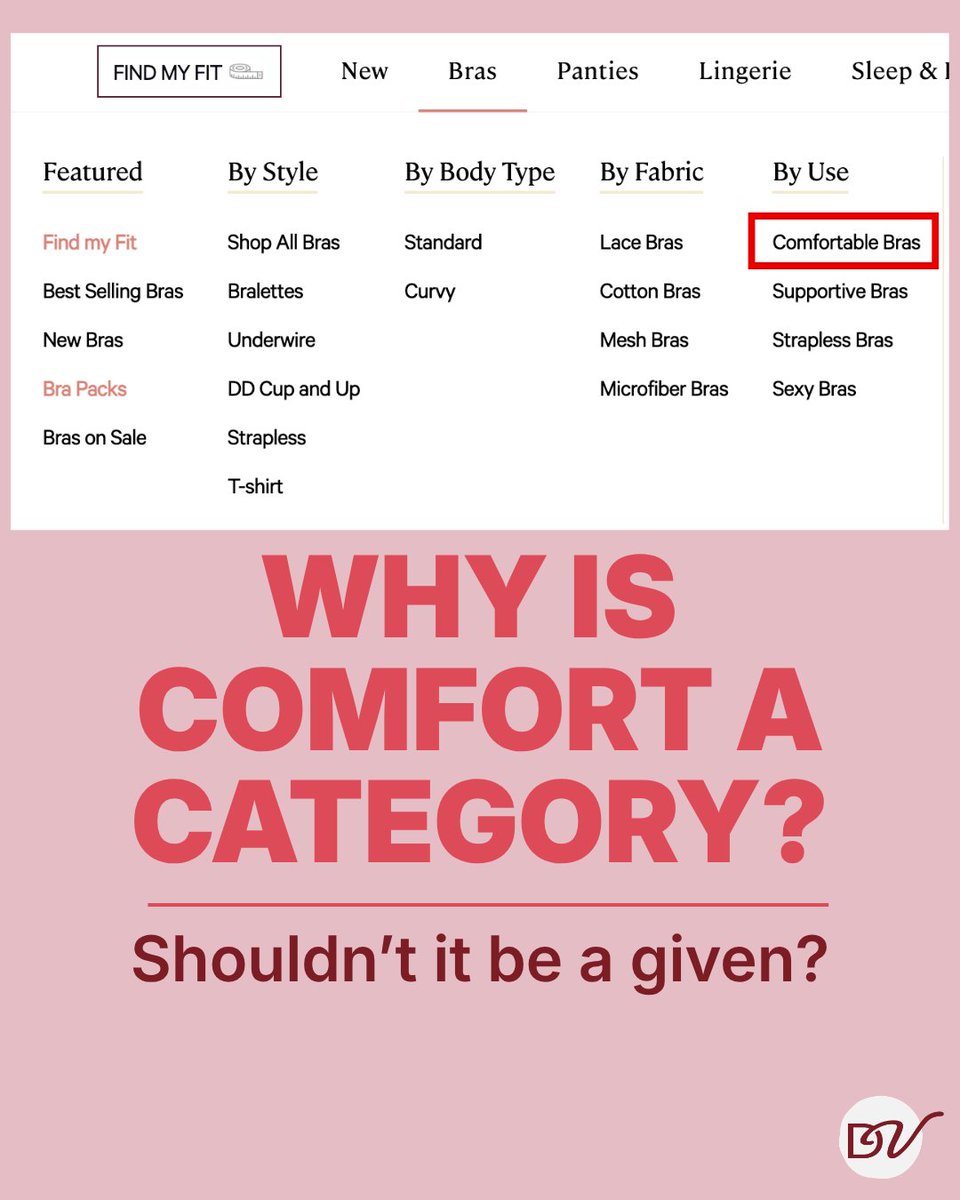
A French luxury lingerie brand lists “Comfortable Bras” as a separate category.
Alongside supportive. Strapless. Sexy.
Why is comfort optional in something worn so close to a woman’s body?
At @AdiraX_Ind, I want to build every product with comfort as its foundation.
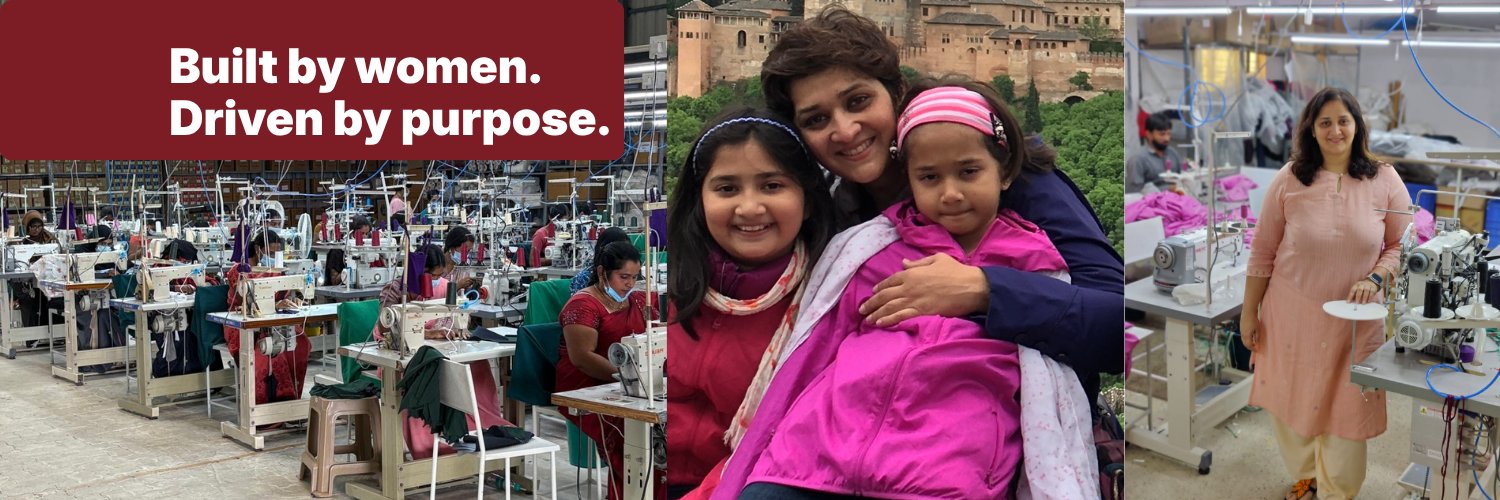
This is what Made in Bharat looks like.
Bright sarees. Bindis. Glass bangles. Mallige Hoovu in their hair. And women standing tall with pride.
This is my team at Yemmiganur and the reason I choose to manufacture in Bharat rather than import from China.
Every @AdiraX_Ind product empowers two women: the woman who wears it and the woman who makes it.
The CDC says:
“Trapped moisture provides a breeding ground for bacteria and fungi.”
CDC guidance:https://t.co/fXEi5DHI4v
So my simple question is:
Something may not be pathological at Hour 0. But in retained, moist conditions, could it contribute to a pathological state by Hour 8 or Hour 12?
I genuinely want to understand.
Flow comes with clots. What happens to them?
1/3: Someone told me shed endometrial tissue is “not pathological.”
I knew broadly what pathological meant. But I realised I didn't know exactly what it meant medically. So I looked it up. 😊
They are right.
Normal shed endometrial tissue is not pathological.
But I had another question. 🧵
Does “not pathological” mean sterile?
Does it mean biologically inert?
Does it mean it cannot contribute to conditions that may later become pathological?
Because if fabric doesn't absorb clots and tissue...where do they remain?
And what happens to them with menstrual fluid and moisture over 8–12 hours?
Around the world, women have started asking why period products are tested and shown with blue or clear water, when menstrual fluid is clearly not water.
Period blood is thicker, more viscous, and can contain clots and tissue. When absorbency numbers for bleed‑into panties come from water tests, they don’t tell us how the garment behaves with real menstrual fluid over a real school or work day
I’ve already taken this concern to the standards authorities in my country, because I believe women deserve tests that match real life.
This July I’m sharing: “Common Science For Women. Not Dumb Marketing.”
One question. One idea. No jargon.
Today’s question:
If period blood isn’t water, should we accept products being tested like it is?
Does this make sense?
I invented India’s first period panty in 2009. And I refuse to follow the trend of bleed-into panties, no matter how much money it makes me.
As a founder and a mom, I will never manufacture them. Here is why:
1/ The Absorption Myth: High-capacity claims (50–80ml) use water tests. Real menstrual blood is viscous and contains tissue. Studies show its actual absorption in these fabrics is closer to just 2ml. It doesn't flow like water.
2/ The Logistical Nightmare: Changing a soaked pair of underwear during a 6–8 hour school or work day is incredibly difficult. Girls end up sitting in pooled wetness for hours.
3/ The Risk of Infection: Period blood has a pH of ~7.4, which is highly alkaline compared to a healthy, acidic vaginal environment. Leaving this bioactive fluid pressed against skin for hours disrupts your ecosystem, letting bacteria that cause BV, odor, and rashes thrive.
True period care isn't a shortcut that risks health for convenience.
I’m ready to compromise on sales. I am NOT ready to expose my customers, especially young schoolgirls, to health risks just to chase a market trend.
I designed @AdiraX_Ind to be a leak-proof backup to your pad or cup, giving you 100% stain protection while letting you change regularly to stay fresh.
You don't have to buy Adira. But as a mom, I ask you to look at the facts and think twice before putting your daughter or yourself in a bleed-into panty.
My full research is in the link below. Please read it. 👇
https://t.co/NmkGxYEIbp
Period Panties were NEVER meant to be bled-into according to me. And the research around that is only getting stronger.
Link to the story : https://t.co/1mRnuCc2CN
@WIONews@AdiraX_Ind
Over the last 2 days, I learned that vision is not a buzzword.
It's measured in:
✔️ Livelihoods improved
✔️ Taboos challenged
✔️ Innovation that serves people
Hon'ble Minister Shri @girirajsinghbjp Ji spoke about creating more value for India's farmers.
I left inspired, challenged, and thinking bigger than before.
@TexMinIndia
#Leadership #Innovation #Adira #Textiles #India
All Kwality Wall’s items in India are planned to be milk-based “next year”, as the company shifts from vegetable fat frozen desserts to dairy ice cream.
Translation: only now are we being moved to what is positioned as higher-quality, more nutritious products.
India has 1.4 billion people.
So my question to global brands is this:
If this is the “biggest strategic reset” market, why do better standards arrive later, and not by default?
Maybe this is what "Aham Brahmasmi" means. Carrying the potential of the universe in each & every cell in our bodies.
Imagine this level of complexity & beauty inside every living cell of our body & we are unaware of it.
#AhamBrahmasmi
Scientists have created one of the most detailed 3D reconstructions of a human cell (eukaryotic cell) ever produced.
This groundbreaking model, often termed a "Cellular Landscape Cross-Section Through a Eukaryotic Cell," combines data from X-ray tomography, nuclear magnetic resonance (NMR), and cryo-electron microscopy to map molecular structures in extreme detail.
Do you doomscroll? I did. Until 2 days ago.
Pavlov rang a bell and trained dogs to salivate on cue.
Today, notifications & hooks are the bell. Short, high dopamine videos are the food. Our reflex to tap, scroll, swipe is the salivation.
A 2024 EEG study in Frontiers in Human Neuroscience found that heavy short‑video use on phones is linked to lower self‑control and weaker executive control in the brain.
Plain English: the more your brain lives on tiny hits, the harder it becomes to focus and resist impulses.
I’m choosing more reading, more meaningful content. Let’s become owners of our attention, not Pavlov’s dogs.
I genuinely believe #Modi is one of the best leaders India can have right now.
My worry isn’t a strong government, it’s a weak Opposition.
When 7 of 10 AAP Rajya Sabha MPs, including Raghav Chadha and Harbhajan Singh, move to BJP using the 2/3rd route, it forces a hard question.
What happens to a democracy when the ruling party keeps getting stronger and the Opposition keeps getting hollowed out?
Do we need to think of deeper fixes now?
Even nudging a values‑driven conservative formation carved out of the BJP ecosystem?
So Bharat gets both: strong governance and a strong Opposition? 🇮🇳
Curious to hear what you think.
#Modi #BJP #AAP #RaghavChadha #HarbhajanSingh #Democracy #Opposition #IndianPolitics #Bharat #JaiHind
Trust is earned. Not declared.
A celebrity can launch a product. They can’t sustain it,
unless there’s integrity in the product itself. Because no amount of influence can compensate when a product fails.
A known face can drive the first sale. Only the product earns the second. And when it doesn’t, it doesn’t just fail.
It creates doubt.
In the brand.
In the category.
In the next founder trying to build it right.
That’s the real cost of hype.
Because trust isn’t borrowed from a face.
It’s built in the product.
#celebrity #brand #influencer