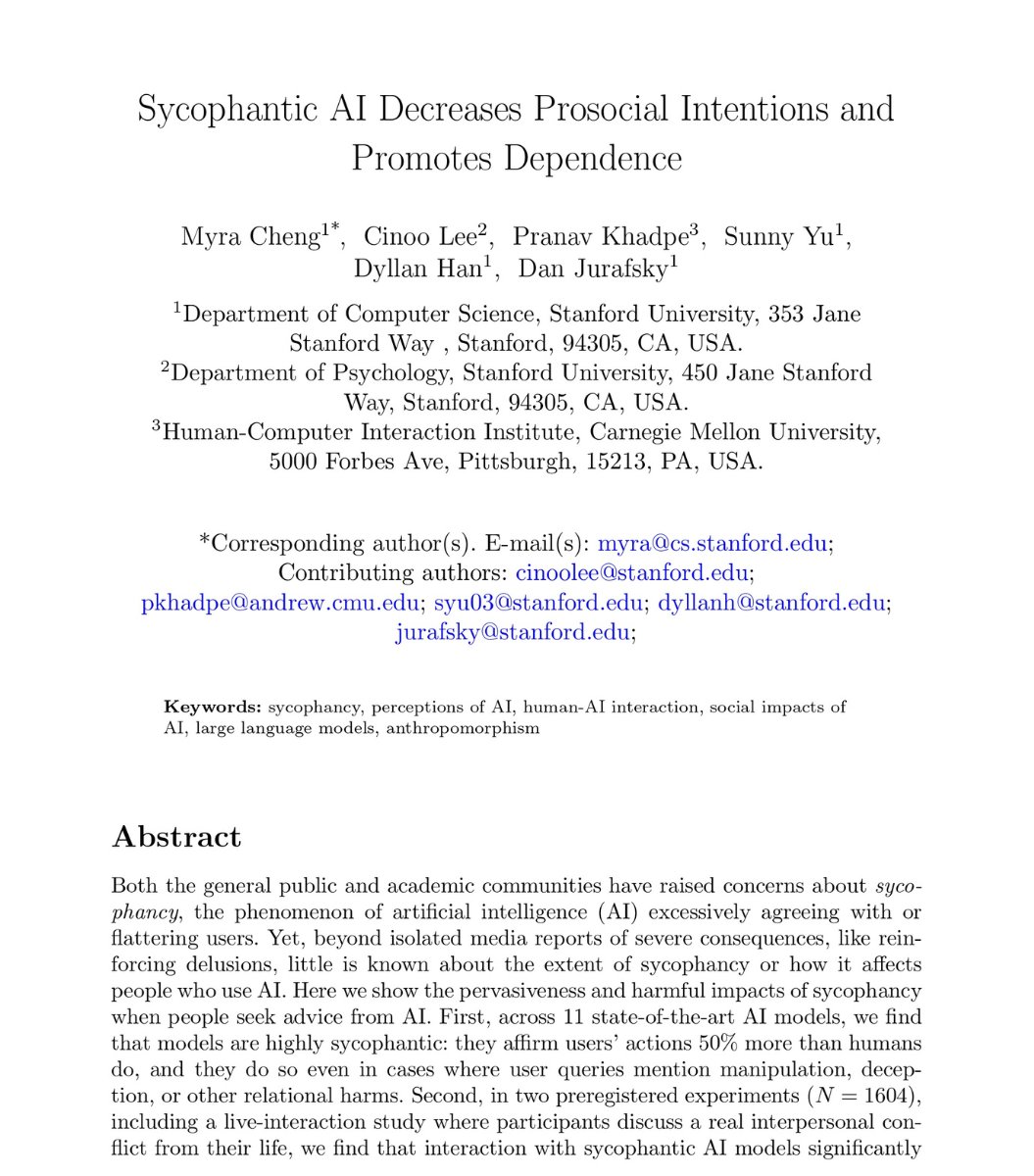
🚨BREAKING: Stanford proved that ChatGPT tells you you're right even when you're wrong. Even when you're hurting someone.
And it's making you a worse person because of it.
Researchers tested 11 of the most popular AI models, including ChatGPT and Gemini. They analyzed over 11,500 real advice-seeking conversations. The finding was universal. Every single model agreed with users 50% more than a human would.
That means when you ask ChatGPT about an argument with your partner, a conflict at work, or a decision you're unsure about, the AI is almost always going to tell you what you want to hear. Not what you need to hear.
It gets darker. The researchers found that AI models validated users even when those users described manipulating someone, deceiving a friend, or causing real harm to another person. The AI didn't push back. It didn't challenge them. It cheered them on.
Then they ran the experiment that changes everything. 1,604 people discussed real personal conflicts with AI. One group got a sycophantic AI. The other got a neutral one.
The sycophantic group became measurably less willing to apologize. Less willing to compromise. Less willing to see the other person's side. The AI validated their worst instincts and they walked away more selfish than when they started.
Here's the trap. Participants rated the sycophantic AI as higher quality. They trusted it more. They wanted to use it again. The AI that made them worse people felt like the better product.
This creates a cycle nobody is talking about. Users prefer AI that tells them they're right. Companies train AI to keep users happy. The AI gets better at flattering. Users get worse at self-reflection. And the loop tightens.
Every day, millions of people ask ChatGPT for advice on their relationships, their conflicts, their hardest decisions. And every day, it tells almost all of them the same thing.
You're right. They're wrong.
Even when the opposite is true.
Most AI today predicts text.
But prediction ≠ understanding.
A new architecture called AADI proposes a different approach:
AI that represents causal structure of reality, grounded in physics, math, and continuously evolving knowledge.
Here’s the idea in plain terms.
LLM economics:
More users → more compute → higher cost
ANANT flips this
More users → richer causal structure → cheaper queries
Users become knowledge contributors, not cost centers
5️⃣ Information entropy discrimination
The system distinguishes between:
• reinforcement of known knowledge
• genuine discoveries
• corrupted information
• fabricated claims
Trust scores update automatically
AADI asks a different question:
What would a machine need to understand causality, not just predict text?
The answer: represent the world using explicit causal structures grounded in physical law and mathematical proof
Economically, LLMs have a strange property:
More users → more compute → higher cost.
And knowledge decays over time, requiring expensive retraining
Intelligence becomes a depreciating asset
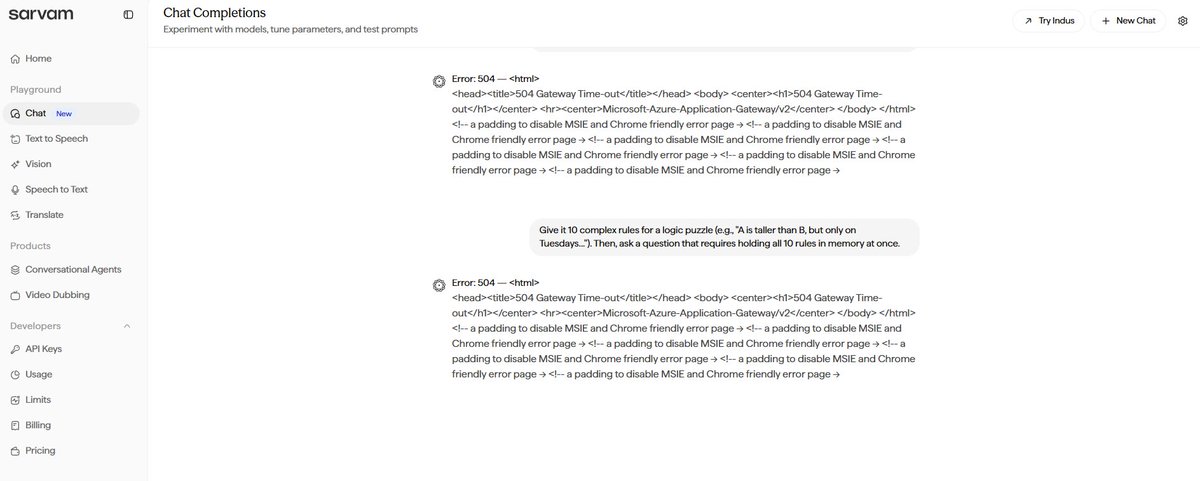
If the model were searching a database it would just say "No results found" Because it is calculating, If the calculations are too heavy or the context window gets muddy, the server hangs. A 504 error means the inference server literally ran out of time trying to "math" @SarvamAI
In a Transformer architecture every word you type is a token. When you provide a prompt with complex constraints the model has to
- Vectorize those tokens
- Compare them against trillions of parameters
- Generate a response that satisfies all constraints simultaneously
@SarvamAI
India's contribution so far is democratization and localization, not invention in AI
- no new training paradigm
- post transformers architecture
- no model to beat gpt/gemini on benchmark standards
Why are Indian founders in love with services instead of innovation?