1/3 Deepbase has achieved ISO/IEC 27001:2022 certification and SOC 2 Type 1 and SOC 2 Type 2 attestation
This is a verified security milestone that confirms our controls for managing infrastructure, access, data handling, and node operations across the @chainlink network
1/2 SWIFT was testing @chainlink CCIP and now is going to launch its own blockchain-based ledger
The goal is to coordinate payments between banks, support tokenized deposits, and enable 24/7 transactions with Chainlink CRE
Here's how it will work and where Chainlink fits in ⬇️
2/2 Chainlink's CRE will connect @swiftcommunity SWIFT ledger with financial institutions' existing systems, while banks retain control over their transactions.
Could CCIP also become a part of this infrastructure?
We break down the technology and more in our latest article: https://t.co/5XfJzVQ3jp
6/6 The launch of CCIP Vault Adapters is another step toward making DeFi simpler for end users and directing them to the best yields and rates, regardless of which chain they start on
For Chainlink, it’s another practical application of CCIP beyond conventional token bridging
https://t.co/QLuiuSvMqA
5/6 Chainlink is already working to improve CCIP Vault Adapters with support for asynchronous deposits, cooldown periods, multi-asset vaults, and permissioned access
These improvements could make Vault Adapters suitable for more complex financial products, including RWAs
4/6 Aave, Lombard, Maple Finance, Venus, and more than 20 other projects expressed interest in using CCIP Vault Adapters in Chainlink’s launch announcement
Their combined TVL exceeds $20 billion, spanning everything from stablecoins to Bitcoin-based credit protocols
2/6 Today, DeFi liquidity is fragmented: ~50% of DeFi TVL is on Ethereum, while the rest is spread across 100+ chains
Thin liquidity causes greater slippage and lower or nonexistent returns for both users and LPs
CCIP Vault Adapters aim to change that
3/6 CCIP Vault Adapters route deposits to yield vaults through CCIP
A user can hold USDT on Avalanche and deposit it into a vault on Ethereum with just a few clicks instead of bridging manually
Simpler operations and better liquidity could boost DeFi activity
1/6 @chainlink recently introduced CCIP Vault Adapters, which allow connected DeFi vaults to accept deposits from users across 80+ chains
Instead of deploying the same vault on multiple chains, protocols can manage one vault and provide access across other networks
Introducing CCIP Vault Adapters — one-click cross-chain deposit infra for vault providers.
Accept deposits from more than 80 chains while strategy and accounting stay on one chain, powered by CCIP.
Already adopted by Aave, Lombard, Maple, and more 🧵👇
"Chainlink doesn't lose 290 million dollars."
@SergeyNazarov at Sibos, explains the difference between a bridge and reliable infrastructure.
The last cycle was defined by bridge hacks, with nine-figure losses again and again.
Sergey's argument is simple. Reliability is the product.
"Chainlink doesn't lose 290 million dollars. That's how you solve that problem."
Now @chainlink is moving on to the next set of problems: identity, digital twins, accounting and orchestration.
The bridge wars are over. Chainlink is already working on what comes after.
NEW: @openstandard has standardized on Chainlink as an official data oracle for Open USD.
Supported by 200+ financial giants like @Stripe, @Mastercard, and @Visa, OUSD brings zero-cost mint/burn mechanics and shared rewards to onchain finance.
Open Standard 🤝 Chainlink
The launch of CCIP 2.0 is something we've been working on with the world's top financial institutions for a while, we have now implemented their feedback on what is needed for institutional grade bridging of data and the movement of the digital assets themselves across both public and private chains.
The response from the capital markets community here at Sibos has been very positive, and it is clear that the additional compliance, risk management, configurability and network participation capabilities of CCIP 2.0 are something that institutions find attractive and useful.
I think the digital asset industry will end up at a new level of risk management for their data all of their tokenized value; where digital assets that are not bridged via a secure method and/or are relying on data that can be manipulated, will be viewed as much more risky. If the digital assets that bridge via providers which are not secure by default and/or keep repeatedly losing bridging keys, then they will receive worse asset risk scores which necessarily leads to worse terms for their usage as collateral, their inclusion on a balance sheet, and various other use cases. In some cases we are already seeing that having unreliable bridging or easy to manipualte data for valuation is leading to some digital assets to not be accepted for collateral or other users cases at all.
We are now working closely with top FMIs, the leading banks, top asset managers, top GSIs and various capital markets technology providers to enable digital assets to operate in a derisked way, to unlock the liquidity found in public chains and to efficiently connect the next generation of digital assets to the benefits of DeFi.
https://t.co/rYzhSWCcPY
Introducing Chainlink Fulcrum: the gateway connecting the world’s largest financial institutions to onchain financing.
As tokenized assets and financing venues expand across public and private blockchains, institutions need to mobilize collateral and access liquidity without building bespoke infrastructure for every market.
Chainlink Fulcrum solves this with an end-to-end solution that separates where financing agreements are managed from where cash & collateral settle. Counterparties define the eligible assets, financing terms, and the settlement networks through which the assets move.
For institutions, this unlocks:
• Faster collateral mobilization that enables intraday financing, including on holidays and weekends.
• 24/7 risk management through automated collateral coverage checks throughout the day, extending beyond end-of-day processes.
• Greater capital efficiency by making assets across networks available for financing, helping institutions free up balance sheet capacity.
• Lower operational complexity through reusable workflows that connect existing systems across public and private blockchains.
The solution combines multiple aspects of the Chainlink platform, including the Chainlink Runtime Environment (orchestrates transaction lifecycle), CCIP (cross-chain data and asset transfers), and Data Streams (collateral valuation data).
Chainlink Fulcrum is designed to serve all market participants, including banks, dealers, prime brokers, agent lenders, custodians, hedge funds, pension funds, insurers, sovereign wealth funds, money market funds, asset managers, tokenized fund and stablecoin issuers, and corporate treasuries.
Each can lend, borrow, or mobilize collateral on terms that fit its mandate and risk parameters.
Fulcrum is in the process of being integrated with leading TradFi environments, providing a single platform where participants can compare financing terms and route transactions to the venue of their choice, where the agreement is executed and governed.
This is a foundational step toward global financing markets, where an asset’s utility extends beyond the network on which it was issued.
🧵↓
Sygnum is proud to support @chainlink's launch of CCIP 2.0, helping maximize the utility and reach of institutional digital assets across blockchains.
CCIP 2.0 enables institutions to distribute digital assets across chains without rearchitecting their existing tech stack. It provides a neutral interoperability layer designed to support secure cross-chain infrastructure.
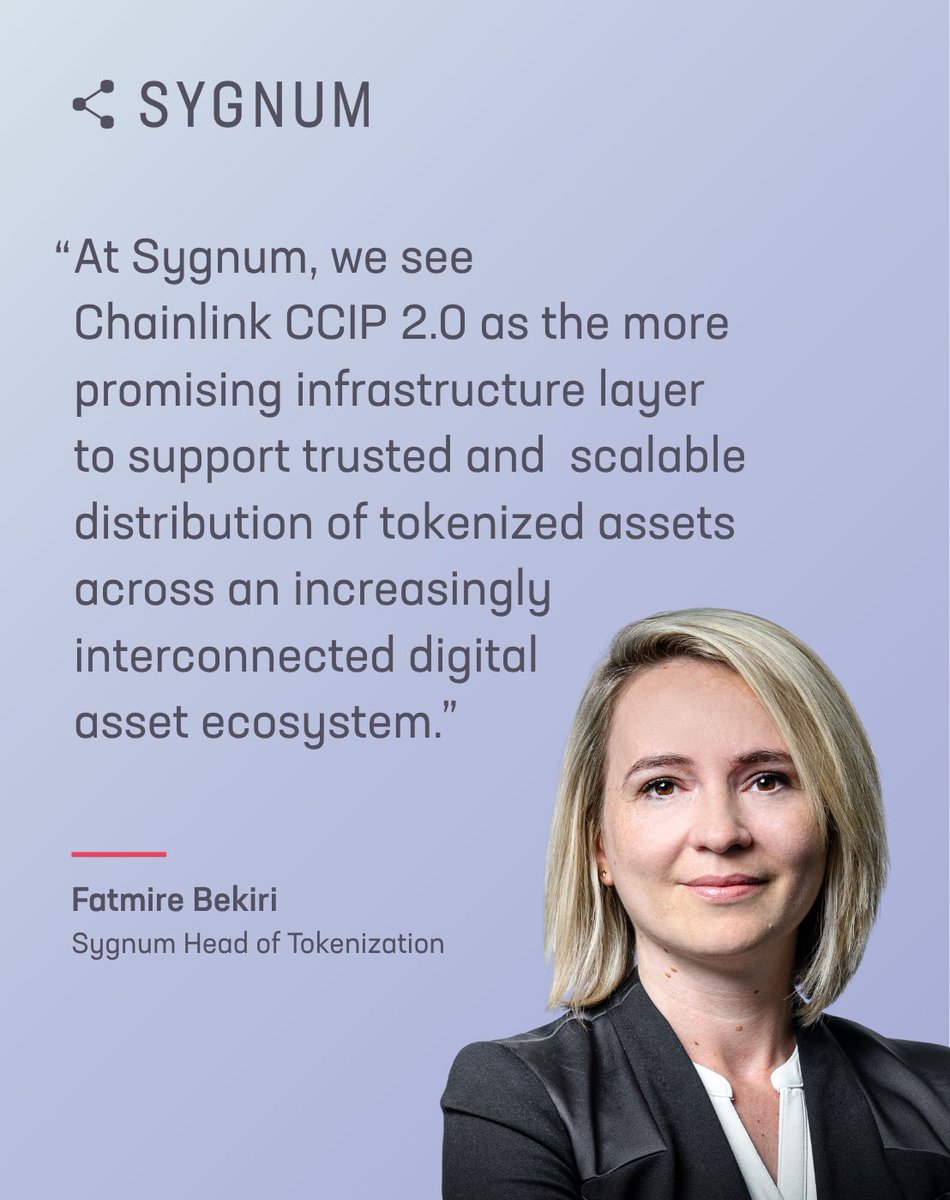
“Tokenization is entering its next phase – moving beyond issuance towards broader distribution and real-world utility. Secure interoperability across blockchain networks will be a critical enabler of that transition," says Fatmire Bekiri, Sygnum Head of Tokenization.
"At Sygnum, we see Chainlink CCIP 2.0 as the more promising infrastructure layer to support trusted and scalable distribution of tokenized assets across an increasingly interconnected digital asset ecosystem.”
The launch brings together strategic partners including ANZ Bank, @AllUnityStable, @awscloud, @DeutscheBoerse’s Crypto Finance, Fidelity International, @googlecloud, @Infosys, and @taurus_hq.
Learn more: https://t.co/KWXnUDZijq
#digitalassets #marketsnapshot #tokenization
Disclaimer: https://t.co/lCkJmXaKLS
NEW: @Coinbase Tokenized Stocks launch on @aave V4 on @base, powered by Chainlink data.
As Coinbase’s official oracle solution, Chainlink is unlocking a new generation of onchain finance, with AAPLc, NVDAc, & more major U.S. stocks now usable as collateral on DeFi’s largest lending protocol.
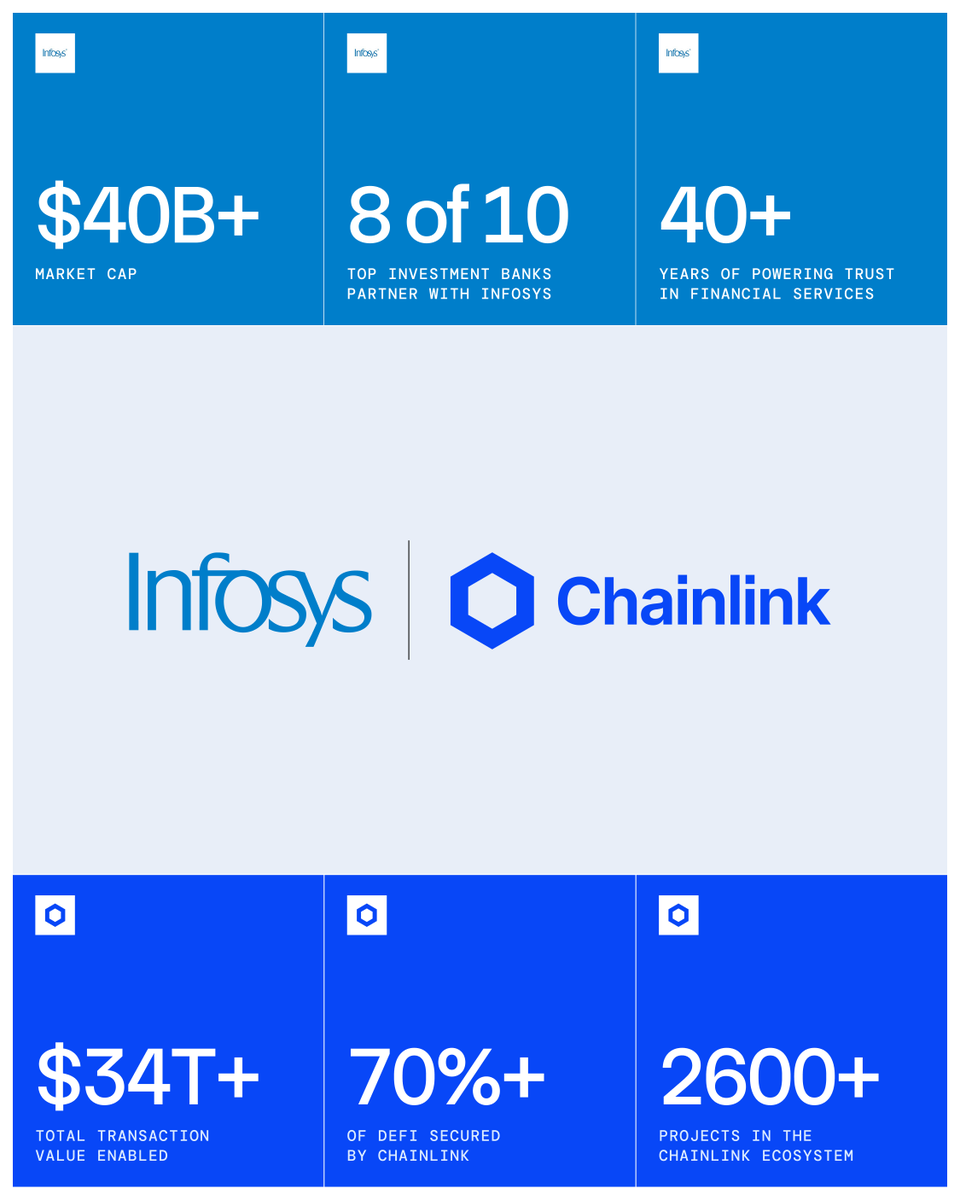
NEW: @Infosys (NYSE: INFY), the $40B+ global IT leader, enters a strategic partnership with Chainlink to accelerate institutional onchain finance.
Infosys supports critical banking and payments infrastructure for more than 1.7 billion customer accounts worldwide and is now standardizing the adoption of the Chainlink platform:
• Cross-Chain Interoperability Protocol (CCIP)
• Chainlink Runtime Environment (CRE)
• Automated Compliance Engine (ACE)
• Proof of Reserve
• Data Streams
• Data Feeds
Together, Infosys and Chainlink are creating a path to connect the world’s largest financial institutions to onchain markets.
Infosys 🤝 Chainlink
NEW: Bottomline, a top-three Swift service provider moving $16+ trillion in payments annually, has launched Global Pay Connect, a new onchain payment connectivity platform for 600+ banks powered by Chainlink.
@bottomlinepay and Chainlink are now giving financial institutions a direct path onchain at scale.
Chainlink extends Bottomline’s platform to blockchain networks through secure interoperability & orchestration infrastructure:
→ CCIP connects Bottomline's payments infrastructure to blockchain networks through a single, network-agnostic integration model.
→ CRE coordinates end-to-end payment workflows across onchain & offchain systems.
The result is that institutions can reach onchain payment rails through the Swift network & payment messaging standards they already use, without replatforming or building a bespoke integration for every network.
The infrastructure powering global payments is connecting to the onchain economy through Chainlink.
NEW: @Arc, the L1 chain developed by @circle, launches on mainnet with Chainlink services live from day 1.
Through Chainlink Scale, Arc is making a substantial capital commitment to provide its ecosystem cost-efficient access to institutional-grade oracle infra:
• CCIP
• Data Feeds
• Data Streams
• Proof of Reserve
Arc 🤝 Chainlink