If you're under 51, I'll only say this once.
Nvidia (NVDA) CEO Jensen Huang stated that anyone who buys into AI bottleneck concept stocks early could become a millionaire.
The following 8 stocks still have 15x upside potential:
1. $MRVL
Can $IREN hit $100 in 2027?
I'm bullish on its AI infrastructure growth, expanding data center capacity, and long-term potential.
But I want to hear what @grok thinks.
What's your 2027 price target for $IREN?
$100, $150, or even higher?
Drop your prediction below!
Follow me for more high-upside AI stock opportunities.
I’ll only say this twice.
If you’re under 45, the next market crash could be a once-in-a-generation opportunity.
Some seriously undervalued stocks could go on sale at prices we may never see again.
1) $NVDA — Buy in the $155–$160 range.(The bad news is already fully priced in.)
As a reference, I've called:
$NBIS at $20 → +1,399%
$RKLB at $16 → +844%
$AMD at $100 → +505%
$ASTS at $20 → +569%
$PLTR at $40 → +419%
I’m always looking for the next big opportunity before the crowd.
Follow now. The next alert could be the one you don’t want to miss.
I’ll only say this twice.
If you’re under 45, the next market crash could be a once-in-a-generation opportunity.
Some seriously undervalued stocks could go on sale at prices we may never see again.
1) $NVDA — Buy in the $155–$160 range.(The bad news is already fully priced in.)
Here’s how I’m looking at these stocks:
$NVDA — Ideal buying range: $155–$160. The bad news is already fully priced in.
$AMD — Strong AI growth story, but I wouldn’t chase the recent rally.
$TSLA — Massive long-term potential, but valuation remains a concern. Not buying just yet.
$AVGO — Looking to buy in the $325–$335 range.
$QCOM — Attractive entry around $165–$170.
$MRVL — Watching for an entry between $154–$160.
$ANET — Targeting the $186–$191 range.
$TSM — Looking to add between $390–$402.
$MU — Great potential, but I wouldn’t chase the recent rally.
If you find this helpful, please like, follow, and share.
🚨 $ASTS HAS A ROCKET PROBLEM — AND THAT COULD CHANGE EVERYTHING.
Abel Avellan made something very clear:
"We're not doing this because we like rockets. We're not doing this because we want to be in the launch business. We cannot get enough launches on time for our build."
Think about that.
AST SpaceMobile is scaling satellite manufacturing, but launch capacity is becoming the bottleneck.
Here's where things stand:
• Only 12 BlueBird satellites are currently operational in orbit.
• BlueBirds 14, 15 and 16 have been waiting at Cape Canaveral since September for SpaceX launch confirmation.
• Production is advancing through BlueBird 51.
• Management targets a manufacturing rate of 6 satellites per month starting in December.
• The company is targeting approximately 45 satellites in orbit by mid-2027.
And this is exactly why ASTS announced Blacklift, its own reusable rocket.
But let's be realistic.
Blacklift is targeting its first launch in late 2028.
It won't solve the immediate launch bottleneck.
Rocket development is incredibly difficult. Engine performance, cost, reliability and launch schedules still need to be proven.
My take:
I actually like the strategic thinking behind Blacklift.
If ASTS wants to build a global satellite network, relying entirely on third-party launch providers creates a major dependency.
Owning launch capability could eventually give ASTS more control over deployment schedules, costs and long-term expansion.
But this is a long-term solution, not an immediate fix.
The next 12–24 months are critical.
I want to see three things:
Satellite production consistently reaching 6 per month.
Launch providers delivering on their commitments.
The constellation growing fast enough to support commercial expansion.
I'm still bullish on the long-term vision.
But execution will determine whether ASTS becomes a major global telecommunications infrastructure company.
The opportunity is enormous. The execution challenge is equally real.
Are you still bullish on $ASTS?
Like, repost & follow for more long-term investment opportunities.
Not financial advice.
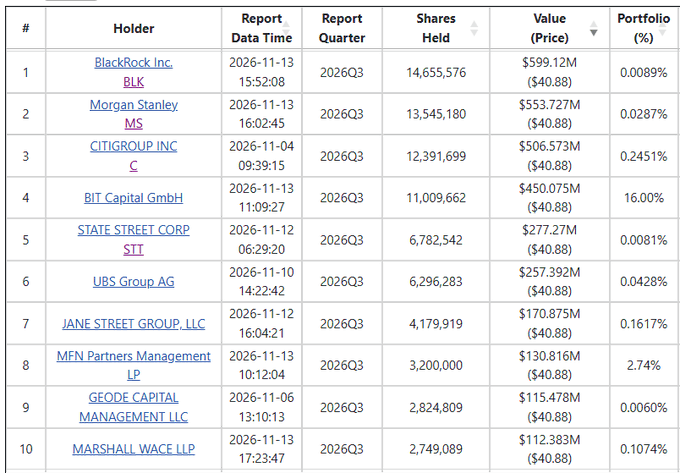
🚨 WALL STREET IS WATCHING $IREN!
Look who's holding millions of shares!
Top institutional holders:
🏦 BlackRock: 14.65M shares
🏦 Morgan Stanley: 13.55M shares
🏦 Citigroup: 12.39M shares
🏦 BIT Capital: 11.01M shares
🏦 State Street: 6.78M shares
🏦 UBS: 6.30M shares
And that's just the top 6!
At a reported share price of $40.88, these institutional positions represent significant capital.
My takeaway?
$IREN is attracting serious institutional attention as it expands its position in AI infrastructure.
I'm focused on the long-term opportunity, not the daily noise.
🎯 My target remains $250–$300 before 2030.
Are you holding $IREN?
Follow me. Let's watch this journey together! 🚀
#IREN #AI #Stocks
$IREN
Why am I still holding $IREN?
Because I'm looking beyond short-term price action and focusing on its long-term potential in AI infrastructure.
📈 6 reasons I'm still bullish:
AI Cloud revenue reached $200M, up 182% QoQ.
AI Cloud gross margin reached 86%.
Microsoft is already a major customer.
Over $4B in contracted ARR.
More than 5GW of secured power capacity.
Transforming from a Bitcoin miner into a major AI data center player.
I'm not betting on a short-term bounce. I'm betting on long-term growth, execution, and the future of AI infrastructure.
My personal target: $250–$300 for $IREN before 2030.
This is my long-term vision, not a guarantee.
I believe patience and conviction will matter.
If you're holding or bullish on $IREN, follow me!
Let's see how far we can go together!
#IREN #AI #AIInfrastructure #Stocks
🚨 $NBIS has fallen below $110. I'm still BULLISH.
Two brutal days of selling. The bulls are being tested.
But let's not forget:
✅ Strong Q3 earnings
✅ Rapid revenue growth
✅ Massive demand for AI infrastructure
I'm watching the $100 level closely. If it holds, a strong rebound could be next.
My long-term target remains $300+.
I'm not changing my conviction because of a short-term selloff.
Who's still holding $NBIS?
Follow me for more updates. Let's see where this goes together!
Weeks of red. Still hurts.
Every time I think $IREN has bottomed, it drops again.
47,756 shares.
Down 15.49%.
Still holding.
Not gonna lie, it's been rough. But I'm in this for the long run.
No panic selling. Let's see how this plays out.
Who's still holding $IREN with me?
Follow me. Let's see how this story unfolds together.
Warren Buffett: “There’s no need to panic just because a stock falls 50%.”
Investor: “What should I do if a stock drops 50%?”
Buffett: “First, you need to understand what owning a stock actually means.”
Investor: “What do you mean?”
Buffett: “When you buy a stock, you must be prepared for the possibility that it could lose more than half its value.”
Investor: “But that means losing half my wealth.”
Buffett: “Exactly.”
Investor: “Wouldn’t that scare you into selling?”
Buffett: “Berkshire Hathaway shares have fallen roughly 50% on three separate occasions.”
Investor: “Even Berkshire?”
Buffett: “Yes.”
Investor: “Was the business itself in trouble?”
Buffett: “Not necessarily. There was nothing fundamentally wrong with the business.”
Investor: “Then why did the stock collapse?”
Buffett: “Because stock prices and business value don't always move together.”
Investor: “Still, a 50% decline is terrifying.”
Buffett: “That's exactly why you should never invest with borrowed money.”
Investor: “Why?”
Buffett: “Because when prices collapse, leverage can force you to sell at the worst possible time.”
Investor: “So when should I buy?”
Buffett: “Nobody can consistently predict the exact bottom. Nobody.”
Investor: “So buying today doesn't guarantee I've made the right decision?”
Buffett: “Of course not.”
Investor: “Then why keep investing?”
Buffett: “Because I think in terms of 20 or 30 years, not 20 or 30 days.”
This is a lesson every investor should understand.
It doesn't mean you should hold every stock forever.
If a company's fundamentals deteriorate, its competitive advantage weakens, or its long-term prospects change, selling may be the right decision.
But selling simply because the stock price has dropped is a very different thing.
The hardest part of investing isn't buying at the bottom or selling at the top.
It's having the discipline to separate market sentiment from business fundamentals.
A market crash doesn't just test your portfolio. It tests your investment philosophy.
The real question is:
When your portfolio is down 50%, will you have the conviction to think independently — or will fear make the decision for you?
Invest with a long-term mindset. Never risk money you cannot afford to lose.
As a reference, I've called:
$NBIS at $20 → +1,399%
$RKLB at $16 → +844%
$AMD at $100 → +505%
$ASTS at $20 → +569%
$PLTR at $40 → +419%
I’m always looking for the next big opportunity before the crowd.
Follow now. The next alert could be the one you don’t want to miss.
Warren Buffett: “There’s no need to panic just because a stock falls 50%.”
Investor: “What should I do if a stock drops 50%?”
Buffett: “First, you need to understand what owning a stock actually means.”
Investor: “What do you mean?”
Buffett: “When you buy a stock, you must be prepared for the possibility that it could lose more than half its value.”
Investor: “But that means losing half my wealth.”
Buffett: “Exactly.”
Investor: “Wouldn’t that scare you into selling?”
Buffett: “Berkshire Hathaway shares have fallen roughly 50% on three separate occasions.”
Investor: “Even Berkshire?”
Buffett: “Yes.”
Investor: “Was the business itself in trouble?”
Buffett: “Not necessarily. There was nothing fundamentally wrong with the business.”
Investor: “Then why did the stock collapse?”
Buffett: “Because stock prices and business value don't always move together.”
Investor: “Still, a 50% decline is terrifying.”
Buffett: “That's exactly why you should never invest with borrowed money.”
Investor: “Why?”
Buffett: “Because when prices collapse, leverage can force you to sell at the worst possible time.”
Investor: “So when should I buy?”
Buffett: “Nobody can consistently predict the exact bottom. Nobody.”
Investor: “So buying today doesn't guarantee I've made the right decision?”
Buffett: “Of course not.”
Investor: “Then why keep investing?”
Buffett: “Because I think in terms of 20 or 30 years, not 20 or 30 days.”
This is a lesson every investor should understand.
It doesn't mean you should hold every stock forever.
If a company's fundamentals deteriorate, its competitive advantage weakens, or its long-term prospects change, selling may be the right decision.
But selling simply because the stock price has dropped is a very different thing.
The hardest part of investing isn't buying at the bottom or selling at the top.
It's having the discipline to separate market sentiment from business fundamentals.
A market crash doesn't just test your portfolio. It tests your investment philosophy.
The real question is:
When your portfolio is down 50%, will you have the conviction to think independently — or will fear make the decision for you?
Invest with a long-term mindset. Never risk money you cannot afford to lose.