- Invited as an industry contributor for a PhD study at De Montfort University, Leicester exploring sustainability, heritage textiles, and the future of fashion supply chains within the Nigerian fashion industry.
Between the unmasking of Banksy and Satoshi, something so very British is revealed - only a Brit will manage to not boast about such power and influence for so long that so much effort will be required to unmask them.
Tonight I had the privilege of hearing a 13 year old explain the terms "cooking" and "cooked" to my 45 year old manager and she said something so excellent I have to document it.
"cooked is bad. cooking is good. you're either in the pot or you're holding it."
To stop ants coming in to your house leave a saucer of milk outside. The adult ants drink it & it has an effect on ant reproduction. The young are born without toes so they can't climb in to your
cavity walls.
This effect is called lack toes in toddler ants.
For our relationships to prosper, we must deliberately and consistently assume benevolent intent in actions, and ignorance — rather than malice — in omissions.
A tiny piece of code called axios runs inside almost every app on your phone and every website you visit. Developers download it 100 million times a week. A few hours ago, someone poisoned it with malware that hands an attacker full control of your computer.
If you’ve never heard of axios, that’s normal. It does one boring but important job: it lets apps talk to the internet. When a website pulls up your feed or an online checkout processes your card, axios is probably doing the work underneath. Over 173,000 other code packages plug into it. It’s everywhere.
The attacker stole a lead developer’s login for npm (think of it as an app store, but for code that programmers use to build software). Once inside, they swapped the developer’s email to an anonymous ProtonMail account and uploaded the poisoned version by hand. That jumped past every security check the project normally runs before new code goes live.
And this was not some rushed job. The attacker staged the malware at least 18 hours before pulling the trigger. They built separate versions for Windows, Mac, and Linux. They poisoned both the current version and an older one within 39 minutes of each other, casting the widest net possible. Once the malware ran on a machine, it deleted itself to cover its tracks.
The trick was smart. They never touched a single line of code inside axios itself. Instead, they tucked in a fake add-on called plain-crypto-js, built to pass as a well-known, trusted library. It copied the real library’s description and author info, so nothing looked off at a glance. When a developer installed axios, this fake package quietly ran the malware on its own.
When a smaller package called ua-parser-js got hijacked back in 2021 with about 8 million weekly downloads, the security world treated it like a four-alarm fire. Axios has 100 million. Over 12x the exposure, with 173,000+ packages depending on it.
Socket, the security firm that flagged this, caught it in about 6 minutes. That’s fast. But 6 minutes is still plenty of time for automated systems at companies everywhere to pull and install the bad version before anyone can react.
If you or your team runs axios: lock your version to 1.14.0 (or 0.30.3 for the older branch). Change every password, API key, and access token on any machine that installed the compromised update. And check your network logs for connections to sfrclak dot com or the IP address 142.11.206.73.
Tehran lit up again. The city that had gone dark only hours earlier was breathing once more. Israeli and American strikes had slammed into the civilian power grid. A high voltage tower in Alborz province was shredded. The Dushan Tappeh substation was blasted into ruin. They cut the arteries that fed the city its lifeblood. It was a surgical strike on everyday existence.
People sat in sudden blackness. Refrigerators fell silent. Lights died. Water pumps stopped. Hospitals scrambled on emergency generators while children cried and old men struggled to breathe. This was not a strike on military targets. This was an attack on homes, on kitchens, on the simple pulse of daily life.
But Iran did not bow. Iranian engineers poured out into the night. They moved through smoke and rubble with tools in their hands and fire in their eyes. They spliced wires. They raised new lines. They rebuilt what had been shattered. Within hours, power began flowing back into neighborhoods. Sections of the city flickered alive again. The restoration moved with astonishing speed.
This was more than repair work. It was defiance turned into action. It was the raw resilience of a people who refuse to stay broken. The attackers believed one blow would plunge the city into submission. Instead Iran showed them the opposite. They brought the light back brighter and faster than expected.
The war is not only fought with bombs. It is fought with hands that rebuild in the dark. Iran is winning that part of the fight. The lights are on. The city is awake. Life pushes forward.
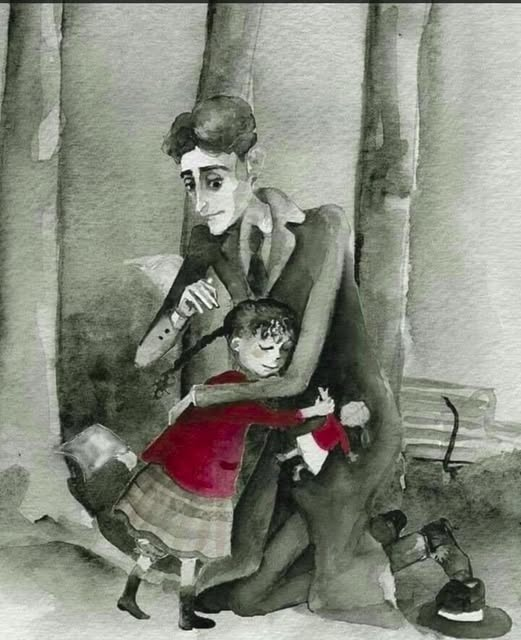
At 40, Franz Kafka (1883-1924), who never married and had no children, walked through the park in Berlin when he met a girl who was crying because she had lost her favourite doll. She and Kafka searched for the doll unsuccessfully. Kafka told her to meet him there the next day and they would come back to look for her.
The next day, when they had not yet found the doll, Kafka gave the girl a letter “written” by the doll saying “please don’t cry. I took a trip to see the world. I will write to you about my adventures.”
Thus began a story which continued until the end of Kafka’s life.
During their meetings, Kafka read the letters of the doll carefully written with adventures and conversations that the girl found adorable.
Finally, Kafka brought back the doll (he bought one) that had returned. “It doesn’t look like my doll at all,“ said the girl.
Kafka handed her another letter in which the doll wrote: "my travels have changed me.” the little girl hugged the new doll and brought her happy home.
A year later Kafka died. Many years later, the now-adult girl found a letter inside the doll. In the tiny letter signed by Kafka it was written:
“Everything you love will probably be lost, but in the end, love will return in another way.”