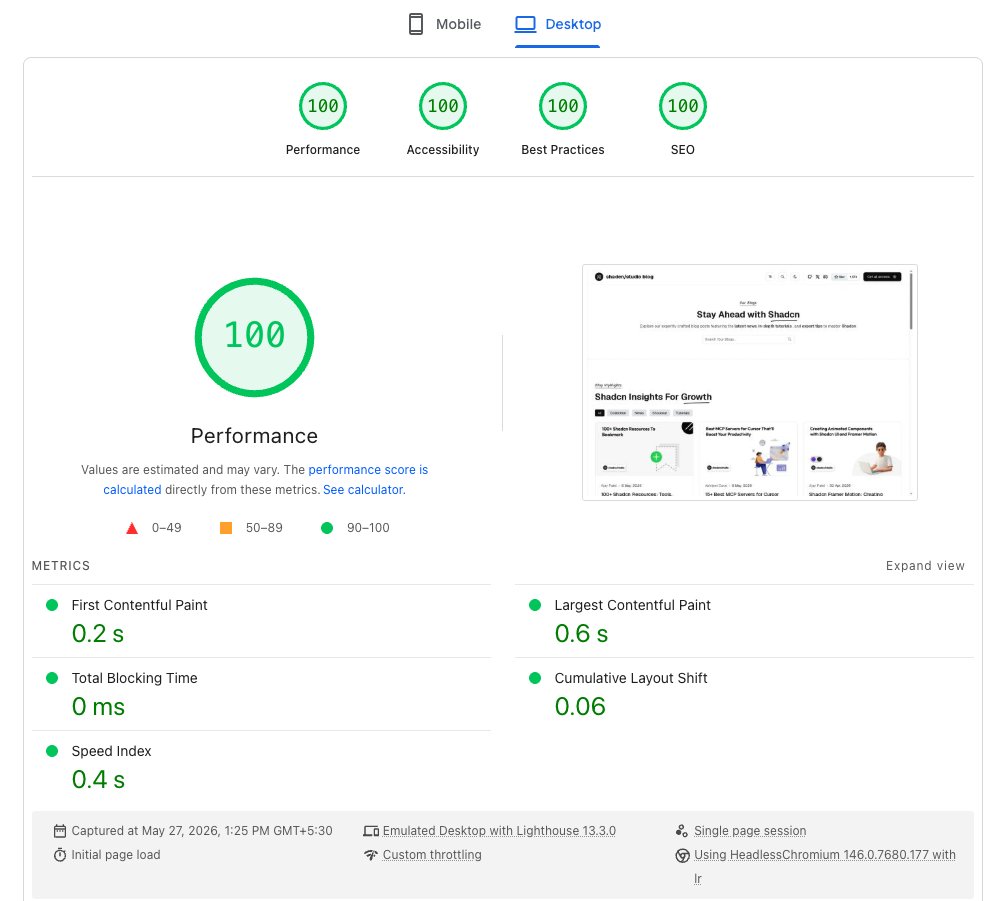
We finally migrated the @ShadcnStudio blog from WordPress → Astro.
The difference was immediate.
Core Web Vitals improved massively ⚡
Astro made the blog feel insanely fast while keeping the developer experience clean and flexible.
Pages load quicker, interactions feel smoother, and the overall browsing experience is far better now.
Sometimes the biggest upgrade isn’t adding more features.
It’s removing unnecessary weight.
@Deepkumbhare85 & @SEOwithAbhi made this happen 🙌🏻
#astro #corewebvitals #performance #webdev #seo
@hashnode I also contacted hashnode support team. They said the endpoint in now deprecated and may be they make available from their paid plan in future. As of now we can use https://t.co/FYMwhezQwj but it will not stay free for more time.
@suni_code Snapchat uses the events/callbacks provided by the os when screenshot is taken and then app sends event to the snapchat's server and server logs the event and pushes a notification to the original sender.
How I use AI and why it's the right way.
I want to talk about a specific trap in using AI tools: the removal of friction. At a high level, we think friction is bad. We want answers fast. But for an engineer, friction is actually a requirement for learning.
The main idea here is that your brain needs to struggle with a problem to map it into long-term memory. Think about debugging a race condition. The frustration you feel when tracing that bug is the learning happening. If you paste the error into an LLM and it gives you the fix instantly, you bypass the neural pathway creation. I still paste the error into claude code but for tasks that aren't particularly important and I feel like where AI would work better but I would give the context of exact files to debug and put in my guidance as well.
This leads to what we call the fluency illusion. Let’s pause and understand this.
Imagine you are reading a solution to a complex algorithmic problem. It looks elegant. It makes sense. You nod your head and think, "I get it." But if I closed the tab and asked you to write that solution from scratch, you would get stuck. Why? Because you recognized the answer, but you never did the work to generate it. AI gives us this illusion constantly.
So now, how do we use these tools without losing our edge?
We need to treat the AI as a sparring partner. This brings us to a concept I call "Draft First."
Writing is thinking. If you are designing a new microservice, do not ask the AI to architect it. Open a blank file. Write down your messy, unrefined logic. Define the API endpoints yourself. This forces your brain to do the heavy lifting of organizing the structure. Only after you have that draft do you bring in the AI to refine it.
Which brings us to the next step: asking for critiques, not answers.
Instead of prompting, "Write me a Python script to do this specific task," try this instead. Write the script or just the high level design yourself, paste it in, and ask: " Find the failure points."
You are now using the model to stress-test your logic. You are the architect and the AI is the critic. If the AI can easily poke holes in your design, it is a clear signal that you haven't thought it through deep enough yet, you need to reiterate, do it again.
Real engineering mastery is about understanding exactly why it breaks. By keeping the friction in your process, you ensure that your understanding is grounded in fundamentals, not just the output of a model and you won't feel like an imposter again.
It’s not about Tailwind.
This is a fundamental shift in the unit of value in software. Most of our current libraries and frameworks were designed to solve human-scale complexity. When the bottleneck of writing the code drops to near-zero, the value of those specific abstractions starts to evaporate.
I have a huge respect for Tailwind. Back in 2021, when I was at RapidAPI, my team actually purchased Tailwind pre-built components by paying the one-time fees. It was a no-brainer because building beautiful, consistent UI from scratch was incredibly time-consuming. But now we are literally just a screenshot away. You can feed an image to a model and ask it to build the UI. It will replicate it with 99% precision in seconds.
If Tailwind didn’t exist today, the AI wouldn't care. It would happily generate 10,000 lines of raw, unoptimized CSS in seconds and maintain it with perfect consistency.
We use frameworks to make code manageable for human brains. But we are no longer the primary consumers of source code. We are the judges now. And I think slowly we are going to see the AI effects on other SaaS as well.
Why pay a $25/month subscription for a notes organizer or a CRM when you can describe your specific workflow to a model and have a bespoke, local-first app built in minutes?
Most SaaS companies stay alive by adding features to justify the paid plans. But if you can build exactly and only what you need, the "one size fits all" model starts to look very shaky.
Today, if you're building a business based on the difficulty of writing the software itself, you are standing on a melting glacier.
AI is crazy!
Want to know about the Folder Structure of our Vue Admin Templates?
We've recently uploaded a short tutorial video that explains the Folder structure of Materio Vue js Admin Template 📷
https://t.co/nOVSWqypZp
#vuejs#vuetutorial#Admin#template#folderstructure#vue3