Build coding agents that learn from experience.
In Building Adaptive AI Agents, you’ll turn an agent’s own traces into reusable skills and build a code knowledge graph that finds the right context where keyword search misses.
Built in partnership with @Oracle and taught by Nacho Martínez (@jupiterwanderer) and Casius Lee.
Enroll for free: https://t.co/xOsWcg4wGd
🛠️ DeepSeek V4 Pro 0813 is out, but just as big of a story may be the company’s open source evaluation harness.
DeepSeek Harness logs every tool call, system prompt, and subagent schedule. Developers can now reproduce performance instead of relying on closed testing environments. And they can easily study, fork, or remake their own harnesses to boot.
Read more in The Batch: https://t.co/6LffWp8Q4q
#DeepLearningAI #OpenSource #Developers
⚡ Top AI companies think inference speed is an architectural requirement worth paying for.
OpenAI and Cerebras demonstrated GPT 5.6 Sol running at 750 tokens per second.
Google released Gemini 3.7 Flash averaging 330 tokens per second.
Nvidia launched Nemotron 3.5 Lightning with NeMo Switchyard for dynamic step routing.
Faster throughput and lower latency alleviate developer context switching and power real-time agentic workflows.
Read the complete breakdown in The Batch: 📖
#DeepLearningAI #AI #TechNews
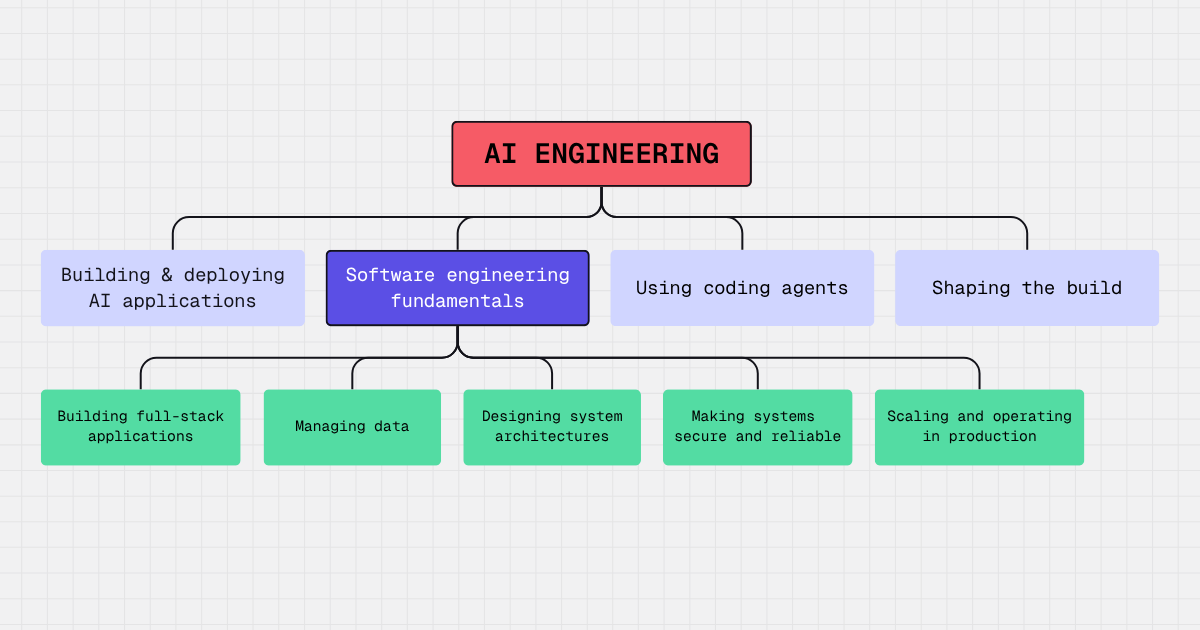
Coding agents can write functional code, but relying on "vibe coding" without knowing core software engineering fundamentals can compromise long-term system reliability, security, and extensibility.
We’ve mapped out Pillar 2 of the AI Engineering Skills Map: Software Engineering Fundamentals to help you bridge the gap.
To build production-ready full-stack applications, focus on building these foundational skills:
🌐 Building Full-Stack Applications
🗄️ Managing Data
📐 Designing System Architectures
🛡️ Making Systems Secure and Reliable
🚀 Scaling and Operating in Production
Master these to steer your agents effectively.
Read the breakdown from Andrew Ng here: https://t.co/h1wii8W4jS
#AIEngineering #SoftwareArchitecture #BuildWithAI
💻 Z .ai's GLM-5.3 just hit 84.5% on the CyberGym vulnerability benchmark, beating top proprietary models, a huge gain over the performance of its predecessor GLM-5.2.
The kicker? https://t.co/FuySRHMOvd’s AI engineers did it purely through fine-tuning and optimization of the model’s agentic capabilities, without changing the base model. The model grew so capable at finding and targeting potential exploits that https://t.co/FuySRHMOvd held back the open weights for safety testing.
Read the full analysis in The Batch: https://t.co/7DjKwCGmlA 📖
#DeepLearningAI #Cybersecurity #LLMs
Everyone has done it: You build a new application with coding agents and love the toy version so much that you wind up deploying it without first evaluating trade-offs like latency, uptime, and compute costs. And we all know vibe coders who do this every day and only discover the production consequences later.
When a developer lacks the proper grounding in software engineering fundamentals, they can’t steer an agent to make the structural decisions needed for building great applications.
In this week's letter, Andrew Ng outlines why understanding the full software development stack, from data management to user interfaces, remains essential for AI engineering.
Here’s Andrew’s list of the key technical capabilities requiring a knowledgeable human’s guidance:
🏗️ Full-Stack Development: Planning out API design, session management, caching strategies, and asynchronous processing.
🗄️ Data Lifecycle Management: Picking data models and storage infrastructure to maintain consistency and clean feeds for downstream AI systems.
📐 System Architecture Design: Choosing everything from the monolith versus microservice dilemma to load balancing.
🔒 Security and Reliability: Building in smart failure-handling policies to ensure graceful degradation, unit and integration testing, and security and testing — early and often.
🚀 Production Operations: Configuring CI/CD pipelines, managing databases, and creating observability tools for understanding workloads.
Read Andrew’s full letter to explore how software fundamentals shape effective AI engineering, and how those fundamentals fit into our overall map of AI Engineering Skills: https://t.co/QE4DsmAJzy
Without strong software engineering fundamentals, coding agents often default to bad trade-offs that hurt system latency, reliability, and cost.
This week in The Batch:
▪️ Andrew Ng on full-stack skills for AI engineering
▪️ GLM-5.3 brings advanced cybersecurity capabilities to open weights
▪️ OpenAI, Google, & Nvidia speed up throughput for real-time interaction
▪️ DeepSeek-V4-Pro ships with an open source harness
▪️ Self-GC uses an LLM to better prune long contexts
Read the full details here: https://t.co/dbcRjZiKuq 📱
Tracking the provenance of synthetic content is becoming a regulatory requirement. To comply with new laws like the EU AI Act, Anthropic will embed invisible watermarks in all future Claude models — and eventually, older ones too.
For generated text, Claude implements Google’s SynthID methodology, using a seed generator to nudge word choices in specific directions in order to create a statistical pattern. This can then be detected by a scoring API. For images, it embeds C2PA metadata. Claude claims this will not meaningfully affect output, but users are skeptical.
We look at the technical implementation, the probability of false positives, and the downstream implications for output quality.
📊Read the analysis: https://t.co/ExbWh46tmU (https://t.co/ExbWh46tmU)
Building reliable AI out of unpredictable components requires a new playbook: continuous iteration and disciplined eval loops.
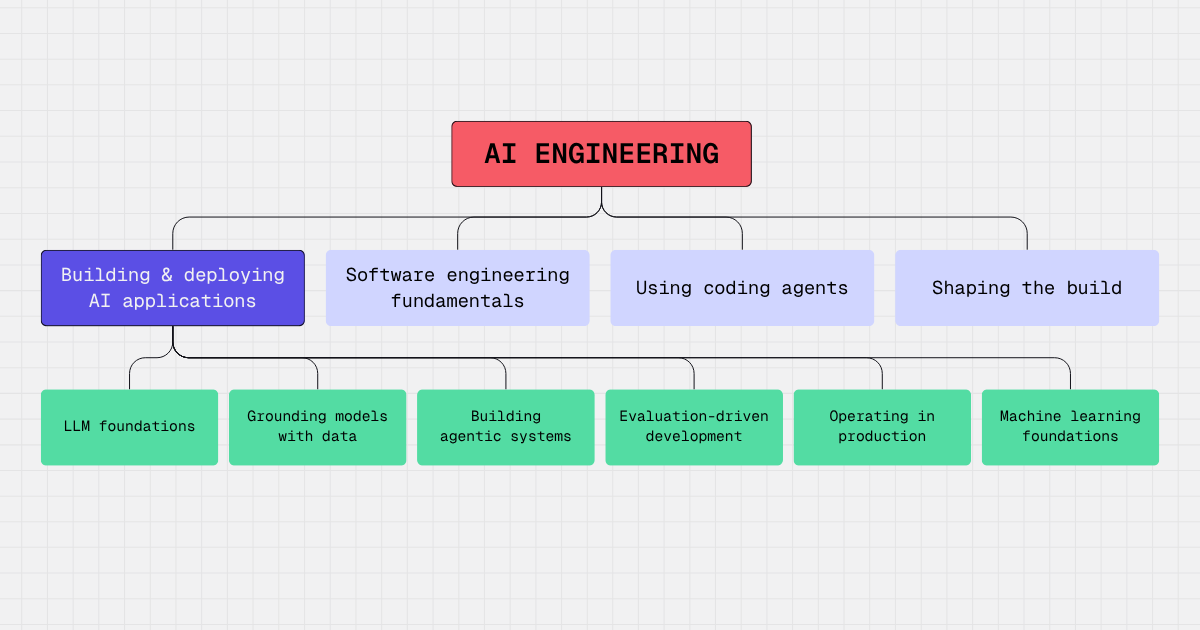
To help developers bridge the gap from quick demo to production, @AndrewYNg mapped out Pillar 1: Building and deploying AI Applications, of the AI Engineering Skills Map: 👇🧵👇
🧠 LLM Foundations: Understand model mechanics to predict failures and select the right architecture.
📊 Grounding Models with Data: Architect reliable context through clean data pipelines and retrieval structures.
🤖 Building Agentic Systems: Design the agent harness, including tool integrations, context memory, and production guardrails.
🧪 Evaluation-Driven Development: Build tailored evaluation loops to drive systematic, measurable progress.
⚙️ Operating in Production: Maintain reliability using real-time observability, security defenses, and statistical evaluation.
📈 Machine Learning Foundations: Use core deep learning principles to evaluate model trade-offs and engineer better data.
Read the full technical breakdown of Pillar 1 here:
https://t.co/H7MHm8rSAI
#AIEngineering #MachineLearning #LLM
Grok 4.6 with Cursor data = a massive leap in agentic efficiency. 🧠 The new model completes long-running knowledge work tasks in half the turns of other leading models. 📉 Fewer turns mean lower costs for complex agentic apps. 💸
Dive into the architecture details: https://t.co/TGIWVT4tdo
🚀 The latest edition of The Batch is live! Here is what you need to know:
🚀 Grok 4.6 by SpaceXAI is here and challenging OpenAI and Anthropic’s top models.
🕵️ Anthropic is adding invisible watermarks to all new Claude models.
🧠 Alibaba released Qwen3.8 Max, a massive 2.4 trillion parameter open weight model.
🗣️ Researchers built Agentic ASR to fix speech to text errors like a human editor.
Read the full breakdowns and benchmark scores on The Batch website and consider subscribing! 👇
https://t.co/Dodl3qdQmq
🧠 Traditional software is predictable. AI is not.
What fundamental skills do developers need in order to build and deploy AI applications?
Here's Andrew Ng's list:
🏗️ LLM foundations
📂 Grounding models with data
🤖 Building agentic systems
🧪 Evaluation-driven development
⚙️ Operating in production
📉 Machine learning foundations
🔗 This is the second installment of the AI Engineering Skills Map. Read more and subscribe:
https://t.co/BbKURqJtoG
#AI #MachineLearning #AIEngineering
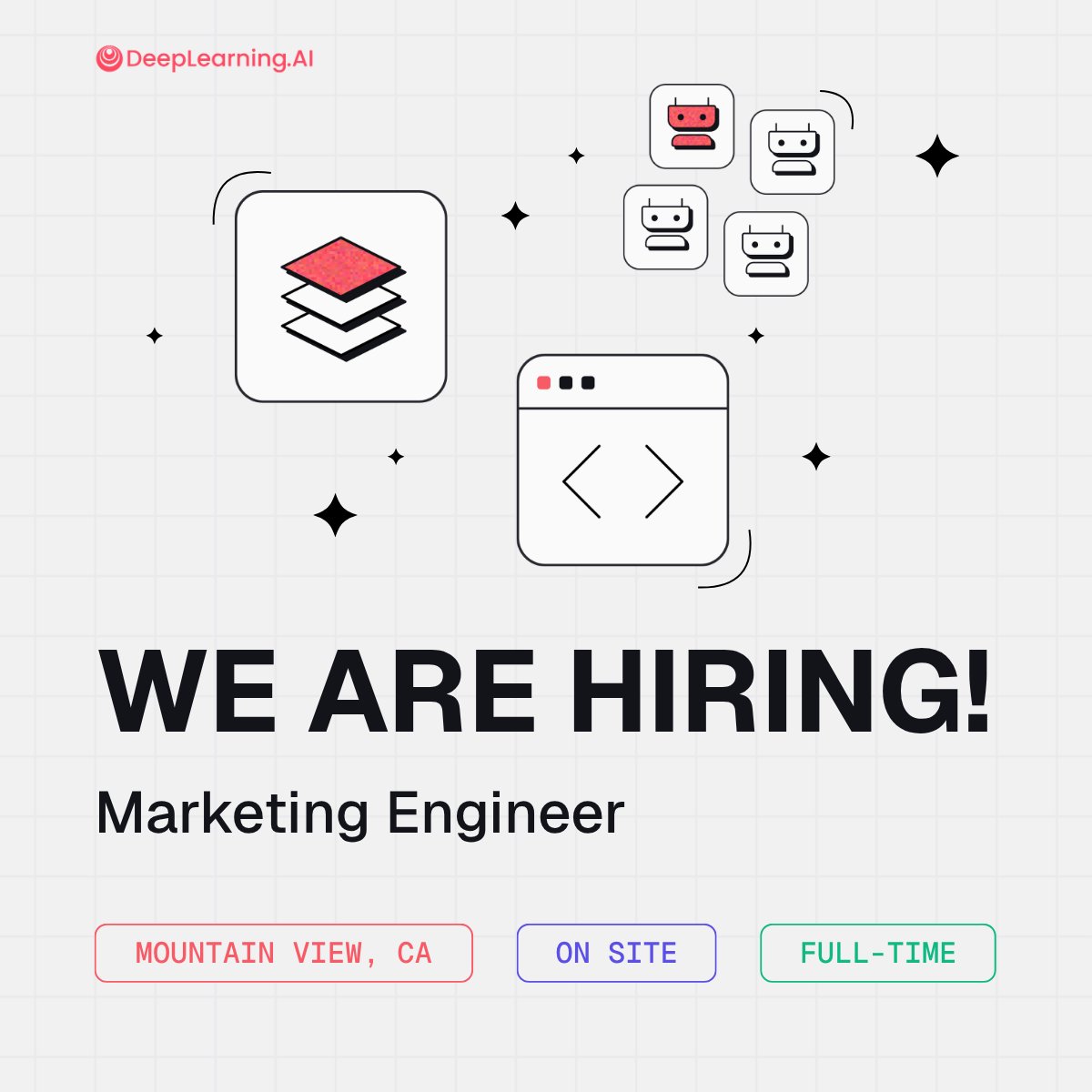
🚀 WE ARE HIRING: Marketing Engineer (Mountain View, CA)
We need an AI-native dev to build agentic workflows, automations, and tooling to help our marketing team operate at scale. Work hands-on with our AI engineering team! 🤖
Full details & apply here: (https://t.co/veqdcOaBdR).
#AI #Hiring #TechJobs #MarketingEngineer #DeepLearningAI
We love seeing our learners reach new milestones! 🚀
Huge congratulations to Omar Wael for completing the Machine Learning Specialization! We’re thrilled to see such thoughtful reflections on their journey—take a look at this highlight from Omar's recent post below.
Read Omar's full post on our forum to hear more about their experience: Reflections on completing the Machine Learning Specialization https://t.co/pQs8oBACKZ
#DeepLearningAI #MachineLearning #LearnerSpotlight #Education #AICommunity
We're deciding what to build next. 🏗️
We'd rather hear what matters to you most than guess. 10 minutes of your time will directly shape the courses and technical frameworks you want us to make next.
Take the survey: https://t.co/6OoThQdZpu
#MachineLearning#AI#DeepLearningAI
Your AI coding agent comes with defaults: which model runs, what you pay, and what leaves your machine. You can turn those defaults into choices.
In our new short course, AI Coding Workflows: From Cloud to Local, built in partnership with @JetBrains and taught by @paulweveritt, Developer Advocate at JetBrains, you'll rebuild the same app across cloud, hybrid, and fully local setups.
Along the way, you'll split work across subagents, put cheaper models on the routine tasks, and finish with models running on your own machine.
Enroll for free: https://t.co/C2X4AEYA3y
AI can write more code than any team can review by hand, and a pull request can look fine while hiding a security issue or missing a requirement.
In our new short course, AI Code Review, built in collaboration with @QodoAI and taught by @nnennahacks, you'll learn the practices that make AI code review effective: review before you open a pull request, give the reviewer full context about your codebase, and triage findings by risk.
Then you'll build your own review agent, from a context engine that finds the right code to a team of specialized reviewers.
Enroll for free: https://t.co/ouU2lu3WDR
Fast inference makes a new class of real-time LLM applications possible.
In our new short course, Fast LLM Inference with Cerebras, built in partnership with @Cerebras and taught by @zhennydez, @duerr_seb, and @MilksandMatcha, you'll build them on the Wafer-Scale Engine, where a model's weights sit on-chip and tokens come out several times faster than a typical GPU setup.
You'll build a webpage that personalizes itself as users interact with it, assemble a multi-tool workflow that analyzes market signals in one response, and adopt habits for cleaner agentic coding with Codex.
Enroll for free: https://t.co/n5qcWhR4Yo
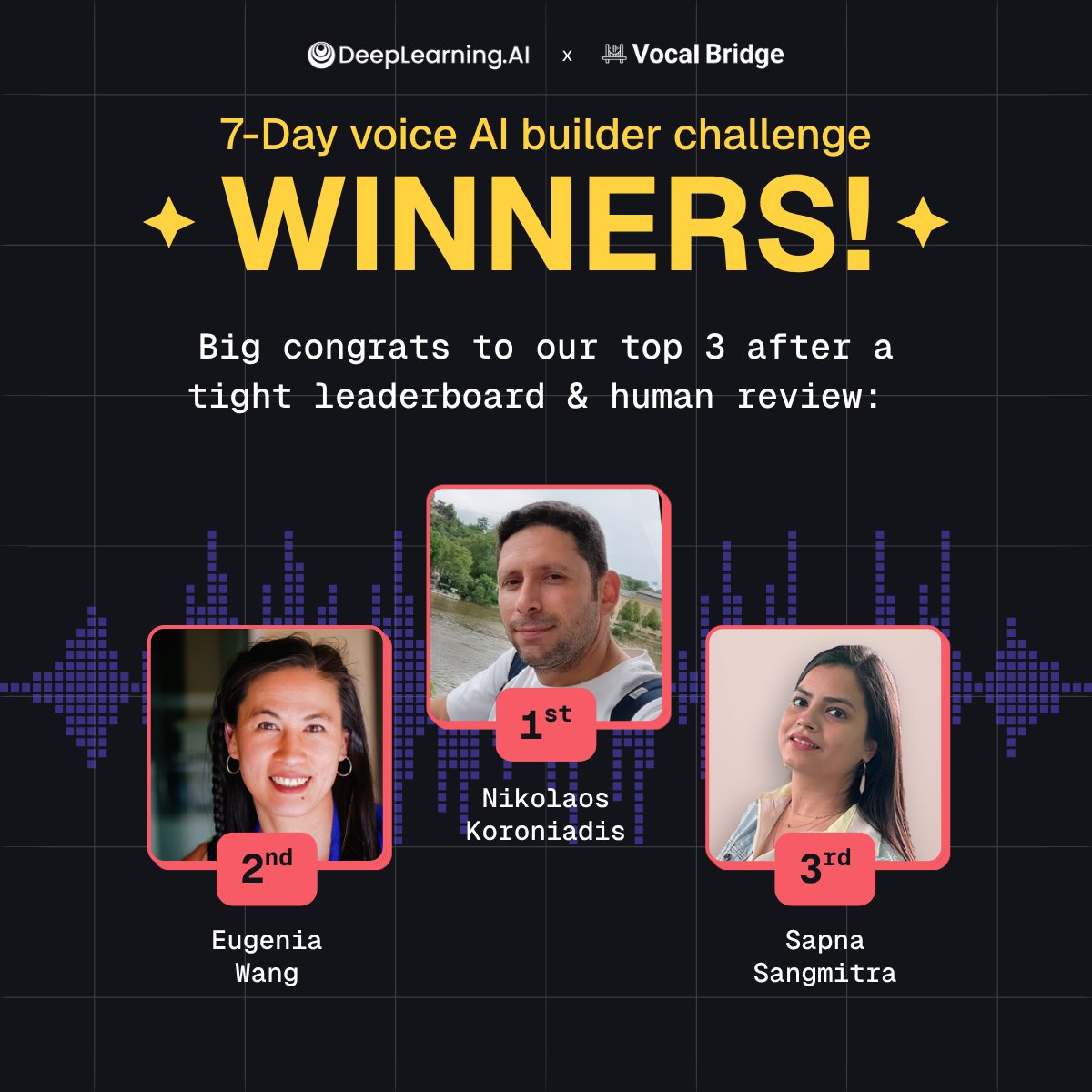
🎉 The results are in for the 7-day Voice AI Builder Challenge with @VocalBridge! Out of 500+ iterations and 38 unique submissions, these builders successfully taught AI agents to pick up the phone when they're stuck. 📞
Big congrats to our top 3, after a tight leaderboard & human review:
🥇 Nikolaos Koroniadis
🥈 Eugenia Wang
🥉 Sapna Sangmitra
🎓 Learn the Voice AI Tech that powered the challenge: https://t.co/D7zER0SDr2
🔔 Save your spot for the next challenge here: https://t.co/gaFZgeIh5U