Permanent interfaces for temporary work are so 2025.
To cut next quarter’s software spend, I need a chart, an editable budget, and an approval queue.
When the job is done, the interface can go. The decision logic and context can be codified. This is what I see coming in the near future, and both OpenAI and Anthropic have already announced a version of this.
Software and UI will assemble around tasks. Every SaaS CEO should prepare for that.
Reverse Engineer Anything is actually insane. I ran it on Deepnote over the weekend.
The results blew my mind. I open-sourced it all here: https://t.co/GwxbP2jpCf
We're so back, it's so over.
I am trying out a new way of working with agents. I give them business context, a clear goal, and authority over two-way door decisions. If we can undo it, they shouldn’t wait for me; they should keep going.
If the agent thinks it needs to make a decision and it’s a one-way door (e.g., changing pricing, buying tools, signing contracts), it goes into a queue I review each morning. They keep working on something else until I review it.
If the agent thinks the decision is a two-way door (e.g., choosing a new landing page layout, rewriting internal policies), it makes a judgment call. The decision gets logged, and I review it next morning.
The agent always works, never gets blocked. The number of things I’m building this way is crazy. This is the way to build products and companies in 2026 and beyond.
Six analysts serve 1,000+ people at a company whose data stack grows with each acquisition. They unify the data and ship actionable insights with AI in Deepnote.
Atolls grows by buying other companies. In practice, that meant stitching CSVs together in Jupyter and sharing screenshots in Confluence.
So, they moved those workflows into Deepnote.
What changed:
1. Data sources sit side by side in one workspace.
2. Analyses reach stakeholders the same day, down from 1–3 days.
3. Self-serve data apps save them 8–10 hours a week on recurring requests.
Now the team has more time for deeper analysis and has already shipped their first machine learning models into production.
Huge thanks to the Atolls team for trusting us with their critical workflows.
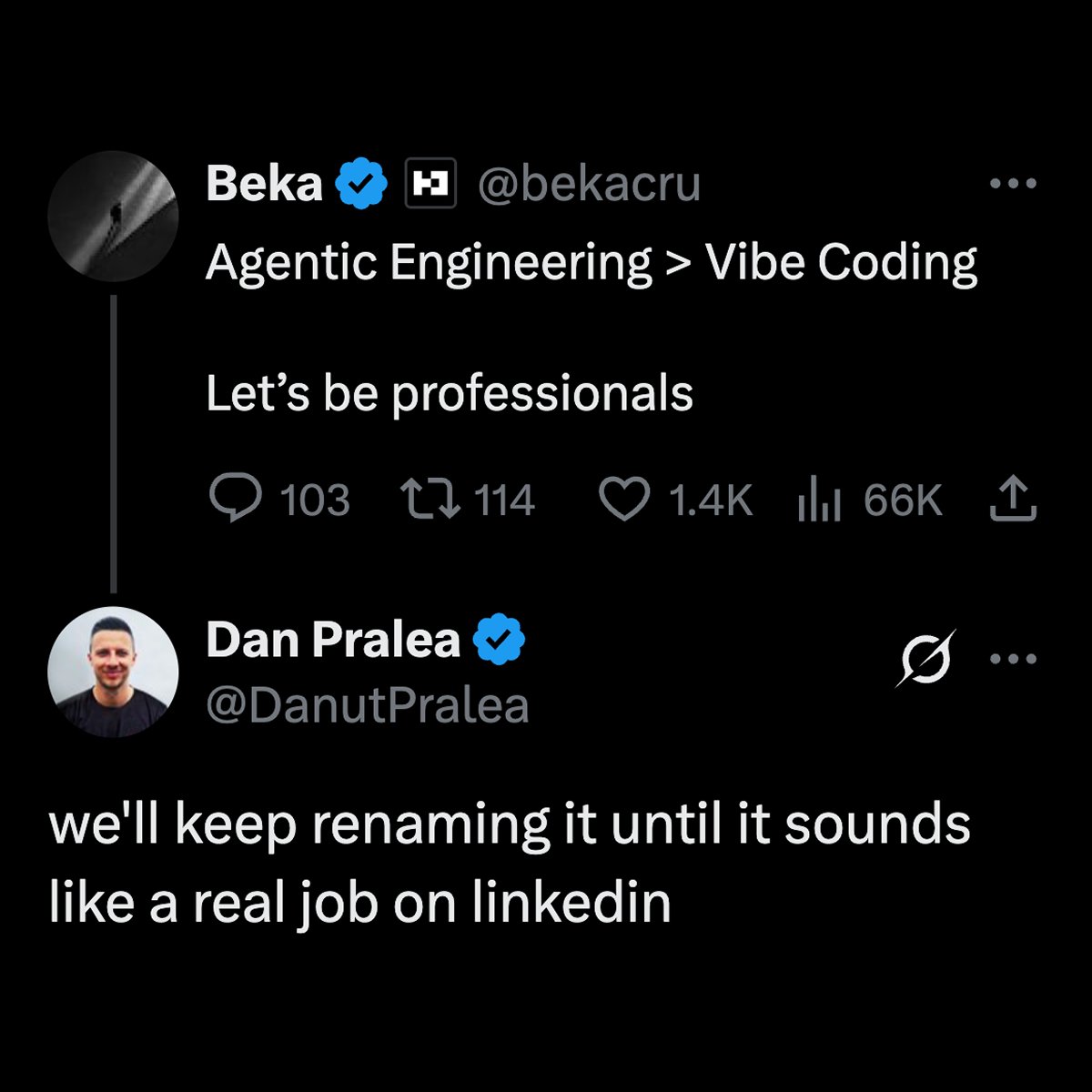
We’ve moved on from vibe coding to agentic engineering.
Vibe coding = you don’t write the code, you don’t read the code. Code has security holes and hallucinations. Can be used for prototypes, nothing else.
Agentic engineering = you don’t write the code, you don’t read the code. But the code is better than code written by a human. You can guarantee it’s correct. You can build large systems.
Every week, there is a new startup building its own harness.
But the best harnesses will be built by the labs. They control the models and can optimize both together. They also have a strong incentive to build the best harness.
So if you’re building a harness, we’re now back to startup 101: pick a niche. Not too small so there is enough revenue. Not too big so you don’t get outcompeted by a giant with more resources and better distribution.
@OpenAI just launched the Data agent in ChatGPT Work, with @DeepnoteHQ available as a native connection.
Connect Deepnote to bring the data sources and context your team already uses into the conversation, then explore your company’s data, build interactive data apps, or take action.
To get started, add the Data Plugin and Deepnote in ChatGPT Work, and start your exploration: https://t.co/8WoTohzhei
Special thanks to Charles Wang, Steve Imm, Oliver C., and Shaina Li for the collaboration.
In a year, you won't know which model you're running.
Fifteen years ago, people looked for a Pentium or Celeron sticker before buying a laptop. Then chips got fast enough that the sticker didn't matter anymore.
Models are heading the same way. Most tasks don't need the frontier, and routing to a cheaper model saves a lot of money. As a result, I believe that by the end of the year we will no longer pay per token but per some obscure intelligence unit.
ChatGPT is currently testing hiding models from you, with Sol as a default and lower-capability models being routed to. I think this will soon become the new norm for all providers.
Do we need one more black box in AI?