Author of Blood Island: An Oral History of Marichjhapi Massacre (2019), Being Hindu in Bangladesh (2023) and other books. Contributing Editor @ThePrintIndia
New Book Alert: On June 7, 2025, we spoke to Sheikh Hasina over the phone. Almost a year had passed since she fled Bangladesh and came to India and we wanted to know what she felt about Bangladesh without her in power. Hasina told us what she thought about the July Revolution and Bangladesh under Muhammad Yunus. We also spoke to her ministers, members of her security detail, and officers in Bangladeshi military intelligence still loyal to her who helped @joyincal09 recreate the scenes inside Haina's official residence on the day she left.
We also spoke to Hasina's political opponents who told us why she had it coming for a long time.
But our book is not about Hasina, her mistakes or her political future.
'Inshallah Bangladesh' is about the extraordinary events of 2024 that changed the lives of Bangladesh's ordinary people. Like my co-author @SahidulKhokonbd who became an anti-national for writing against radical Islam and had to run for his life, and the 266 other journalists like him implicated in various cases.
It is about young women who are afraid of playing football, and Sufis who watch helplessly as their mazars are pulled down, and Hindus who are trying to get used to hearing open calls of genocide. And young military officers trying to make sense of a General's betrayal.
The book is also about past fissures shaping present politics. About stories that are not published. Like a dystopian novel about Sheikh Mujib finding currency after Hasina's fall. About the call for a Hindu homeland that is as old as the call for Bangladesh. About atheist bloggers once forced out of Bangladesh returning to save Bangladesh's soul.
If the July Revolution promised a New Bangladesh, our book examines why the students' party that emerged from it is already so unpopular. Inshallah Bangladesh is the story of an unfinished revolution that did not begin in 2024. @swatichopra1@juggernautbooks
Here's the preorder link: https://t.co/kP0S7JB9Cg
My grandmother was 12 years old during the Noakhali riots. I have heard stories of her spending the night at Feni College with her sister in her lap during the riots. Kamma left us three years ago.
80 years have passed. Kojagori Lakkhi Pujo. A full moon night.
@deepscribble
Photo Exhibition.
This is a project very close to my heart. In this exhibition are images made over almost three decades and I would love for you to see it.
My relationship with Calcutta began in January 1998, when I arrived from Delhi aboard the Rajdhani Express and stepped out into the bustle of Howrah. It was love at first sight. An early encounter sparked a connection that would develop into a longstanding photographic pursuit.
No Refusal is an attempt to preserve a fragment of the city’s lived experience through photography. These images reflect the impermanence of familiar urban landmarks, and the ways in which seemingly ordinary objects become repositories of collective memory.
In 2023, I wrote Being Hindu in Bangladesh with @ProfAvishek. We interviewed Hindus who are in Bangladesh today and also those who have escaped. Avishek's own family members are survivors of the Noakhali massacre of 1946. Three generations later, it still haunts them.
NOAKHALI MASSACRE, 1946: THE KOJAGORI LOKHKHI PUJA THAT TURNED INTO A NIGHTMARE FOR BENGALI HINDUS
Today is Kojagori Lokhkhi Puja, one of the most sacred and emotionally significant days for us Bengali Hindus.
Eighty years ago, on this very festival, our ancestors in Noakhali, East Bengal (now Bangladesh), were massacred.
The Noakhali Massacre began on 10 October 1946, the day of Kojagori Lakshmi Puja.
I do not commemorate Noakhali on 10 October every year. For me, its anniversary is Kojagori Lokhkhi Puja itself.
It was on this sacred day that Muslim mobs unleashed violence against Hindu villages.
Hindus were murdered, women raped and abducted, houses looted and burned, temples desecrated, and people forcibly converted to Islam.
The violence spread across Noakhali and neighbouring Tippera (now Comilla).
Golam Sarwar, a former Muslim League legislator, emerged as one of the principal instigators.
Entire villages were devastated. Thousands fled their ancestral homes. Contemporary reports described mass conversions, sexual violence, killings and widespread destruction.
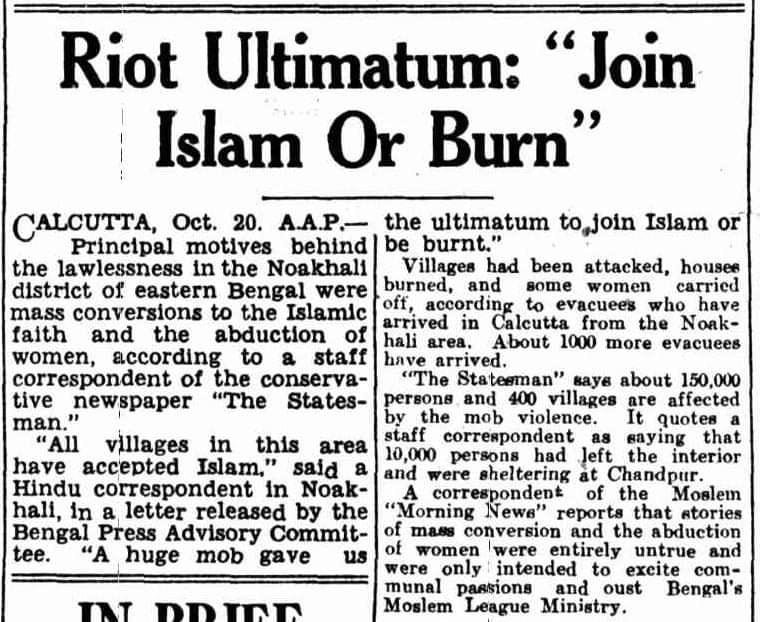
1. “RIOT ULTIMATUM: JOIN ISLAM OR BURN”
OUR ANCESTORS, TOO, HAD THEIR RALIV, GALIV YA CHALIV MOMENT IN HISTORY.
An Associated Press report dated 20 Oct 1946, citing The Statesman, described mass conversions to Islam and the abduction of Hindu women.
The report stated that approximately 150,000 people across 400 villages had been affected by the violence.
It quoted a Hindu correspondent from Noakhali describing an ultimatum from a mob to convert to Islam or be burned.
2. THE TELEGRAM FROM NOAKHALI
A telegram dated 17 Oct 1946, sent from Chaumuhani to the Bengal Provincial Congress Committee, reported that murder, looting, arson and forced conversions were continuing.
It warned:
“Unconverted people are being slaughtered on mass scale.”
The telegram also reported starvation and the failure of local authorities to provide protection, demanding immediate military intervention.
3. GANDHI AND THE WOMEN OF NOAKHALI
On 18 Oct 1946, after being informed of the atrocities, Gandhi spoke about the plight of women in Noakhali.
Gandhi suggesting that self immolation by taking poison was preferable to surrendering to dishonour.
4. WOMEN CHOSE DEATH OVER SEXUAL VIOLENCE & DISHONOUR
In 1946: The Great Calcutta Killings and Noakhali Genocide, Dr. Dinesh Chandra Sinha and Ashok Dasgupta reproduce these statements on page 266.
The book also quotes the Hindusthan Standard, which reported that women in Noakhali, desperate to escape sexual violence, had jumped into fires, taken poison or hanged themselves.
Gandhi visited Noakhali in Nov 1946 and undertook his peace mission. But the killings, forced conversions, displacement and trauma had already devastated Hindu communities.
5. “QUIT NOAKHALI OR DIE, GANDHI WARNS HINDUS”
Even six months later, on 8 April 1947, The New York Times published a report under this headline.
It described continuing threats against Hindus, including attempts to burn them alive.
The terror had not simply disappeared.
6. THE HUMAN REMAINS OF NOAKHALI
One of the photographs attached to this post shows human skeletal remains in Noakhali following the communal violence.
It is preserved in the Bridgeman Images archive, sourced from Dinodia, with the description:
“A human skeleton at Noakhali East Bengal after the riots between Hindus and Muslims, November 1946.”
Archive reference: DND2561152.
This is not an illustration. It is an archival photograph documenting the aftermath of the violence.
For Bengali Hindus, Noakhali was not simply another communal riot. It was an assault on their lives, their faith, their women, their homes and their right to exist in their ancestral land.
And the timing makes it particularly painful.
Kojagori Lokhkhi Puja is the night when Bengali Hindu families worship Maa Lakshmi, light their homes and pray for peace, prosperity and the well being of their loved ones.
NOAKHALI, 1946. NEVER FORGET.
दुर्गा पूजा के बाद तारिक रहमान की असली परीक्षा—हसीना की वापसी, हिंदू वोट और इस्लामवादियों के फरमान
दिप्रिंट के लिए दीप हलदर @deepscribble लिखते हैं
#ThePrintOpinion
https://t.co/VuK9z8x25f
'Piyush Pandey brought the language of small towns into ad agency corridors'
On his death anniversary, read #ThePrintOpinion by Prasoon Joshi @prasoonjoshi_
https://t.co/lZtu4mtoFQ
Compared with Durga Puja 2025, passenger traffic in #Kolkata’s suburban and metro rail sections rose by 32–33% during Durga Puja 2026. The city has a shrinking population and a low share of young people. The rise is attributable largely to an influx of people from the suburbs. The passenger data corroborates reports of a 25–40% year-on-year rise in Puja sales by eateries. Food and beverage sales hit an eight-year high.
The sharp spike in footfalls challenges theories of a ‘lack of Pujo vibes’ and offers some explanation for the Chorbagan #stampede. I did not go out for pandal hopping. However, inputs from friends suggest that crowd distribution among pandals may have shifted this year. This could partly explain why traffic police bandobast was not at its usual best in the early days of the celebrations.
I hope the authorities will conduct a deep dive into the data to prepare for the 2027 Durga Puja season.
#DurgaPuja2026
'Tarique Rahman’s real test after a grand Durga Puja – Hasina’s return, Hindu votes, Islamist diktats'
Deep Halder @deepscribble writes
#ThePrintOpinion
https://t.co/HUuztYH2ao
Dev Prabhakar Singh Tomar is the grandson of an infamous Chambal dacoit. After four attempts at UPSC, three interviews and years of preparation, Tomar secured an AIR of 629.
The Chambal region, which straddles the borders of Madhya Pradesh, Rajasthan and Uttar Pradesh, has long been synonymous with two things—its rugged ravines and the dangerous dacoits that dwelled in them.
One can leave Chambal to escape the poverty and caste conflict that plagues the region, but the dacoit tag is far more difficult to shed. It follows you everywhere.
Tomar’s grandfather accepted state amnesty and surrendered back in 1972. But his Chambal links followed Tomar through school, college and higher studies.
His way of overcoming the stigma was to study hard, score well in his exams and find a good job.
To know what pushed him to prepare for civil services, read this report by Himanshi Aggarwal:
https://t.co/zz5ZroI7bE
979 Bangladeshi women returned from Saudi Arabia in just nine months after facing physical, mental and sexual abuse.
Behind every number is a woman who left home with hope, often to escape poverty and support her family. Many returned traumatised, exploited and robbed of the future they had worked for.
This is not an isolated incident. Reports over the years have documented abuse, unpaid wages, exploitation and failures to protect vulnerable migrant workers. The same stories keep returning, while accountability remains a serious concern.
Meanwhile, two Bangladeshis were beheaded in Saudi Arabia for expressing their love in public, and Bangladesh was reportedly informed only after their executions.
The ugly hypocrisy of Saudi Arabia’s Sharia-based legal system raises a serious question: Is this justice in the name of Islam, or a betrayal of the very principles of justice and humanity?
Good points. A little context: NSG was designed after much debate under core police-army-civil team to follow the broad structure if German anti-terror group GSG9. This was given its IPS against the Baadee-Meinhof Gang if I remember corrected. Others, SAS, US spl forces and the Israeli anti-terror groups were seem as too military. The larger motivation was to keep it still in a police structure, led by a senior cop. This was the lesson, and a response to Op Bluestar that drew enormous controversy and embarrassment for the Army. The idea was now to keep the Army out of counter-terror except in live insurgencies.
Once the German design was chosen for the new institution, GSG standard weapon became the first choice. That the Germans later pulled out spares and support was a bitter lesson learnt. Of course now the sane Germans will sell anything to India and also buy loads of ammunition esp 155mm artillery shells. But that’s if only if we’d sell to them.
That equation has changed. And brave risk-taking entrepreneurs like you are one if the reasons for this.
Thank you @sardesairajdeep for your grudging endorsement of my stand. It is precisely because we have imbibed the traditional Bengali reverence for books that we are appalled. That is why the BJP defended the likes of Salman Rushdie (he got his visa back during the Vajpayee govt) & Taslima. This tradition of Hindu pluralism has guided us and not those who feign a liberal inheritance. Happy Vijayadashami.
दिनेश त्रिवेदी ने वही किया, जिसकी भारत की बांग्लादेश नीति को जरूरत थी—ढाका को बैकफुट पर ला दिया
दिप्रिंट के लिए दीप हलदर @deepscribble लिखते हैं
#ThePrintOpinion
https://t.co/T8soxUXRpQ
'Blood Island' by @deepscribble on the Marichjhapi massacre is a great introduction to the violent, Communist State-sponsored eviction and genocide of thousands of Bengali Hindu Dalit refugees in post-independence India, under the CPM's Jyoti Basu regime in West Bengal.
Excellent work by @SuvenduWB in setting the record straight and holding the Communists on trial in the court of memory, right from the original sins.
✊🏼
Marichjhapi massacre of Dalit refugees becomes Durga Puja theme in Kolkata pandal
We should thank @deepscribble for writing the book ‘Blood Island’ on the forgotten massacre of Dalit refugees on a faraway island in the Sundarbans during 1978-79.
Most Indians were completely unaware of this massacre. Even those who claim to be champions and messiahs of the Dalit cause remained silent about it.
https://t.co/P6zeHsJ8cW
Several feared dead in a durga puja pandal on saptami in #kolkata
Massive crowd resulted in stampede like situation and chorbagan puja pandal has been shut
Please pray for the families…